
Air moves from areas of high pressure to low pressure, creating winds. Uneven heating of the Earth's surface by the sun causes differences in air pressure, leading to wind movement. Winds play an important role in weather patterns, the distribution of heat, and rainfall. Strong winds can cause damage, and extremely strong winds form storms and cyclones. A thunderstorm is a storm with thunder, lightning, and heavy rain, often accompanied by strong winds. This One Word Quiz for Winds, Storms, and Cyclones Class 8 examines atmospheric phenomena and disaster preparedness strategies. A cyclone is a large-scale system of rotating winds that forms over warm ocean waters. Cyclones can cause severe destruction through high-speed winds, heavy rainfall, and storm surges. Monitoring weather using satellites and radar helps in predicting cyclones and issuing timely warnings. Safety measures include staying indoors, avoiding coastal areas, and following official instructions. Learning about winds, storms, and cyclones helps students understand atmospheric science, weather forecasting, and disaster preparedness. Take these 10 multiple-choice questions to test your understanding.
Mark each statement as True or False: 1. Vacuum cleaners work by creating low pressure inside them. 2. Fast-moving air molecules collide more frequently and increase pressure. 3. Cyclones always form near the poles.
Answer: (a) 1-T, 2-F, 3-F
Rick observed that as the air around a candle flame gets heated, the flame leans in one direction. He concludes that wind is blowing due to air movement. What scientific principle best supports his observation?
Answer: (d) Warm air rises, creating low pressure
Study the flowchart and identify the "X".
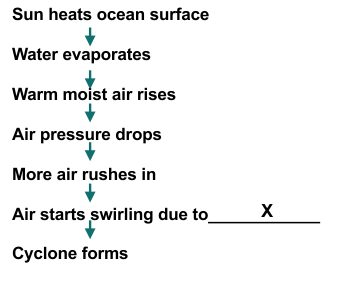
Answer: (d) Earth’s rotation
A barometer reading steadily rises over two days. What does this most likely indicate?
Answer: (b) Improving weather with clear skies
Which sequence of events leads to a tornado?
Answer: (b) Warm moist air rises rapidly → Cold dry air meets it → Air spins violently → Funnel cloud forms
During cyclone warnings, windows are tightly shut and objects are removed from rooftops. Which principle of air pressure justifies this?
Answer: (b) High-speed winds outside create low pressure, which can cause inside air to burst outward
Choose the set of statements that are INCORRECT based on the diagram and your knowledge of cyclones.
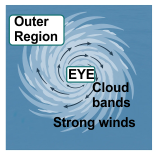
Answer: (c) The wind moves inward towards the low- pressure centre in a straight line without any rotation
Which of the following sequences best explains the formation of a thunderstorm using the simplified key below? Key: 1 – Warm moist air rises rapidly 2 – Air cools, condensation occurs, and clouds develop 3 – Intense heating of the ground by the Sun 4 – Strong upward currents and electrical charges cause thunder and lightning
Answer: (a) 3 → 1 → 2 → 4
Study the given assertion and reason carefully and choose the correct option. Assertion (A): Thunderstorms are typically found in hot and humid tropical areas. Reason (R): The formation of thunderstorms requires moisture, unstable air, and a mechanism for the air to rise.
Answer: (a) Both A and R are true, and R is the correct explanation of A.
A person living near the coast notices cool wind entering their home every afternoon. What is the most scientific explanation?
Answer: (c) Land heats up faster, creating pressure difference