Light is a form of energy that enables vision and travels in straight lines at a speed of approximately 300,000 kilometres per second. Light can be reflected, refracted, or absorbed by materials. Reflection occurs when light bounces off a surface. Mirrors reflect light to form images. Regular reflection from smooth surfaces produces clear images, while diffuse reflection from rough surfaces scatters light. Refraction is the bending of light when it passes from one medium to another of different density, which is why objects appear bent in water. This Quiz on Light for Class 8 explores these optical phenomena and the functioning of various optical instruments. Lenses use refraction to focus or disperse light. Dispersion is the splitting of white light into its constituent colours, forming a spectrum. The human eye is a natural optical instrument that focuses light to form images. Learning about light helps students understand optics, vision, and optical instruments. Take these 10 questions to test your knowledge.
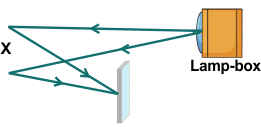
In the given ray diagram, point X represents the position where reflected rays meet. What does X most likely represent?
Answer: (c) The focal point
When a person observes their full reflection in a clean, flat bathroom mirror while raising their right hand, they notice that their reflection appears to raise its left hand. Which of the following best describes the nature of the image formed?
Answer: (d) Virtual, laterally inverted, upright
An object is placed in front of a convex mirror. What is the most accurate description of the image formed?
Answer: (c) Diminished, virtual, and upright
Match the mirror type in column A with image type likely to form in column B: Mirror Type Image Type Likely to Form A Plane mirror 1 Virtual and magnified (when close) B Shaving mirror 2 Virtual, erect, wide field view C Convex mirror 3 Always real, inverted, can be magnified D Rear view mirror 4 Always virtual, erect, diminished
Answer: (b) A- 3, B- 1, C- 4, D- 2
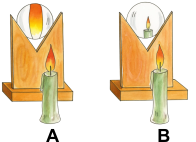
What kind of image is formed in Setup B when the candle is moved farther from the mirror?
Answer: (a) Real and inverted
If the speed of light is highest in medium M and lowest in medium O, which order of optical density is correct?
Answer: (a) M < N < O
A student places two identical glass prisms next to each other with their bases opposite. What will happen to the dispersed colours from the first prism?
Answer: (b) They will recombine into white light
If an object is moved from infinity towards the pole of a concave mirror, what happens to the image?
Answer: (d) It moves from focus to mirror and becomes virtual eventually
Read the statements and choose the correct option: Assertion: A concave mirror can be used to concentrate light to a single point. Reason: A concave mirror converges parallel light rays to a focal point due to the curved shape of its surface.
Answer: (a) Both assertion and reason are correct, and the reason explains the assertion.
If a light source is moved closer to an object, what happens to the size of the shadow cast by the object?
Answer: (a) The shadow becomes larger and sharper