Mixtures are combinations of two or more substances that are not chemically bonded and retain their individual properties. Separating mixtures into their components is important in daily life and industries. The method of separation depends on the physical properties of the substances involved. Handpicking is used for large, visible impurities. Threshing separates grains from stalks. Winnowing separates lighter particles like chaff from heavier grains using wind. This Sorting and Separation of Materials Quiz for Grade 8 examines various separation techniques and their practical applications. Sieving separates particles of different sizes. Sedimentation and decantation separate insoluble solids from liquids. Filtration is used for finer particles that do not settle quickly. Evaporation recovers dissolved solids from solutions. Distillation separates liquids with different boiling points. Chromatography separates dissolved substances. Learning about separation techniques helps students understand practical chemistry and develop analytical and problem-solving skills. Take these 10 questions to test your knowledge.
Which of the following cannot be separated using magnetic separation?
Answer: (b) Aluminium chips from iron scraps
A student is given a mixture of kerosene, water, and sand. Which of the following is the most effective and correct order to separate all three components?
Answer: (d) Filter to remove sand, allow the liquids to settle, then use a separating funnel for kerosene and water
Which of the following statements about thermal conductivity is true?
Answer: (d) Metals generally have high thermal conductivity due to the mobility of their electrons.
During a materials lab, a student observes the following about one sample: 1. It does not bend under pressure. 2. It cannot be scratched by a metal rod. 3. It does not break when dropped, but it also does not flex at all. Based on these combined observations, which property is most dominant in this material?
Answer: (a) Hardness
Which method fails if both components of a mixture are equally soluble in the same solvent?
Answer: (c) Crystallisation
A mixture of liquid A and solute B is heated. Which method ensures recovery of both A and B separately without any loss?
Answer: (c) Distillation
Which of these describes a compound, not a mixture or element?
Answer: (b) Carbon dioxide formed by heating limestone
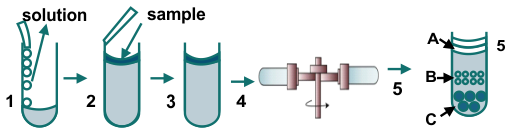
The diagram shows the steps of a centrifugation experiment used to separate a mixture of different particles suspended in a liquid. After the tube is spun in the centrifuge (Step 4), three distinct layers (A, B, and C) are formed in Step 5. Which of the following best matches the correct identification of the layers A, B, and C formed after centrifugation?
Answer: (b) A – Supernatant (clear liquid); B – Lighter solids; C – Heavier solids
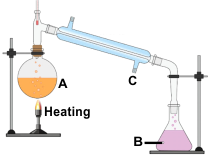
The long horizontal tube labelled C is surrounded by cold water. What is the name and function of this part?
Answer: (a) Condenser; condenses vapour into liquid
Which pair correctly matches one element and one compound from everyday life?
Answer: (a) Oxygen and water