The environment consists of all biotic and abiotic factors that influence living organisms. Natural resources like air, water, soil, forests, minerals, and fossil fuels are gifts of nature that support life and economic activities. Resources can be renewable, like solar and wind energy, or non-renewable, like coal and petroleum. Over-exploitation of resources, pollution, deforestation, and habitat destruction have led to environmental degradation and loss of biodiversity. This Environment Quiz for Class 8 addresses conservation strategies and sustainable development practices comprehensively. Conservation involves the sustainable use and protection of natural resources through practices like afforestation, rainwater harvesting, reducing waste, recycling, and using renewable energy. The concept of sustainable development aims to meet present needs without compromising future generations. Learning about the environment and conservation helps students develop environmental awareness, responsibility, and commitment to protecting the planet. Answer these 10 questions to assess your understanding of environmental science and conservation.
If all forests in a hilly region are cleared, which of the following sequences is most logically expected to happen?
Answer: (b) Flooding → Soil erosion → Loss of biodiversity
Read the statements carefully and select the option that best matches all of them: It does not have teeth. It breaks down what others leave behind. It is invisible to the naked eye but essential for life. It plays a key role in recycling nutrients within ecosystems.
Answer: (c) Bacteria
If rats chew grains in your storeroom and snakes are seen around, what part of the food chain is this an example of?
Answer: (b) Producer → Herbivore → Carnivore
Read the given statements and choose the correct option. i. Energy decreases at each higher trophic level. ii. A hawk can be both a secondary and tertiary consumer. iii. Decomposers directly consume producers. iv. Food chains always start with carnivores.
Answer: (b) Only iii & iv are false
A student is learning how forests support the environment and uses the decision key below to classify their functions A, B and C Step 1: Does the function involve oxygen? → Yes → Go to Step 2 → No → Go to Step 3 Step 2: → If it involves the release of oxygen → A = ? → If it involves the absorption of oxygen → B = ? Step 3: → If related to water movement in plants → C = ? → If not → D = Soil binding
Answer: (a) A – Photosynthesis, B – Respiration, C – Transpiration
Choose the analogy that best matches how the body processes these. "Air pollution : Lungs :: Water pollution : ?"
Answer: (d) Kidneys
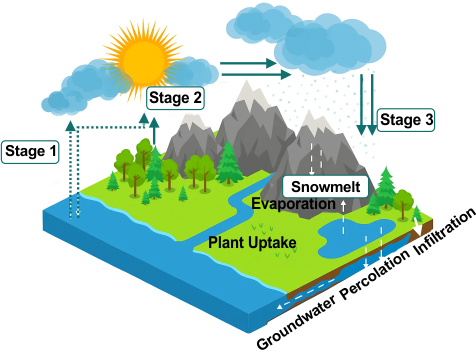
Match the following descriptions (Statements P–R) with the appropriate stages (1, 2, or 3) based on your understanding of the processes shown: Statements: P. This step reduces the water content of surface water bodies and increases atmospheric humidity. Q. This process is responsible for converting invisible water vapor into visible cloud droplets, releasing latent heat. R. This step is directly influenced by gravity and results in the replenishment of groundwater or river systems.
Answer: (a) P – 1, Q – 2, R – 3
A student sets up this filter: Gravel → Sand → Charcoal → Cotton → Beaker She pours muddy water and finds it still brown at the end. Which step should be corrected?
Answer: (d) Add a sedimentation step before filtration
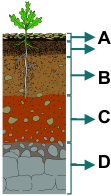
Observe the labelled diagram of soil layers. The labels A, B, C, and D represent different horizons. Match each of the following statements with the correct label. Statements 1. Contains large pieces of unweathered parent rock. 2. Rich in minerals but poor in organic content. 3. Dark in color due to decomposed organic matter; supports most plant roots. 4. Contains partially weathered rocks and little organic material.
Answer: (a) 1-D, 2-B, 3-A, 4-C
A city is experiencing a severe water shortage. The local government implements a policy to encourage rainwater harvesting and promote the use of drip irrigation in agriculture. Which of the following is the most logical short-term impact of these measures?
Answer: (c) A reduction in the rate of water table depletion.