
Nutrition is the process by which organisms obtain and utilise food for energy, growth, and repair. Plants are autotrophic and prepare their own food through photosynthesis using sunlight, carbon dioxide, and water. Animals are heterotrophic and depend on plants or other animals for food. Transportation is the movement of water, minerals, and food within organisms. In plants, xylem transports water and minerals from roots to leaves, while phloem transports food from leaves to other parts. This Nutrition and Transportation Quiz for Class 8 examines these vital life processes in both plants and animals. In animals, the circulatory system transports nutrients, gases, and wastes using blood. Respiration is the process of breaking down food to release energy. It involves inhalation of oxygen and exhalation of carbon dioxide. Learning about these life processes helps students understand how organisms sustain life and maintain their functions. Take these 10 questions to test your knowledge.
Read the given assertion and reason carefully and choose the correct option. Assertion (A): All insectivorous plants are autotrophs. Reason (R): Insectivorous plants contain chlorophyll and can perform photosynthesis to make their own food.
Answer: (d) A is false but R is true.
Use the dichotomous key below to identify the plants labeled A to D: 1a. Plant is green → go to 2 1b. Plant is non-green → go to 3 2 2a. Grows on another plant and absorbs water/minerals → A. 2b. Traps insects → B. 3 3a. Grows on dead matter → C. 3b. Lacks chlorophyll, parasitic → D.
Answer: (b) A–Mistletoe, B–Venus Flytrap, C–Mushroom, D–Cuscuta
Use the following dichotomous key to identify A, B, C, and D from the given animals. Then, choose the correct matching option. 1a. Feeds by chewing with mandibles → Go to 2 1b. Feeds by sucking or siphoning → Go to 3 2 2a. Has strong jaws and scavenges → A 2b. Uses beak to tear flesh → B 3 3a. Feeds on nectar using a long tongue → C 3b. Feeds on blood through piercing → D
Answer: (b) A – Ant, B – Eagle, C – Hummingbird, D – Mosquito
Observe the diagram of the human digestive system with labelled parts 1 to 5. Match each label with the correct statement below, and choose the option where all matches are correct. A. This part absorbs water and stores undigested waste before egestion. B. This long coiled structure absorbs most nutrients using villi. C. This muscular tube uses peristalsis to transport food to the stomach. D. This part begins mechanical and chemical digestion using teeth and salivary amylase. E. This part produces hydrochloric acid and pepsin for protein digestion.
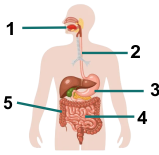
Answer: (b) A–4, B–5, C–2, D–1, E–3
Study the flowchart below that shows the steps of nutrition in Amoeba. Identify the option where the sequence or description of a step is incorrect. Step 1 → Formation of pseudopodia to surround the food particle Step 2 → Formation of food vacuole inside the nucleus Step 3 → Enzymes are secreted into the food vacuole to digest the food Step 4 → Digested food diffuses into the cytoplasm for assimilation Step 5 → Undigested food is expelled out of the body
Answer: (a) Step 2 is incorrect
Which of the following best describes the changes that occur in your body when you blow air into a balloon forcefully?

Answer: (c) Chest cavity volume decreases, internal pressure increases, and air is pushed out through the mouth.
Identify the odd pair out based on their method of respiration.
Answer: (d) Leech and Earthworm
During a school experiment, a student wraps a transparent plastic bag around a leafy branch of a plant in sunlight and ties it tightly. After a few hours, water droplets are seen inside the bag. Another student does the same setup during the evening but finds no droplets inside. However, when tested chemically, carbon dioxide is still being released from the leaves inside the bag. Which conclusion can be drawn from the second observation?
Answer: (c) The plant continued respiration but not photosynthesis at night.
Observe the diagram of the human heart showing parts marked 1, 2, 3, and 4. Match them with the correct functions from the statements below: Statements: A. Receives deoxygenated blood from the body. B. Pumps oxygenated blood to the rest of the body. C. Receives oxygenated blood from lungs. D. Sends deoxygenated blood to the lungs. Which of the following options correctly matches the markings to the statements?
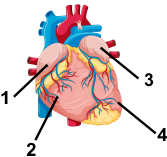
Answer: (c) 1-A, 2-D, 3-C, 4-B
Use the dichotomous key below to identify the correct structure based on its description. Dichotomous Key: 1a. Structure stores a liquid temporarily before it is excreted → go to 2 1b. Structure does not store, but either transports or filters liquid → go to 3 2 2a. Structure expands when filled and contracts during release → Option A 2b. Structure is a narrow tube allowing the liquid to exit the body → Option B 3 3a. Structure filters unwanted substances like excess water and salts → Option C 3b. Structure connects two organs, acting as a conduit for urine → Option D
Answer: (a) A – Urinary Bladder, B – Urethra, C – Kidney, D – Ureter