Fibres are flexible, thread-like structures that are spun into yarn and woven or knitted into fabric. Natural fibres are obtained from plants, such as cotton from cotton bolls and jute from jute plants, or from animals, such as wool from sheep and silk from silkworms. Each natural fibre has unique properties and requires specific processing methods. Synthetic fibres like polyester, nylon, rayon, and acrylic are manufactured from chemical substances, primarily petroleum-based products. This Fibre to Fabric Quiz for Class 8 examines the properties and processing methods of both natural and synthetic fibres. Synthetic fibres are strong, durable, easy to maintain, and dry quickly, but they may not be as breathable as natural fibres. The textile industry involves various processes, including ginning, spinning, weaving, knitting, dyeing, and finishing. Learning about fibre to fabric helps students understand material science, the textile industry, and the advantages and disadvantages of different types of fibres. Answer these 10 questions to test your knowledge.
A student wears a nylon shirt while playing outside in summer. After some time, he feels very uncomfortable and sweaty. What could be the most scientific reason behind this discomfort?
Answer: (c) Nylon traps body heat and doesn’t absorb sweat.
The diagram shows the process of fibres being pulled and twisted into a yarn. Which process is represented, and what property does it give to the yarn?
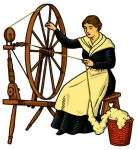
Answer: (b) Spinning; strength and flexibility
A silk farmer raises silkworms for high-quality silk production. The farmer knows that if cocoons are collected too early, the silk threads are weak and incomplete. If collected too late, the moth emerges. If a silk farmer wants to harvest silk at the correct time, when should they collect the cocoons?
Answer: (c) After 35 days
Which of the following is not used for spinning yarn?
Answer: (d) Powerloom
Arrange the following fibres in descending order of their ability to absorb water (most to least): 1. Cotton 2. Wool 3. Polyester 4. Nylon
Answer: (a) 1 > 2 > 4 > 3
A town banned plastic carry bags and encouraged eco-friendly alternatives. A shop started using bags made of fibre X. Fibre X is: Derived from plant stalks Biodegradable Tough and coarse What is Fibre X most likely to be?
Answer: (b) Jute
A student burns a fibre and notes the following: It shrinks from the flame Gives off a chemical odour Melts before burning Forms hard black bead on cooling Which fibre is being tested?
Answer: (c) Nylon
Which of the following does NOT justify the use of silk in luxury fabrics?
Answer: (d) Fire resistance
Given is the flowchart for the process of making cotton. Identify which step is missing?
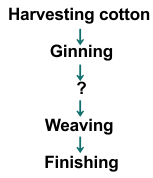
Answer: (b) Spinning
The bar graph below shows the burn rate of four unidentified fibres labeled A, B, C, and D. Using your knowledge of how different fibres behave when burned, identify which fibre corresponds to each label. The fibres are: Nylon, Polyester, Wool, and Cotton.
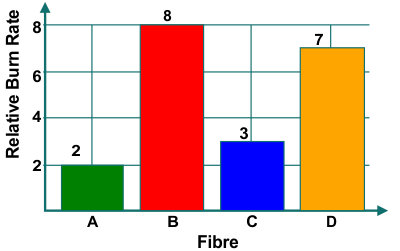
Answer: (a) A - Wool, B - Cotton, C - Polyester, D - Nylon