Heat is a form of energy that flows from a hotter object to a cooler one. It is measured in joules or calories. Temperature is a measure of how hot or cold an object is and is measured using thermometers in degrees Celsius, Fahrenheit, or Kelvin. Heat causes various changes in matter, such as expansion, change of state, and change in temperature. Solids, liquids, and gases expand when heated and contract when cooled. This Quiz on Heat for Class 8 examines the methods of heat transfer and their real-world applications in detail. Heat transfer occurs through three methods: conduction, where heat passes through a material without the movement of the material itself; convection, where heat is transferred through the movement of fluids; and radiation, where heat travels in the form of electromagnetic waves without needing a medium. Understanding heat helps students learn about thermodynamics, weather phenomena, and the functioning of various thermal devices. Answer these 10 questions to assess your understanding.
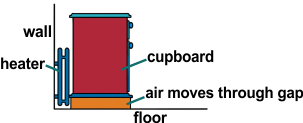
A cupboard is placed in front of a heater. There is a small gap under the cupboard through which air can move. Which row best describes the temperature of the air in the gap and the direction of its movement?
Answer: (b) Air temperature: Cool Air direction: Towards the heater
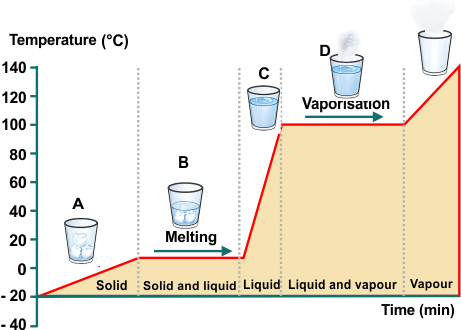
Why is the line at Region D flat even though heat is continuously supplied?
Answer: (b) Because energy changes liquid to vapour without raising temperature
Match the phenomena with the type of heat transfer involved: Type of Heat Transfer Phenomena A Conduction 1 Land heating faster than sea B Convection 2 Metal spoon in hot soup C Radiation 3 Feeling warmth near a bonfire D Uneven heat capacity 4 Air circulating in a room heater
Answer: (b) A- 2, B- 4, C- 3, D- 1
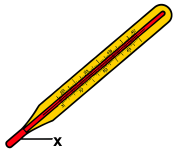
Which part is labelled X and what is its function?
Answer: (c) Bulb – holds liquid for temperature expansion
Choose the correct set of statements related to thermal expansion: 1. Bimetallic strips bend on heating due to different expansion rates 2. Expansion of solids is used in thermometer. 3. Railway tracks are laid with gaps to allow expansion 4. Liquids expand more than solids but less than gases
Answer: (d) 1, 3 and 4
Read the statement and choose the corect option: Assertion (A) : Radiators in heating systems are placed near the floor. Reason (R): Warm air rises and cold air sinks.
Answer: (a) Both A and R are true, and R is the correct explanation
Which of these temperature conversions is correct?
Answer: (c) –273°C = –459°F = 0 K
Which of the following best explains why the woollen jacket is more effective in conserving body heat in such cold conditions?
Answer: (d) Wool contains trapped air pockets that minimise heat loss by conduction and convection
During a coastal science experiment, the wind direction sensor records wind moving from sea to land between 11:00 a.m. and 4:00 p.m. Which of the following conditions most likely changed after 4:00 p.m. to reverse this pattern?
Answer: (a) Pressure over land increased due to cooling
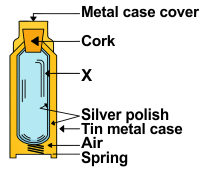
If the vacuum layer around X was accidentally filled with air, what would be the most likely outcome?
Answer: (a) The flask would cool the liquid faster through conduction and convection