Acids, bases, and salts are important classes of chemical substances with distinct properties and uses. Acids are substances that taste sour and turn blue litmus paper red. Examples include hydrochloric acid, sulphuric acid, and citric acid found in lemon. Bases are substances that taste bitter, feel slippery, and turn red litmus paper blue. Examples include sodium hydroxide and calcium hydroxide. When acids and bases react, they neutralise each other to form salt and water. This Acid, Base and Salt MCQ helps students understand these chemical reactions and their practical applications. Common salt, baking soda, and washing soda are examples of salts. Indicators like litmus, phenolphthalein, and turmeric help identify acids and bases. Understanding acids, bases, and salts helps students learn about chemical reactions, pH scale, and their applications in daily life, industries, and medicine. Take these 10 multiple-choice questions to evaluate your knowledge of this fundamental chemistry topic.
Which of the following statements are correct regarding the reaction of acids with metals? 1. Acids react with all metals to produce hydrogen gas. 2. The reaction between acids and copper produces copper chloride and hydrogen. 3. Magnesium reacts rapidly with dilute hydrochloric acid, releasing hydrogen.
Answer: (c) 2 and 3 only
Which pair of substances will both turn methyl orange yellow?
Answer: (b) Lime water and Sodium hydroxide
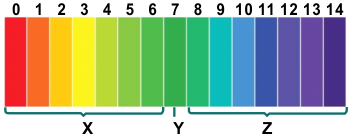
Which region (X, Y, or Z) would an antacid tablet target, and why?
Answer: (d) X, to neutralise excess stomach acid
A white precipitate forms when sodium hydroxide is added to a colourless solution of zinc nitrate. On adding excess sodium hydroxide, the precipitate dissolves. What can be concluded about zinc hydroxide?
Answer: (b) It is not soluble at first but may dissolve in more sodium hydroxide
A student adds calcium hydroxide to sulfuric acid until no more reaction occurs. What remains in the beaker after evaporation?
Answer: (c) Calcium sulphate
Read the statement and choose true and false: 1. A salt is always neutral in nature. 2. The pH of a neutral salt solution is always exactly 7. 3. All salts are formed from neutralisation reactions.
Answer: (d) A- F, B- F, C- F
Read the statement and correctly fill the blanks: 1. Blue litmus paper turns ______ when dipped in an acidic solution. 2. When sulphuric acid reacts with zinc, ______ gas is evolved. 3. The acid present in vinegar is ______ acid.
Answer: (a) A-red, B- hydrogen, C- acetic
A label on toothpaste box reads “Contains sodium bicarbonate (NaHCO₃)” What is the function of sodium bicarbonate in toothpaste?
Answer: (c) Neutralises acid in mouth
When an acidic solution is diluted with water, what changes occur?
Answer: (a) pH increases, conductivity decreases
A student mixes dilute hydrochloric acid with sodium hydroxide in a beaker. After the reaction, the temperature of the solution increases. Based on this observation, which of the following conclusions is most accurate?
Answer: (d) The reaction is chemical and not reversible, as new substances are formed and energy is released.