
Changes occur constantly in the world around us. A physical change is a change in which the physical properties of a substance change, but its chemical composition remains the same. Examples include melting ice, dissolving sugar in water, and tearing paper. Physical changes are usually reversible. A chemical change, also called a chemical reaction, results in the formation of one or more new substances with different properties. These Multiple Choice Questions on Physical and Chemical Changes help students distinguish between these two types of transformations. Examples include burning of wood, rusting of iron, and cooking of food. Chemical changes are usually irreversible and may involve energy changes, colour change, gas evolution, or precipitate formation. Understanding the difference between physical and chemical changes helps students recognise and explain everyday phenomena and industrial processes. Attempt these 10 multiple-choice questions to test your knowledge of physical and chemical changes and their characteristics.
Study the given diagram carefully and choose the correct answer. A student conducted an experiment and a balloon placed on the bottle inflates. Which conclusion is most accurate?
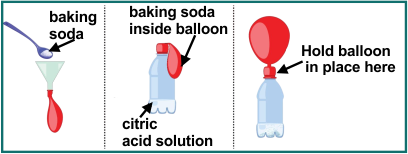
Answer: (b) A chemical change occurred forming a new gas
Lesley accidentally spilled tea on a white cotton tablecloth. Her mother first dried it under the sun, then tried to scrub it using soap, and finally used a lemon slice to remove the stain. Which of the following steps involved a chemical change?
Answer: (c) Applying lemon juice
Match the transformation in Column A with the correct classification in Column B. Column A Column B P Cutting wood into pieces 1 Physical change Q Burning of wood 2 Irreversible change R Melting of candle wax 3 Both physical & chemical change S Lighting a candle 4 Chemical change
Answer: (a) P–2, Q–4, R–1, S–3
Which process among the ones shown or suggested in the diagram involves a chemical change?
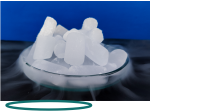
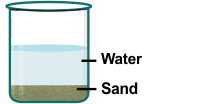
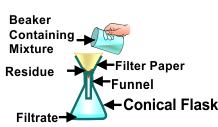
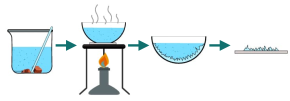
Answer: (d)
Based on the scene shown, Identify the correct set of physical and chemical changes from the options below:
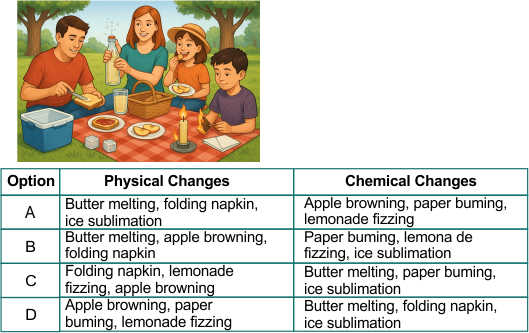
Answer: (a) A
Three reaction types are described: Set A: Produces heat Set B: Produces gas Set C : Results in a solid product A reaction lies in the region X. Which one best fits from the options given?
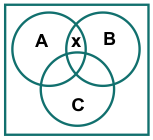
Answer: (b) Reaction of vinegar and baking soda
Choose the correct statement about the metal fence shown in the given picture during monsoon.
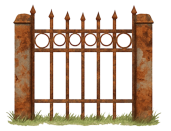
Answer: (c) It is a chemical change and an example of a combination reaction.
Observe the circuit diagram given. When the switch is turned ON, current flows through the circuit. Which of the following correctly describes the chemical reaction that takes place in the solution when the switch is turned ON?
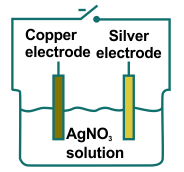
Answer: (a) Silver gets displaced by copper from the solution.
The graph shows the change in temperature over time for four different reactions (W, X, Y, Z). Based on the nature of temperature change, identify which reaction curve most likely represents the combination reaction.
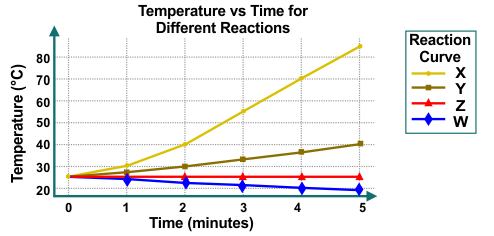
Answer: (a) W
Choose the incorrect set of statements. 1. Neutralisation between an acid and a base is a chemical change. 2. Decomposition of hydrogen peroxide is a fast chemical change producing oxygen gas. 3. Precipitation reactions produce insoluble solids during chemical change. 4. Fermentation of sugar is a slow chemical change.
Answer: (d) 2 only