
Motion is the change in position of an object over time. It can be linear, circular, periodic, or random. To describe motion accurately, measurements of distance and time are essential. Distance is measured in metres using scales, tapes, or odometers. Time is measured in seconds using clocks or stopwatches. Speed is the distance travelled per unit time, while velocity includes direction. This Quiz on Motion & Measurement Quiz for Class 8 helps students understand kinematics and the graphical representation of motion. Uniform motion occurs when an object covers equal distances in equal intervals of time, while non-uniform motion involves varying speed. Graphs like distance-time graphs help visualise motion. Measuring motion and time with precision requires standard units and accurate instruments. Understanding motion helps students learn about kinematics, interpret graphs, and apply concepts to real-world situations like transportation and sports. Answer these 10 multiple-choice questions to evaluate your understanding of motion and measurement.
Which of the following statements correctly describe different types of motion? I. A car increasing its speed on a curved race track demonstrates both curvilinear and non-uniform circular motion. II. The Earth spinning on its axis exhibits both rotational and periodic motion. III. Every oscillatory motion is periodic, but not every periodic motion is oscillatory. IV. Vibratory motion is a specific type of rectilinear motion where an object rapidly moves back and forth.
Answer: (b) II and III only
Match the daily life action in Column A with the primary type(s) of motion it exhibits in Column B. Column A Column B 1 A child swinging on a swing P Rotational motion 2 A drill bit spinning in place Q Oscillatory motion 3 A sprinter running on a straight track R Revolutionary motion 4 The minute hand of a clock S Rectilinear motion
Answer: (a) 1-Q, 2-P, 3-S, 4-P
Based on the graph, what can be said about the motion?
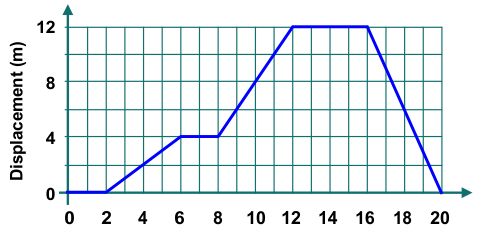
Answer: (a) The displacement is zero.
Analyze the following steps shown in the flowchart for measuring the mass of a fruit using a spring balance. Which step introduces an error in the process? Step 1: Zero the scale Step 2: Hang the fruit from the hook Step 3: Read pointer from the side Step 4: Note the value
Answer: (c) Step 3
Observe the distance-time graph of Object A. What type of motion is represented?
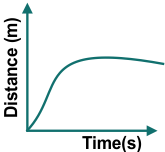
Answer: (c) Decreasing non uniform motion
Which line on the graph could represent an object whose displacement is zero at the end of its journey?
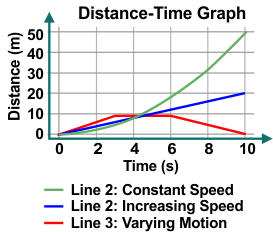
Answer: (c) Line 3
A young aspiring scientist decides to build a small robotic car. To ensure it travels precisely, she programs it to move 5 meters straight ahead, then turn right 90 degrees and move another 5 meters straight, and finally turn right 90 degrees again and move 5 meters straight. After this sequence, what would be the displacement of the car?
Answer: (b) 5 m to the right of the starting point
Study the given distance–time graph for Object A. Which of the following conclusions is INCORRECT based on the graph?
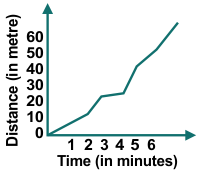
Answer: (d) The motion is oscillatory between 2 and 6 minutes.
Which type of motion is not represented in the given scenaro shown in the image given?

Answer: (d) Curvilinear motion
Choose the set of statements that is INCORRECT about curvilinear motion.
Answer: (b) i. The motion includes constant speed. ii. The object moves in a straight line but at changing speeds. iii. Equations for curvilinear motion includes linear equations.