
Air is a mixture of gases that surrounds the Earth. It mainly contains nitrogen, oxygen, carbon dioxide, and water vapour. The atmosphere is the layer of air that protects life on Earth by blocking harmful rays and maintaining temperature. Air pressure, wind, and weather patterns are all related to the atmosphere. Learning about air and atmosphere helps us understand the importance of air for breathing and life processes. Air & Atmosphere Quiz for Grade 7 also teaches us about air pollution and the need to keep the air clean. Try these 10 questions to check how well you understand air and the atmosphere.
Identify the atmospheric layers based on the following hints and select the correct option: (i) The layer where weather phenomena occur. (ii) The layer that contains the ozone layer. (iii) The outermost layer of the atmosphere.
Answer: (c) (i) Troposphere (ii) Stratosphere (iii) Exosphere
Choose the option that correctly match the column I with column II. Column I Column II A. Eye of the cyclone 1. Brings heavy rainfall and strong winds. B. Eye wall 2. Area of calm weather within the cyclone. C. Low-pressure area 3. Attracts air, leading to cyclonic rotation. D. Storm surge 4. Causes coastal flooding and erosion.
Answer: (d) A-2, B-1, C-3, D-4
Choose the option to correct the inaccuracies in the following statements: Statement 1: Climate is what we feel over the next few days or the next couple of weeks. Statement 2: A trend in the atmosphere over months or years is weather.
Answer: (a) Replace word 'Climate' with 'Weather' in statement 1.
The arrows in the given figure indicate the wind direction over the mountain. Which statement accurately describes the climate of regions A and B?
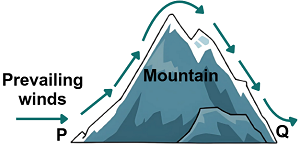
Answer: (d) Region P would have cooler temperatures and heavier rainfall.
The graph given below illustrates the historical and modern levels of atmospheric carbon dioxide (CO₂) over the past 800,000 years. The key inferences from this are: (i) For hundreds of thousands of years, atmospheric CO₂ levels fluctuations were natural. (ii) Starting around the industrial revolution, there is a sharp rise in CO₂ levels. (iii) The extraordinary rise in CO₂ levels in the modern era is largely attributed to human activities.
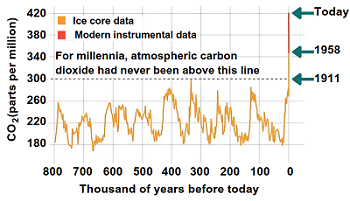
Answer: (d) (i), (ii) and (iii)
Considering the Earth rotation from east to west, which of the following diagram correctly represent the direction of wind flow in northern hemisphere.
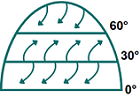
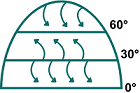
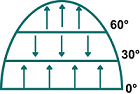
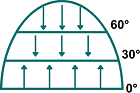
Answer: (b)
A cyclone is predicted to make landfall in a densely populated area. The government implements an evacuation plan and restricts access to low-lying regions. Which strategy BEST minimises long-term impacts?
Answer: (c) Developing storm-resistant infrastructure.
Human activities have increased the amount of CO2 in the atmosphere to dangerous levels. Which of the following activities contribute to this increase? (i) Wasting food (ii) Using Energy Star-certified appliances (iii) Frequently using air travel (iv) Regularly using public transportation
Answer: (a) (i) and (iii)
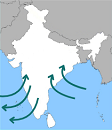
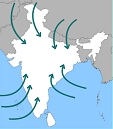
In India, wind direction changes with the seasons due to the uneven heating of land and ocean. Based on the provided map, which option correctly depicts the prime wind movement during the summer season?
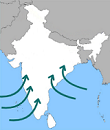
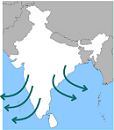
Answer: (a)
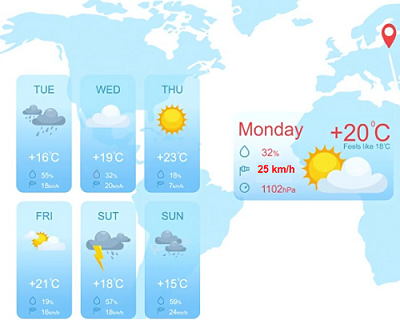
Carefully read through the passage and answer the following questions. Weather/meteorological Report Meteorology is the study of the atmosphere, its phenomena, and its impact on weather. A meteorological report provides a detailed summary of current and predicted weather conditions for a specific location. These reports typically include the forecast date and time, current weather conditions, and future projections. Scientific weather forecasting relies on meteorological knowledge, using quantitative data about the atmosphere’s current state and applying scientific principles to predict its future behaviour. Current weather conditions are gathered through ground-based observations, as well as data from ships, aircraft, radiosondes, Doppler radar, and satellites. This information is transmitted to meteorological centres, where it is compiled, analysed, and transformed into various charts, maps, and graphs. Carefully study the given weather report of an area. In this weather report, what do 30% and 1102 hPa typically represent?
Answer: (b) 30% refers to humidity, and 1102 hPa refers to atmospheric pressure