
Thermal energy is the energy that comes from the temperature of matter. Heat is the transfer of thermal energy from a hotter object to a cooler one. Heat can be transferred through conduction, convection, and radiation. Learning about thermal energy and heat transfer helps us understand everyday phenomena like cooking, heating, and cooling. This well-designed heat Transfer Quiz for grade 7 tests your knowledge about insulators, conductors, and how to control heat flow. Answer these 10 questions to evaluate your knowledge about thermal energy and heat transfer.
When placing a cold metal spoon in hot tea, which statement best describes how heat flows?
Answer: (b) Heat flows from the tea to the spoon by conduction, warming the spoon.
Which scenario best illustrates convection as the primary mode of heat transfer? A. Holding a hand near a light bulb and feeling warmth. B. A pot of water boiling on a stove, where hot water rises and cold water sinks. C. Feeling the heat of the sun on your face outside. D. A metal spoon getting hot in a pot of soup.
Answer: (b) Only B
If you want to speed up the cooling process of a hot object, which of the following should you do?
Answer: (a) Increase the surface area of the object in contact with the air
Two objects, one made of wood and the other made of metal, are both placed in a room with a temperature of 20°C. The wood is initially at 30°C, and the metal is at 50°C. Which object will cool down faster?
Answer: (b) The metal will cool down faster because it has a higher thermal conductivity.
Leo poured some boiling water into three different containers, P, Q and R. The time taken for the water in each container to cool down is shown in the graph below. She asked her friends what can they infer from the graph. Which student has made the right inference?
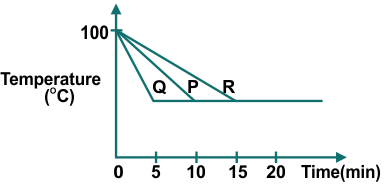
Answer: (c) Student C: Container P is a better conductor than R but a poorer conductor than Q
In an experiment, a layer of oil is added on top of boiling water while a piece of ice, wrapped in metal gauze, is placed at the bottom. How would this setup affect the rate at which the ice melts?
Answer: (a) The oil layer slows down heat transfer, melting the ice more slowly.
A scientist records the following specific heat capacities and latent heats of vaporization for different substances: Which substance requires the least energy to vaporize 1 gram of liquid at its boiling point? Substance Specific Heat Capacity (J/g°C) Latent Heat of Vaporization (J/g) Water 4.18 2260 Ethanol 244 900 Methanol 2.53 1100 Benzene 1.74 400
Answer: (d) Benzene
A house is insulated using three layers of materials with different thermal conductivities. The layers are arranged increasing order of their thermal conductivities as follows: Layer 1: Foam Layer 2: Fiberglass Layer 3: Brick If the interior of the house is warmer than the exterior, which layer arrangement would likely maximize insulation?
Answer: (c) Place Foam as the innermost layer, followed by Fiberglass, with Brick as the outermost layer
A metal rod is divided into three equal sections. The first section is copper, the second section is iron, and the third is aluminium. One end of the rod is heated to 100°C while the other end is kept at 0°C. The thermal conductivities are as follows: Copper (401 W/mK), Iron (50 W/mK), and Aluminium (237 W/mK). Which section will show the highest temperature gradient?
Answer: (b) Iron section, because its lower thermal conductivity resists heat flow, increasing the gradient.
The table below shows the latent heat of fusion and specific heat capacity of two substances, X and Y: Each substance initially weighs 50 g and is at an initial temperature of −20°C, below its melting point of 0°C. Each substance is then heated to 0°C, where it completely melts. Which substance will require more total energy to reach the liquid state at 0°C, and by how much more energy? Substance Latent Heat of Fusion (J/g) Specific Heat Capacity (J/g°C) X 150 0.5 Y 300 1.5
Answer: (d) Substance Y; 8500 J