
Adaptation is the process by which living organisms develop features that help them survive in their environment. Animals in deserts have features to conserve water, while those in cold regions have thick fur. Plants in dry areas have deep roots and waxy leaves. Learning about adaptations to environmental conditions helps us understand how organisms cope with challenges like temperature, water availability, and food. The Adaptation Quiz for Grade 7 tests and teaches you about the diversity of life and how evolution shapes living beings. Answer these 10 questions to check your knowledge about adaptations.
A habitat consists of many abiotic and biotic factors and an animal must adapt to these factors in order to survive. One such biotic factor is development of defensive mechanisms, or behavioural strategies to avoid predators. Select the correct option with organism and its defence mechanism.
Answer: (b) Tortoise retracts into its shell
Dunes play a crucial role in beach ecosystems by reducing shoreline erosion and absorbing storm surges. Marram grass is a vital part of dune habitats that helps to prevent coastal erosion by having :
Answer: (a) Network of thread like fibrous roots
The image shows a Great Egret displaying several structural adaptations for a specific purpose. Adaptation A refers to long, delicate plumes that emerge from its back, while Adaptation B is a patch of skin on its face that turns vibrant neon green. These adaptations assist in:
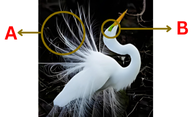
Answer: (c) Reproduction
Following are some examples of adaptive methods. Select the correct reason due to which animals exhibit these methods or behaviours. I. Large padded feet of tiger II. Sharp claws of squirrel III. Ink squirting into the water by octopus IV. Secretion of venom by spider I II III IV a For hunting, digging and climbing Move silently and stalk their prey To immobilise the prey Confuse predators b To immobilise the prey For hunting, digging and climbing Move silently and stalk their prey Confuse predators c Confuse predators Move silently and stalk their prey To immobilise the prey For hunting, digging and climbing d Move silently and stalk their prey For hunting, digging and climbing Confuse predators To immobilise the prey
Answer: (d) d
Carefully examine the provided images of two plants that thrive in distinct environmental conditions. In Plant X, the leaves are modified into spines, while in Plant Y, the leaves are transformed into pitchers. Choose the correct explanation for why these plants have developed such adaptations. I. Plant X grow in arid regions while plant Y grows in nutrient-deficient soil. II. In plant X, leaves are modified into spines to minimise the rate of photosynthesis. III. Plant Y grow in temperate region and plant Y can be found in Tundra. IV. In plant Y, leaves are modified into pitcher to capture and digest insects in order to fulfil nitrogen requirements.
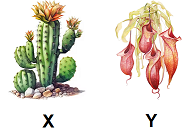
Answer: (d) I and IV
The provided image depicts a shark, a cartilaginous fish; a dolphin, a mammal; and a penguin, a bird. Although these species are unrelated, they have evolved a similar physical characteristic that enhances their swimming abilities. What type of adaptation is this?

Answer: (b) Stream line body
Students at a zoo observed bears with variations in colour and size. They documented their characteristics and explored how these traits relate to adaptations. Which of the following incorrectly links a feature to its adaptive function?

Answer: (b) Short fur - Adaptation for protecting against sunburn in hot climates.
In the following question, you will find an assertion and a reason. Select the appropriate option that applies. Assertion: Arctic fox changes their fur colour depending on the season. Reason: Their fur looks white in winter and in summer their coat is dark and light grey in colour.
Answer: (c) Both the assertion and reason are correct but the reason is not the correct explanation of assertion.
Carefully read through the passage and answer the following questions. Adaptation of Herbivores Herbivores are heterotrophs that consume plants. Various herbivores have evolved unique adaptations to thrive on plant-based diets. Some herbivorous insects possess specialised mouthparts called stylets, which allow them to pierce plant tissues, while insects like caterpillars, grasshoppers, and beetles use mandibles to chew plant material. Herbivorous mammals have flat teeth designed for grinding plant matter. Ruminants, a group of herbivorous mammals, have multi-chambered stomachs to enhance digestion, and they rely on specialised bacteria in their digestive systems to break down cellulose. Aphids are insects with stylets (shown in the image) to pierce plant tissues. What is the correct match of the tissue they pierce and the food type they obtain from piercing?
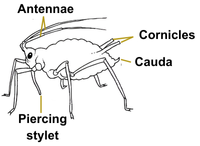
Answer: (a) Phloem- Sugary sap
Carefully read through the passage and answer the following questions. Adaptation of Herbivores Herbivores are heterotrophs that consume plants. Various herbivores have evolved unique adaptations to thrive on plant-based diets. Some herbivorous insects possess specialised mouthparts called stylets, which allow them to pierce plant tissues, while insects like caterpillars, grasshoppers, and beetles use mandibles to chew plant material. Herbivorous mammals have flat teeth designed for grinding plant matter. Ruminants, a group of herbivorous mammals, have multi-chambered stomachs to enhance digestion, and they rely on specialised bacteria in their digestive systems to break down cellulose. Herbivory causes damage to plants, and since plants cannot escape from herbivores, they have developed various strategies to deter animals that feed on them. Which of the following is not such a strategy?
Answer: (d) Trapping of insects