
Respiration is the process by which living organisms release energy from food. It involves taking in oxygen and releasing carbon dioxide. Gas exchange occurs in the lungs in humans and animals, and through stomata in plants. Breathing and respiration are related but different processes. Learning about respiration and gas exchange helps us understand how our body produces energy. This well-designed Respiration in organisms Grade 7 quiz tests your knowledge about the respiratory system, aerobic and anaerobic respiration, and the importance of oxygen for life. Take this quiz with 10 questions to check your understanding of respiration and gas exchange.
Plants also respire to survive and take in oxygen by the following structures except:
Answer: (b) Mesophyll cells
Select the option that correctly matches the structure i, ii , and iii with their common names and description. Structure Common Name Description A Alveoli Air sacs Tiny sacs where gas exchange occurs B Bronchi Windpipe Primary airway leading to the lungs C Trachea Voice box Connects the throat to the lungs D Epiglottis Windpipe Prevents food and liquid from entering the airway
Answer: (a) A
Thomas has been overwatering his plants in the hopes of promoting better growth, but he discovered that the plants died after a few weeks. What could be the most likely reasons for his plants’ death?
Answer: (a) Amount of oxygen available to the plant's roots is reduced
The following equation is associated with the process of respiration in organisms. Which organism is most likely to switch to a different form of respiration when oxygen is absent?

Answer: (b) Yeast
When yeast respire in absence of oxygen and break down glucose, the resulting products are valuable for various industries. If yeast respire using oxygen, in which process would it still be useful?
Answer: (c) Baking bread
Which image correctly represents the gaseous exchange in plants through tiny pores on leaves called stomata?
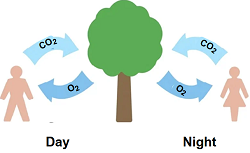
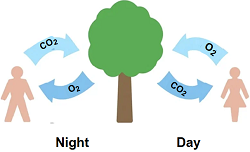
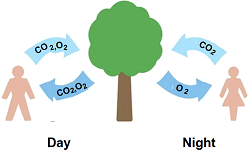
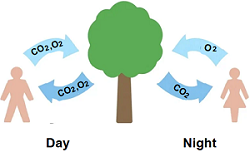
Answer: (d)
The AQI (Air Quality Index) in a given region has remained elevated for a week, causing many outdoor workers to experience chronic coughing, wheezing, and throat discomfort with prolonged exposure. These symptoms indicate:
Answer: (d) Irritation and inflammation of the respiratory system
Carefully read through the passage and answer the following questions. Lactic acid accumulation During intense exercise, when oxygen is insufficient, the body switches to anaerobic respiration, converting glucose into lactic acid, which accumulates in muscles. Despite breathing in oxygen, the intake may not meet the demand, creating an oxygen deficit. Anaerobic respiration allows quick ATP production for high-energy activities, such as sprinting, though lactic acid buildup is a waste byproduct. In sports, energy needs are met through two forms of respiration: anaerobic (high-intensity, short-duration) and aerobic (low-intensity, long-duration) exercises. You experience temporary fatigue and muscle cramps during high-intensity workouts but not during low-intensity exercises like walking. Which of the following statements correctly explain why?
Answer: (c) Body can balance the supply of oxygen with the demand for energy during a walk.
Carefully read through the passage and answer the following questions Lactic acid accumulation During intense exercise, when oxygen is insufficient, the body switches to anaerobic respiration, converting glucose into lactic acid, which accumulates in muscles and can lead to cramps and fatigue. Despite breathing in oxygen, the intake may not meet the demand, creating an oxygen deficit. Anaerobic respiration allows quick ATP production for high-energy activities, such as sprinting, though lactic acid buildup is a waste byproduct. In sports, energy needs are met through two forms of respiration: anaerobic (high-intensity, short-duration) and aerobic (low-intensity, long-duration) exercises. Select the correct option regarding the given statements. Statement 1(S1): Fermentation produces ATP rapidly but in smaller amounts compared to aerobic respiration. Statement 2 (S2): It is quick and partial breakdown of glucose.
Answer: (a) Both the statements are correct and S2 is the correct explanation for S1.
Carefully read through the passage and answer the following questions. Gas exchange in the Lungs Air enters the body through the mouth or nose, moving quickly to the pharynx (throat) and then through the larynx (voice box) into the trachea, a strong tube with cartilage rings that keep it open. The trachea divides into the left and right bronchi, which further branch into smaller bronchioles within the lungs. At the ends of the smallest bronchioles are tiny air sacs called alveoli, which inflate during inhalation and deflate during exhalation. Gas exchange in the lungs involves several steps. First, air moves in and out of the lungs during ventilation. In the alveoli, oxygen diffuses into the capillaries, while carbon dioxide moves from the capillaries into the alveoli, a process that occurs passively. The cardiovascular system, through perfusion, pumps blood throughout the lungs. During exhalation, the body expels carbon dioxide from the alveoli. Finally, oxygen binds to red blood cells, which then return to the heart, carrying oxygen-rich blood throughout the body. Carefully study the given representation of gas exchange in lungs. What is true for letters X and Y.
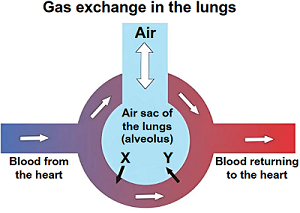
Answer: (b) X is always O2, Y is always CO2