
An atom is the smallest unit of an element that retains its chemical properties. It consists of a nucleus containing protons and neutrons, surrounded by electrons. An ion is an atom or group of atoms that has gained or lost electrons and carries an electric charge. Learning about atoms and ions helps us understand the structure of matter and how chemical reactions occur. The Atoms and Ions Quiz for Grade 7 checks the amount of knowledge you have regarding the formation of compounds and the role of ions in conducting electricity. Try these 10 questions to evaluate your understanding of atoms and ions.
If image A represents ‘atoms’, what are images B and C represent?
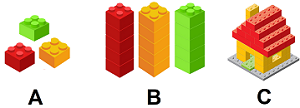
Answer: (b) B- Molecules, C- Compound
Fill in the blank: The following diagram represents the distribution of electrons in the orbits of an atom and its nucleus. This element is _________.
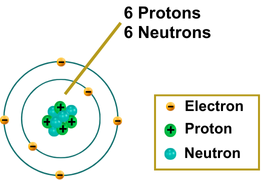
Answer: (d) Carbon
Ammonium sulphate [(NH4)2SO4] is used as fertiliser to neutralise the pH of alkaline soil. How many atoms are there in one molecule of ammonium sulphate?
Answer: (c) 15
A teacher asked their students to write the radicals of some atoms. As a hint he provided only atomic numbers of the elements, not the atomic mass because:
Answer: (c) Radical formation depends on the number of electron in outermost shell.
Compounds can be separated into their elements. How many elements are present in the given compounds: I- Baking soda II- Glucose III-Table salt
Answer: (d) I- 4, II-3, III-2
Select the correct option to complete the following table: Element No. of Neutrons No. of Protons No. of Elctrons Atomic mass Chlorine 18 X 17 35 Oxygen 8 8 8 Y Deuterium Z 1 1 2
Answer: (a) X- 17, Y-16, Z-1
Read the following paragraph and select the correct option to replace the italicised words. A balanced chemical equation gives the molecular formula of the reactants and products. However, it does not provide information about the temperature required for the reaction and the state of the reactants and products.
Answer: (a) Time, concentration
Carefully read through the passage and answer the following questions. Chemical Reactions and Their Characteristics Chemical reactions are different from physical changes as they completely change a substance into another with different properties. Simple chemical reactions are completed in less time and are single-step processes, while complex chemical reactions are multistep and therefore take a longer time to complete. All chemical reactions occur because unstable atoms want to achieve stability by attaining a stable electronic configuration, which is octet completion. Chemical reactions involve changes such as changes in colour, change of state, precipitation formation, release of gas, energy, and odour. To proceed, many reactions require heat, called endothermic reactions; some reactions require sunlight, or pressure higher than atmospheric pressure, or catalysts. Chemical equations are a way to represent chemical reactions. In a balanced chemical reaction, the total mass of the reactants is equal to the total mass of the products. Choose the option to correctly balance the below reactions.
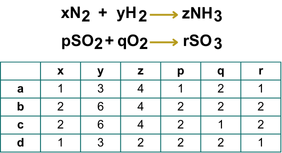
Answer: (c) c
Carefully read through the passage and answer the following questions. Atomic theory and subatomic particles Three postulates from the modern atomic theory contradict Dalton's atomic theory of atoms. First atoms are divisible into protons, neutrons and electrons. Second, atoms of the same elements have different properties as in isotopes. Third, the atoms of different elements have the same properties as in the case of isobars. Electron, proton and neutron are the subatomic particles which build the atom. Electrons are found outside the central nucleus, revolving around it. The nucleus of an atom consists of protons and neutrons. Neutrons are electrically neutral but have the same mass as a proton. Protons are positively charged while electrons are negatively charged. Protons and neutrons are approximately the same in mass but they are much more massive than electrons hence nearly all the weight of an atom lies in the nucleus of an atom. A charged atom or molecule is called an ion or radical. A positively charged ion is a cation which is formed by the removal of electrons from an atom, they are also called basic radicles. Negatively charged ions are anions and formed when an electron is gained by the atom and also called as acidic radicles. The compounds which are formed by the combination of cation and anion are ionic. Isotopes have different physical properties such as melting point, boiling point and density but similar chemical properties despite being the atoms of the same elements because:
Answer: (b) They have different number of neutrons but the same electronic configuration.
Carefully read through the passage and answer the following questions. Atomic theory and subatomic particles Three postulates from the modern atomic theory contradict Dalton's atomic theory of atoms. First atoms are divisible into protons, neutrons and electrons. Second, atoms of the same elements have different properties as in isotopes. Third, the atoms of different elements have the same properties as in the case of isobars. Electron, proton and neutron are the subatomic particles which build the atom. Electrons are found outside the central nucleus, revolving around it. The nucleus of an atom consists of protons and neutrons. Neutrons are electrically neutral but have the same mass as a proton. Protons are positively charged while electrons are negatively charged. Protons and neutrons are approximately the same in mass but they are much more massive than electrons hence nearly all the weight of an atom lies in the nucleus of an atom. A charged atom or molecule is called an ion or radical. A positively charged ion is a cation which is formed by the removal of electrons from an atom, they are also called basic radicles. Negatively charged ions are anions and formed when an electron is gained by the atom and also called as acidic radicles. The compounds which are formed by the combination of cation and anion are ionic. Identify the subatomic particles by the given hints and select the correct option. I. It has charge but negligible mass. II. It is an ionized hydrogen atom. III. It is an uncharged subnuclear particle
Answer: (b) I- Electron, II- Proton, III- Neutron