
Reproduction is the process by which plants produce new plants. Plants reproduce through sexual and asexual methods. Sexual reproduction involves the formation of seeds through pollination and fertilisation. Asexual reproduction occurs through methods like budding, vegetative propagation, and spore formation. Learning about plant reproduction helps us understand the life cycle of plants and how they spread. Reproduction in plants Grade 7 quiz is well-designed to test your knowledge about the structure of flowers, the role of pollinators, and the importance of seed dispersal. Try these 10 questions to see how much you know about plant reproduction.
Just as the P contains Q, which are male gametes, the R contains S, which are female gametes. The P, Q, R and S are respectively:
Answer: (a) Anther, pollen grains, ovary, ovules
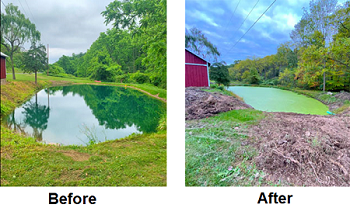
Every morning, Femi goes for a walk with her grandfather. Along their path, there’s a pond with clean, clear water. One day, she noticed that within a week, the pond had become covered with green algae, and the water was no longer clear (as shown in the image). By which method of reproduction did the algae spread so quickly?
Answer: (b) Fragmentation
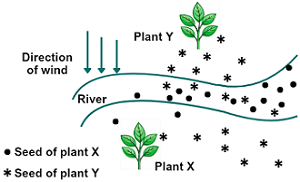
Carefully examine the diagram below. What is true about the seeds of plants X and Y? A. The seed of plant X is dispersed by water, while the seed of plant Y is dispersed by wind. B. The seed of plant X is dispersed by wind, while the seed of plant Y is dispersed by water. C. The fruit of plant X has hair-like structures. D. The fruit of plant X has a fibrous husk.
Answer: (b) A and D only
Identify the technique shown in the diagram, which is commonly used for propagating various varieties of ornamental trees and shrubs.

Answer: (c) Bud grafting
Grafting is a horticultural technique in which the tissues of two plants are joined and allowed to grow together. This process can create a new plant variety that exhibits traits from both parent plants. However, grafting is not considered sexual reproduction. Which of the following reasons correctly explains why grafting is not a form of sexual reproduction?
Answer: (a) No fusion of male and female gametes occurs.
Consider the following seeds and select the option that accurately matches their characteristics and mode of dispersal. Seed Characteristics Mode of dispersal a Dates Spiny Explosion b Xanthium Spongy and fibrous coat Animal c Coconut Deformation of pod Water d Moringa Light, small and hairy Air
Answer: (d) d
Which of the following is not a characteristic feature of a flower pollinated by water? (i) Large, sticky pollen grains (ii) Long, ribbon-like structures (iii) Flowers are usually submerged in water (iv) Lack of strong scent or bright colour (v) Pollen grains are produced in small number. (vi) Flowers are very large and noticeable.
Answer: (d) (i), (v) and (vi)
Carefully read through the passage and answer the following questions. Methods of vegetative propagation Horticulturists have developed asexual propagation methods like grafting, cutting, layering, and micropropagation, using vegetative plant parts to create plants in ways not possible naturally. In grafting, a stem segment from a desirable plant (scion) is attached to a rooted plant (stock). The vascular systems of both plants fuse, allowing the scion to grow, produce shoots, and eventually bear flowers and fruits. Some plants are propagated through stem cuttings, where a stem segment with nodes and internodes is placed in moist soil or water to develop roots. Layering is a technique where a stem still attached to the plant is bent down and covered with soil. Micropropagation, or plant tissue culture, is a technique to propagate many plants from a single plant quickly under laboratory conditions. A sterilised plant part, such as a stem, leaf, or seed, is placed on a nutrient-rich culture medium. It forms a callus, which eventually develops into plantlets. These plantlets are initially grown in a greenhouse before being transferred to the field. Lisa noticed her gardener pruning the branches of a plant and placing the cuttings into a planting medium to grow new plants. She wondered if plants could propagate without seeds. Which method best explains the gardener's approach?
Answer: (a) Artificial vegetative propagation
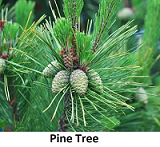
Carefully read through the passage and answer the following questions. Pollination in flowering plants Pollination is a crucial part of the sexual reproduction process in flowering plants, leading to the formation of seeds that grow into new plants. Flowers contain the reproductive organs, with male gametes in the pollen on the anthers and female gametes in the ovules. Pollination brings these gametes together, often facilitated by the wind or animals like insects and birds. Flowers attract pollinators with their shape, colour, scent, nectar, and pollen. While some flowers self-pollinate, cross-pollination is essential for genetic diversity and plant survival. Plants have mechanisms to promote cross-pollination, such as separate male and female flowers or different flowering times. Which of the following plants do not pollinate in the same way as the plant shown in the given image?
Answer: (c) Cotton
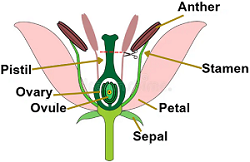
Carefully read through the passage and answer the following questions. Pollination in flowering plants Pollination is a crucial part of the sexual reproduction process in flowering plants, leading to the formation of seeds that grow into new plants. Flowers contain the reproductive organs, with male gametes in the pollen on the anthers and female gametes in the ovules. Pollination brings these gametes together, often facilitated by the wind or animals like insects and birds. Flowers attract pollinators with their shape, colour, scent, nectar, and pollen. While some flowers self-pollinate, cross-pollination is essential for genetic diversity and plant survival. Plants have mechanisms to promote cross-pollination, such as separate male and female flowers or different flowering times. To explain the role of the flower in plant reproduction, a teacher cuts the flower at the red dotted line shown in the diagram. The expected observation will be:
Answer: (b) The seed and fruit will not develop as the stigma is absent to receive the pollen.