
Physical transformations are changes in the state or appearance of matter without altering its chemical composition, like melting ice or breaking glass. Chemical transformations involve changes in the chemical structure of substances, resulting in the formation of new substances, like rusting iron or burning wood. Learning about physical and chemical transformations helps us distinguish between these two types of changes. The Transformations Quiz for Grade 7 helps you test your knowledge about the conditions that cause these transformations and their importance in nature and industry. Answer these 10 questions to check your knowledge about physical and chemical transformations.
Painting, chromium plating, and galvanization are all methods used to prevent iron from rusting by blocking its interaction with:
Answer: (c) Water and oxygen
Consider the given statements and select the correct option. Statement 1(S1) : Crystallisation is ordered, rearrangement of molecules by reformation of bonds. Statement 2(S2) : It is a physical change.
Answer: (c) S1 is incorrect but S2 is correct.
The water cycle includes processes such as evaporation, condensation, and precipitation. Based on your knowledge select the type of changes the water cycle involves.
Answer: (a) Reversible, physical change
Alice's grandfather explained that wine is made from grape juice and it is fermented grape juice. He also observed that wine has a different colour, smell, and taste compared to grape juice. This indicates that fermentation is a:
Answer: (b) Chemical change
Ice cubes in a freezer often shrink over time, even when the temperature is consistently below 0°C. Which of the following processes could explain this phenomenon? (i) Ice melts in the freezer and refreeze at other parts. (ii) Ice gradually sublimates and redeposits on the cooler parts of the freezer. (iii) Ice melts and then evaporates when the door of the freezer is open.
Answer: (b) Only (ii)
Categorize the following processes (X, Y, P, Q, A and B) into physical or chemical changes and select the correct option. (i) Milk ----X-----> Curd -------Y------> Butter milk (ii) Iron Chair -------P-----> Rusting of Iron Chair ------Q------> Painting of Iron chair (iii) Rice ------A------> Cooked rice ------B------> Eating rice Chemical changes Physical changes a X, P, A, B Y, Q b X, P, A Y, Q, B c Y, P, Q, B X, A d Y, P, B X, Q, A
Answer: (a) a
A metal X tends to deteriorate by forming a reddish-brown substance when exposed to air, and the rate of deterioration increases in a humid environment. What is true about this change? (i) Metal X is copper. (ii) This is a physical change. (iii) This is a chemical change. (iv) Reddish brown substance is Fe2O3. (v) Air provides water and nitrogen for change.
Answer: (d) Only (iii) and (iv)
Carefully read through the passage and answer the following questions. Indicators of Chemical Change To assess whether a reaction has taken place, chemists look for fundamental indicators, including changes in temperature, colour change, the emergence of an odour, the formation of a precipitate, or the production of gas. Temperature change occur due to the breaking or forming of chemical bonds. When the bonds of the reactants break, excess energy may be released, resulting in heat being emitted and a rise in temperature. Conversely, some reactions require energy from the surroundings to proceed, causing heat to be absorbed and lowering the temperature. One common way to differentiate a physical reaction from a chemical reaction is that a chemical reaction is not easily reversible if it can be reversed at all. The graph provided illustrates the change in states of water by the absorption of heat and the increase in temperature. Select the correct option explaining this change. A. Chemical bonds are formed when ice melts to become water. B. Freezing water results in a chemical change due to temperature decrease. C. Change in temperature does not always indicate a chemical change.
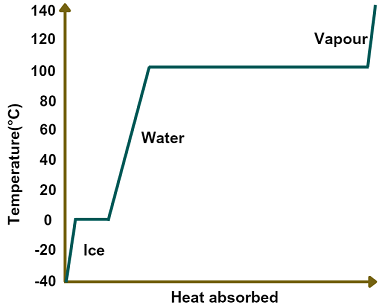
Answer: (d) C only
Carefully read through the passage and answer the following questions. Alloy: A physical change A change that can be challenging to classify as either physical or chemical occurs when two or more molten metals are combined to form an alloy. Alloys are created to improve the strength, corrosion resistance, malleability, or other properties of the base metal. An alloy is a metal with properties distinct from those of the individual metals used to create it. A typical alloy is brass, consisting of around 60% copper and 40% zinc, yet its properties differ from those of pure copper or zinc. Despite these differences, brass is not formed through a chemical reaction. The copper and zinc atoms remain in brass without chemically bonding. Therefore, the formation of brass is considered a physical change rather than a chemical one. The formation of an alloy is a physical change, even though it involves combining two or more metals or non-metals. The correct reason is: (i)The atoms of the different metals do not chemically bond together. (ii)The constituent elements retain their properties. (iii) A new substance is formed having the same properties as base metal. (iv)No new substance is created; only the colour changes.
Answer: (a) (i) and (ii)
Carefully read through the passage and answer the following questions. Alloy: A physical change A change that can be challenging to classify as either physical or chemical occurs when two or more molten metals are combined to form an alloy. Alloys are created to improve strength, corrosion resistance, malleability, or other properties of the base metal. An alloy is a metal with properties distinct from those of the individual metals used to create it. A typical alloy is brass, consisting of around 60% copper and 40% zinc, yet its properties differ from those of pure copper or zinc. Despite these differences, brass is not formed through a chemical reaction. The copper and zinc atoms remain in brass without chemically bonding. Therefore, the formation of brass is considered a physical change rather than a chemical one. When X is mixed with chromium, nickel, and other elements, it forms Y, which is preferred over X due to its increased resistance to rusting. Identify X and Y, respectively.
Answer: (d) X: Iron Y: Stainless steel