
Dynamics is the study of motion and the forces that cause it. Mass is the amount of matter in an object, and it affects how the object moves when a force is applied. Concepts like acceleration, momentum, and Newton's laws of motion explain the relationship between force, mass, and motion. Learning about the dynamics of mass and motion helps us understand how objects behave in the physical world. Dynamics of Mass and Motion for Grade 7 Quiz: Check your knowledge and give you insight regarding the applications in vehicles, sports, and machinery. Take this quiz with 10 questions to check your knowledge about the dynamics of mass and motion.
What type of motion do the pistons in an engine demonstrate as they move up and down?
Answer: (d) Linear and periodic
A metal object has a mass of 300 g and displaces 100 cm³ of water. If another object made of a different material displaces 100 cm³ of water and weighs only 200 g, what can be concluded about the density of the two materials?
Answer: (b) The first material is denser than the second material.
A ball is dropped from a building and is experiencing uniform gravitational acceleration. Which statement best describes its velocity and acceleration at any given moment?
Answer: (b) Velocity is increasing while acceleration remains constant.
An object is thrown upward with an initial velocity. When it reaches the highest point, which statement is correct about its velocity and acceleration?
Answer: (c) Velocity is zero, and acceleration is non-zero.
A solid block has a density greater than water and is dropped into a liquid with twice the density of water. What will happen to the block?
Answer: (a) It will float partially submerged.
An object is thrown vertically upward with an initial velocity. The acceleration due to gravity is constant and acts downward. Which of the following graphs correctly represents the object's velocity versus time?
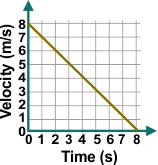
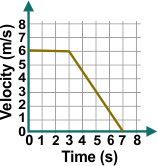
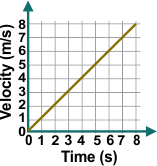
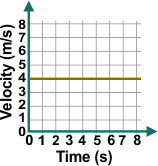
Answer: (a)
An object moves along a straight path, and its distance-time graph is a straight line passing through the origin with a constant positive slope. Which of the following statements is true?
Answer: (c) The object is moving with constant velocity.
Two cyclists start from rest and accelerate at different rates. Cyclist A accelerates at 4 m/s² for 5 seconds, while Cyclist B accelerates at 3 m/s² for 10 seconds. How much farther does Cyclist B travel compared to Cyclist A?
Answer: (d) 100 m farther
An object moves away from its starting point at a speed of 60 km/h for 30 minutes. It then halts and stays stationary for 15 minutes before returning to the starting point at a speed of 40 km/h. Which distance-time graph accurately represents this journey?
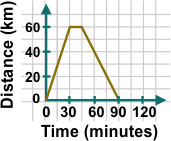
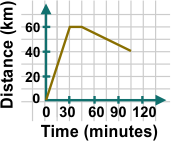
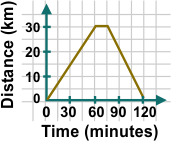
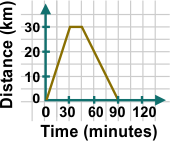
Answer: (d)
Pete visited his friend's place and then returned home. The travel graph provides details about Pete's journey. At 2:30 pm, Pete took a break. He stayed with his friend for one hour before starting his return trip home. Calculate the total distance Pete travelled during this journey.
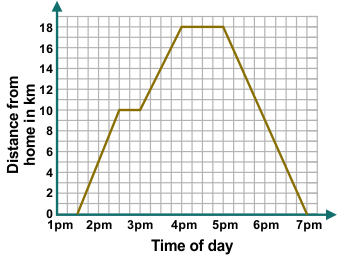
Answer: (c) 36 km
| Topic | Quiz |
|---|---|
| Acids, Bases, and Salts | Quiz on Acids, Bases, and Salts |
| Adaptations to Environmental Conditions | Quiz on Adaptations to Environmental Conditions |
| Atoms and Ions | Quiz on Atoms and Ions |
| Physical and Chemical Transformations | Quiz on Physical and Chemical Transformations |
| Electricity and its Effects | Quiz on Electricity and its Effects |
| Understanding Air and Atmosphere | Quiz on Understanding Air and Atmosphere |
| Thermal Energy and Heat Transfer | Quiz on Thermal Energy and Heat Transfer |
| Light and Sound | Quiz on Light and Sound |
| Dynamics of Mass and Motion | Quiz on Dynamics of Mass and Motion |
| Nutritional Processes in Living Organisms | Quiz on Nutritional Processes in Living Organisms |
| Plant Reproduction | Quiz on Plant Reproduction |
| Respiration and Gas Exchange | Quiz on Respiration and Gas Exchange |