
Nutrition is the process by which living organisms obtain and use food for energy, growth, and repair. Plants make their own food through photosynthesis, while animals depend on plants or other animals. Digestion, absorption, and assimilation are important steps in nutrition. Learning about nutritional processes in living organisms helps us understand how different organisms obtain energy. Nutrition Processes Quiz for Grade 7 tests your knowledge about the digestive system in humans and animals, and the role of nutrients in maintaining health. Take this quiz with 10 questions to evaluate your understanding of nutritional processes.
Match Column I, which lists the feeding habits of animals, with Column II, which describes the special characteristics to support their habits. Column I Carnivore A Carnivore į Siphon B Herbivore ii Needle like proboscis C Nectar sucker iii Rumination D Blood sucker iv Sharp teeth, strong jaws
Answer: (a) A-iv, B-iii, C-i, D-ii
Select the correct option regarding the given statements. Statement 1: Pitcher plant eats insects to fulfil their nutritional requirement. Statement 2: Pitcher plant could not perform photosynthesis.
Answer: (b) Statement 1 is correct statement 2 is incorrect
While visiting her grandfather's farmland, Lina observes farm workers spraying liquid urea, a nitrogen-rich fertiliser, on crops. If plants can produce their own food to meet their energy needs, fertiliser still necessary for: (i) protein and fat synthesis (ii) sugar production (iii) chlorophyll synthesis (iv) growth and repair
Answer: (d) (i), (iii) and (iv)
The doctor has advised a person to opt for fresh or frozen vegetables over canned ones, or to rinse canned foods before use. He is also encouraged to choose fresh meat and fish instead of canned or processed varieties and to reduce intake of take-out and pre-made foods like pizza, frozen meals, and packaged dinners to minimise sodium intake. This suggests that the person is likely dealing with:
Answer: (c) Hypertension
A palaeontologist discovered two animal fossils with intact dentition, shown in the pictures X and Y. From these pictures, he can determine their dietary habits as:
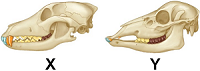
Answer: (a) X- Carnivore, Y- Herbivore
Foods, such as meat, cheese, eggs, and others, increase acid production in the body. Choose the option that accurately explains where this acid is produced and why.
Answer: (c) Stomach; for the digestion of proteins
In a science lab experiment where one leaf of a potted plant was covered with black paper for a few days and later tested for starch. What conclusions can be drawn from the observations of this experiment? (i) Absence of chlorophyll in the covered part of the leaf (ii) Absence of starch in the covered part of the leaf (iii) Light is important for photosynthesis (iv) Chlorophyll is important for photosynthesis
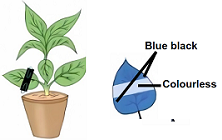
Answer: (c) (ii) and (iii)
Correctly identify the organs of the digestive system based on the following hints: (i) Protein digestion begins here. (ii) No digestion takes place here. (iii) Carbohydrate digestion begins here. (iv) Water is absorbed from undigested food here. (v) Nutrient absorption starts here. (i) (ii) (iii) (iv) (v) 1 Mouth Oesophagus Stomach Small intestine Large intestine 2 Stomach Large intestine Small intestine Mouth Oesophagus 3 Stomach Oesophagus Mouth Large intestine Small intestine 4 Oesophagus Mouth Stomach Large intestine Small intestine
Answer: (c) Row c
Carefully read through the passage and answer the following questions. Essential components of photosynthesis The surface of plant leaves contains numerous tiny pores called stomata (or stoma). Green plants absorb carbon dioxide from the air for photosynthesis, and this carbon dioxide enters the leaves through the stomata. Plants capture sunlight through chlorophyll, a pigment that absorbs light, located in the chloroplasts of plant cells. The absorbed light excites electrons in the chlorophyll, converting the light's energy into chemical energy. Water is also an essential component for photosynthesis. Plants absorb water through their roots, which is then transported upward via xylem vessels to the leaves. There, it reaches the photosynthetic cells and is used in the process of photosynthesis. Photosynthesis forms the foundation of all life on Earth. In what ways do humans rely on photosynthesis? (i) For the nutritional requirement (ii) For the requirement of clothes (iii) For the requirement of electricity, heat (iv) For the requirement of clean water and air
Answer: (d) (i), (ii), (iii) and (iv)
Carefully read through the passage and answer the following questions. Digestion and absorption of fat Fat digestion and absorption are complex because triglycerides are large, water-insoluble molecules that tend to cluster in large droplets within watery environments like the digestive tract. To effectively digest these fats, the body first breaks them into smaller droplets, allowing enzymes called lipases to further break down the molecules. While minimal fat digestion occurs in the mouth and stomach, the majority takes place in the small intestine. There, fats are broken down into absorbable products, which require specialized transport since they don’t mix well with blood. As the stomach contents reach the small intestine, most dietary fats remain undigested, forming large droplets. Bile, produced by the liver and stored in the gallbladder, is released into the duodenum to aid in this process. Bile salts, with both hydrophobic and hydrophilic properties, act as emulsifiers, breaking down large fat globules into smaller droplets and increasing their surface area for enzymatic action. Pancreatic lipases then digest triglycerides into fatty acids, monoglycerides, and free glycerol, making the fats easier to absorb. Bile facilitates fat absorption by forming micelles with the digested fat products. These micelles allow fats to approach the microvilli of intestinal cells, where they are absorbed. After crossing into the cells, bile salts are recycled to continue emulsifying fats and forming new micelles. Bile helps in the digestion of fats by emulsifying them. Another important role of bile is:
Answer: (b) absorption of fat and fat-soluble vitamins.