
Acids, bases, and salts are three important groups of chemical substances. Acids taste sour and turn blue litmus paper red. Bases taste bitter, feel slippery, and turn red litmus paper blue. Salts are formed when acids and bases react together. Learning about acids, bases, and salts helps us understand their properties and uses in daily life. This acid, base, and salt MCQ for Grade 7 tests your knowledge about indicators, the pH scale, and neutralisation reactions. These substances are widely used in industries, laboratories, and households. Take this quiz with 10 questions to test your understanding of acids, bases, and salts.
Acids have been classified into different categories. Select the odd one among the given pairs of acids. (i) Hydrochloric acid, Acetic acid, Sulfuric acid (ii) Citric acid, Formic acid, Nitric acid
Answer: (a) (i) Acetic acid (ii) Nitric acid
Solutions A and B are kept in two different beakers. They are tested with the litmus strips and the observations are recorded as given in the images below. What type of solution they could be?
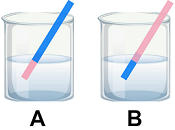
Answer: (c) A- Soda water, B-Lime water
After Archie was bitten by an ant, he began crying due to the burning sensation and pain. His mother brought calamine solution, while his grandmother brought baking soda to apply to the affected area. What is true about both remedies?
Answer: (d) They neutralise the formic acid injected by the ant.
When a snowfall is expected, people spread salt on their parking lots and sidewalks. This practice prevents the accumulation of snow and helps in the easy removal of ice because:
Answer: (a) Salting lowers the freezing point of water, which helps melt snow and ice.
Two solutions A and B, contain different ions in majority. Identify the statement that does not accurately reflect their potential properties.
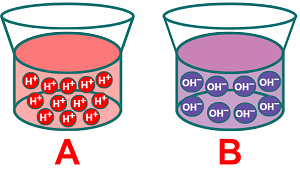
Answer: (b) A has bitter taste
Read the following assertion with its reason and select the correct answer. Assertion: Salt is always neutral. Reason: It is formed by the neutralisation reaction.
Answer: (c) Assertion is incorrect but reason is correct.
Select the correct option mentioning the nature of salt formed by the neutralisation reaction of: (i) Sodium hydroxide with carbonic acid (ii) Hydrochloric acid and ammonium hydroxide (iii) Potassium hydroxide and sulfuric acid
Answer: (a) (i) Basic (ii) Acidic (iii) Neutral
Carefully study the given table and choose the row which displays an incorrect change in the colour of indicators? Substance Red litmus Phenolphthalein Methyl Orange (a) Curd Blue Pink Yellow (b) Spinach Blue Pink Yellow (c) Lime water No change Colourless Red (d) Orange juice No change Colourless Red
Answer: (c) a and c
Carefully read through the passage and answer the following questions. pH scale pH is a scale used to measure the strength of acids and bases, ranging from 0 to 14. The pH test measures the concentration of hydrogen ions present in a solution. A high concentration of hydrogen ions results in a low pH (indicating an acidic substance), while a low concentration of hydrogen ions results in a high pH (indicating a basic substance). The overall concentration of hydrogen ions is inversely related to the pH value and can be assessed using the pH scale. Acids are substances that release hydrogen ions (H+) and lower the pH, while bases release hydroxide ions (OH–) and raise the pH. The stronger the acid, the more readily it donates H+. Three different solutions are kept in jars, and their pH values are provided. Which statement(s) about these solutions is/are incorrect? (i) III has more OH- ions than II. (ii) II has more H+ ions than I. (iii) I gives red colour while III gives yellow colour with methyl orange.
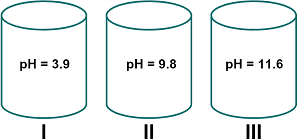
Answer: (b) Only ii
Carefully read through the passage and answer the following questions. Neutralisation reaction A neutralisation reaction is a chemical process in which an acid and a base react to form water and a salt. In this reaction, the acid produces H+ ions, which react with the OH− ions produced by the base, forming neutral water. The other product of the reaction is an ionic salt. The pH of the neutralised solution depends on the strengths of the acids and bases involved in the reaction. The neutralisation of a strong acid and a strong base results in a pH of 7. The neutralisation of a strong acid with a weak base will result in a pH below 7, while the neutralisation of a weak acid with a strong base will produce a pH greater than 7. Neutralisation reactions are commonly applied in daily life, such as in wastewater treatment, antacid tablet production, and controlling soil pH levels. Closely analyse the given salt solutions and select the correct statement concerning these salt solutions. P: Ammonium chloride solution Q: Sodium acetate solution R: Potassium chloride solution
Answer: (d) R exhibits the same behaviour as a common salt solution when tested with blue litmus paper.