
Electricity is the flow of electric charge through a conductor. It is a form of energy that powers many devices in our daily lives. Electricity produces various effects like heating, lighting, and magnetic effects. An electric current flowing through a wire can generate heat and light, as seen in bulbs and heaters. Learning about electricity and its effects helps us understand how electrical appliances work. Check out this Electricity Grade 7 MCQ Quiz that tests your knowledge about electrical safety and the importance of conserving energy. Answer these 10 questions to test your understanding of electricity and its effects.
A student wraps a wire around a wooden stick and connects it to a battery. What will most likely happen?
Answer: (b) The wood will conduct electricity to the battery.
When a switch in an electric circuit is turned off, what happens to the current in the circuit?
Answer: (b) The current instantly stops flowing in the circuit.
What would happen to the brightness of a bulb in a parallel circuit if another identical bulb is added in parallel?
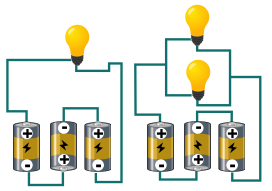
Answer: (c) The brightness of both bulbs will remain the same
A steel rod is used in place of the iron bar in the experiment. When the circuit is closed, the steel rod attracts iron filings. Which of the following statements is correct?
Answer: (a) The steel rod remains magnetized even after the switch is turned off.
In which of the following cases would you observe electroplating? A. A plastic spoon is connected to a copper electrode in a copper sulphate solution. B. An iron spoon is connected to a copper electrode in a copper sulphate solution. C. A wooden stick is dipped in copper sulphate without any current. D. A glass rod is connected to a battery and dipped in copper sulphate solution.
Answer: (a) Only B
A student tests four liquids with a bulb circuit. The following results are obtained: Which of the following is the most reasonable conclusion based on the observations? Liquid Bulb Glows (Yes/No) Gas Bubbles Form (Yes/No) Lemon juice Yes Yes Saltwater Yes Yes Distilled water No No Oil No No
Answer: (b) Liquids containing ions conduct electricity and form gas bubbles
Lina built an electrical circuit using wires, three batteries, three bulbs, a switch, a piece of cardboard, and a metal paper clip. When she turned on the switch, none of the bulbs lit up. Which of the following could represent the circuit Lina constructed?


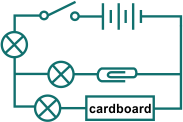
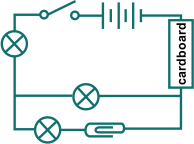
Answer: (d)
The table below shows the electrolytes used in different electroplating processes: Why is aluminium oxide used in molten form rather than as a solution? A. Aluminium reacts with water. B. Aluminium oxide does not dissolve in water. C. Aluminium is more reactive than water. D. Aluminium cannot be plated using electricity. Metal to Be Plated Electrolyte Used Nature of Electrolyte Silver Silver nitrate solution Ionic compound Copper Copper sulfate solution Ionic compound Nickel Nickel chloride solution Ionic compound Aluminium Molten aluminium oxide Covalent compound
Answer: (b) Only B
Harry sets up four circuits using identical batteries and bulbs in working condition. In which circuits will bulb T have the same brightness?
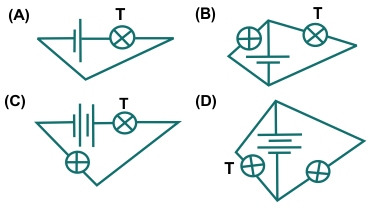
Answer: (d) A, B and C only
Gabrielle sets up an electric circuit as shown below. She uses identical batteries, switches and bulbs. She wants to switch on the hair dryer only. Which switches should she close?
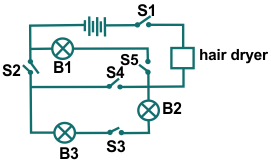
Answer: (c) S1, S2 and S4 only
| Topic | Quiz |
|---|---|
| Acids, Bases, and Salts | Quiz on Acids, Bases, and Salts |
| Adaptations to Environmental Conditions | Quiz on Adaptations to Environmental Conditions |
| Atoms and Ions | Quiz on Atoms and Ions |
| Physical and Chemical Transformations | Quiz on Physical and Chemical Transformations |
| Electricity and its Effects | Quiz on Electricity and its Effects |
| Understanding Air and Atmosphere | Quiz on Understanding Air and Atmosphere |
| Thermal Energy and Heat Transfer | Quiz on Thermal Energy and Heat Transfer |
| Light and Sound | Quiz on Light and Sound |
| Dynamics of Mass and Motion | Quiz on Dynamics of Mass and Motion |
| Nutritional Processes in Living Organisms | Quiz on Nutritional Processes in Living Organisms |
| Plant Reproduction | Quiz on Plant Reproduction |
| Respiration and Gas Exchange | Quiz on Respiration and Gas Exchange |