Transformation of matter refers to the changes that substances undergo. Physical changes, like melting and freezing, do not alter the chemical composition of matter. Chemical changes, like burning and rusting, produce new substances with different properties. Learning about the transformation of matter helps us understand the processes occurring around us every day. Through this well-designed transformation of matter for Grade 6, you can identify physical and chemical changes and their reversibility. Take this quiz with 10 questions to evaluate your understanding of the transformation of matter and the types of changes substances undergo.
Which of the following factors can speed up the rate of a chemical reaction between powdered iron and dilute hydrochloric acid?
Answer: (d) Stirring the mixture to increase contact between particles
Choose the correct option which correctly identify the change as reversible or irreversible. 1. Digesting food in the stomach 2. An iron nail turning black after exposure to air 3. Water vapour condensing on a cold surface 4. A glass bottle shattering into pieces
Answer: (c) 1-Irreversible, 2-Irreversible, 3-Reversible, 4-Irreversible
A student performed an experiment by heating a compound in a closed container. The compound released gas, leaving a solid residue. Upon cooling, the gas re-condensed into a liquid. What type of change(s) occurred during the process?
Answer: (d) Both physical and chemical changes.
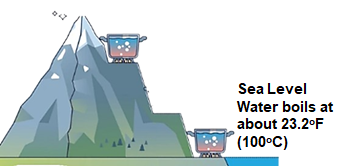
A student conducts an experiment by heating water on a stove. They observe that the water starts to boil at 100°C. If they repeat the experiment on a mountain where the air pressure is lower, what might happen to the boiling point of water?
Answer: (b) It will decrease.
A table displays the following properties for Substance X: Property Observation Colour Shiny silver Melting Point 200°C Reaction with Acid Vigorous release of hydrogen gas Density 2.4 g/cm³
Answer: (d) Reaction with acid only
You are conducting an experiment to test the solubility of a gas in a liquid at different pressures. Which of the following would best explain what happens to the solubility of the gas as the pressure increases?
Answer: (a) As pressure increases, the solubility of the gas in the liquid increases.
A steel boat floats on water, but a solid steel piece sinks. Which of the following explains why the boat floats? 1. The boat is hollow, increasing its volume and lowering its overall density. 2. The boat is made of a special type of steel that is less dense than water. 3. The steel in the boat is heated and expanded, making it less dense. 4. The solid steel piece has a larger volume than the boat, making it denser.
Answer: (a) 1 only
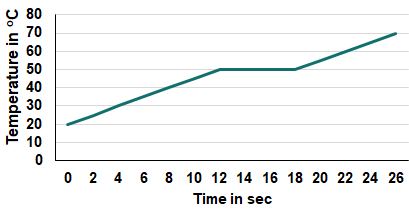
Below is a graph showing the temperature changes of a substance as it is heated over time. The graph indicates that the temperature increases steadily until it reaches a plateau, where it stays constant for some time before continuing to rise. Which of the following explains the constant temperature during the plateau?
Answer: (b) The substance is undergoing a physical change, where it is changing from solid to liquid.
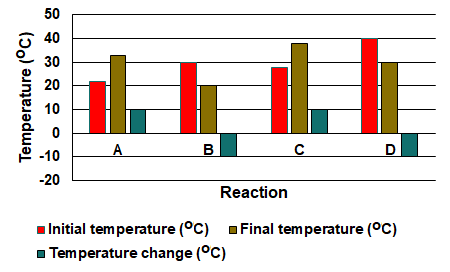
Consider the passage given below and answer the following question: Reactions and Energy: Exothermic and Endothermic Reactions In the world of chemistry, reactions can either release energy or absorb energy. These types of reactions are called exothermic and endothermic, respectively. Understanding how these reactions work helps us learn how energy flows during chemical changes. Exothermic Reactions: Exothermic reactions release energy, usually in the form of heat or light, into their surroundings. This causes the temperature around the reaction to increase. One of the most familiar examples is burning. When wood or fuel burns, it combines with oxygen in the air and releases heat and light. Another example is respiration in animals, where glucose reacts with oxygen inside cells, producing energy, carbon dioxide, and water. Endothermic Reactions: Endothermic reactions, on the other hand, absorb energy from the surroundings, usually in the form of heat. This causes the temperature around the reaction to drop. Photosynthesis in plants is a well-known example of an endothermic reaction. In this process, plants absorb sunlight to convert carbon dioxide and water into glucose and oxygen. Similarly, when you dissolve ammonium nitrate in water, the solution becomes cooler because the process absorbs heat. The graph below shows the temperature changes observed during four different reactions (A, B, C, and D). Based on the graph and the data table, analyse the temperature changes and identify which of the following statements are correct: 1. Reactions A and C are exothermic because the temperature increases. 2. Reactions B and D are endothermic because the temperature decreases. 3. All reactions that involve combustion are exothermic. 4. The dissolving of salts always results in a decrease in temperature. Property Exothermic Reactions Endothermic Reactions Energy Exchange Releases energy (heat or light) Absorbs energy (heat) Temperature Change Increases temperature Decreases temperature Examples Burning wood, respiration Photosynthesis, dissolving ammonium nitrate
Answer: (b) 1 and 2 are correct.
Read the passage carefully and answer the questions accordingly: The Wonders of Matter Matter surrounds us in every form imaginable, from the sturdy steel of skyscrapers to the invisible gases that fill the air we breathe. Matter can be classified based on its physical properties (such as texture, density, melting point, and state of matter) and chemical properties (such as combustibility, reactivity, and the ability to corrode). Understanding these properties helps us identify, use, and even transform materials for specific purposes. For example, the melting of butter on a warm stove is a physical change—it alters the state from solid to liquid, but the butter remains butter. On the other hand, burning a strip of magnesium produces a dazzling white light and forms magnesium oxide, a new substance. This is an example of a chemical change because the original material cannot be recovered in its original form. To explore these ideas further, consider this experiment: Place a copper coin in two different bowls. In one bowl, pour a mixture of salt and lemon juice, and in the other, use plain water. Over a day, the coin in the salt and lemon juice becomes shiny, as the acidic mixture dissolves the tarnish (a chemical reaction). The coin in plain water remains unchanged. The study of these properties is essential for applications ranging from cooking to designing spacecraft. By distinguishing between physical and chemical changes, we can predict how matter behaves under various conditions, paving the way for incredible technological advancements. Look at the following data table. Which material would be most likely to be used in an outdoor environment that needs to resist rusting and perform well in high temperatures? Material Melting Point (oC) Reaction with Air Density (g/cm3) Lead (Pb) 327.5 Reacts slowly to form a protective oxide layer; does not corrode easily. 11.34 Magnesium (Mg) 650 Reacts quickly with oxygen to form a thin, protective oxide layer. Highly flammable in powdered form. 1.74 Aluminum (AI) 660.3 Reacts with oxygen to form a durable and protective oxide layer, resists rust. 2.7
Answer: (c) Aluminium
| Topic | Quiz |
|---|---|
| Introduction to Cell | Quiz on Introduction to Cell |
| Electrical Circuits and Phenomena | Quiz on Electrical Circuits and Phenomena |
| Elements, Compounds and Mixtures | Quiz on Elements, Compounds and Mixtures |
| Environmental Studies | Quiz on Environmental Studies |
| Human Body, Health and Hygiene | Quiz on Human Body, Health and Hygiene |
| Kinematics and Distance Measurement | Quiz on Kinematics and Distance Measurement |
| Life Sciences | Quiz on Life Sciences |
| Magnetic Interactions and Applications | Quiz on Magnetic Interactions and Applications |
| Optics and Light Phenomena | Quiz on Optics and Light Phenomena |
| Transformation of Matter | Quiz on Transformation of Matter |