Environmental studies focus on the relationship between living organisms and their surroundings. It includes topics like pollution, conservation, natural resources, and sustainable development. The environment provides us with air, water, food, and shelter. Learning about environmental studies helps us understand the impact of human activities on nature. This Environment Quiz Grade 6 tells us how to protect the environment and maintain ecological balance for future generations. Try these 10 questions to see how well you understand environmental studies and the importance of conservation.
In a dense forest, two squirrels are trying to collect nuts from the same tree. Which ecological interaction does this best represent?
Answer: (c) Competition
Human activities such as driving cars and burning fossil fuels release carbon dioxide (CO2) into the atmosphere. The table below shows the CO2 levels in different regions over time. What conclusion can be drawn from this? Region CO2 Level (ppm) in 2000 CO2 Level (ppm) in 2024 Urban area 350 400 Rural area 350 375
Answer: (a) CO2 levels have increased in both urban and rural areas, suggesting a global trend.
Imagine a situation where a large shipment of plastic waste accidentally ends up in the ocean. Over time, what can you infer about its impact on the environment? A. Marine animals may ingest plastic, leading to injury or death. B. The ocean ecosystem will remain unaffected as plastic does not dissolve in water. C. Plastic will break down into microplastics, contaminating the food chain. D. The plastic will sink to the ocean floor and stay there.
Answer: (d) A and C only
The table below shows average temperature and rainfall data for three ecosystems. Which ecosystem is likely to have animals with thick fur and small ears? Ecosystem Avg. Temperature (°C) Avg. Rainfall (mm/year) X 28 2200 Y -15 250 Z 35 150
Answer: (b) Y
An invasive plant species spreads rapidly in a wetland ecosystem, covering the surface of water bodies. Based on this, what changes might occur in the ecosystem? A. Native aquatic plants may die due to reduced sunlight. B. Oxygen levels in the water may decrease, affecting aquatic life. C. The invasive species will improve biodiversity by adding new plants. D. Fish and other organisms may leave the ecosystem in search of better conditions.
Answer: (a) A, B, and D only
In a grassland ecosystem, a disease spreads among rabbits, significantly reducing their population. What could be the immediate effect on the ecosystem?
Answer: (c) The number of foxes will decrease due to lack of food.
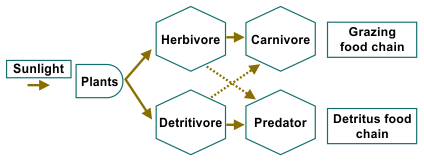
Study the given flowchart about the interconnections between the Detritus Food Chain (DFC) and Grazing Food Chain (GFC). Select all the correct statements about these interconnections. 1. The GFC depends on the DFC for decomposed organic matter to nourish producers. 2. The DFC contributes to nutrient recycling, which supports the functioning of the GFC. 3. The DFC is independent of the GFC and does not contribute to its operations. 4. A disruption in the DFC can affect the stability of the GFC.
Answer: (c) Only 1, 2, and 4
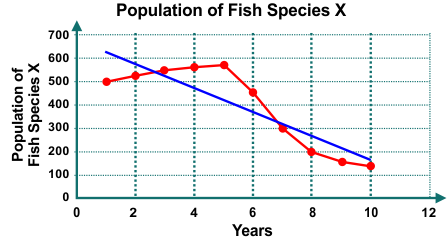
Read the passage carefully and answer the questions accordingly: The Interconnectedness Within an Ecosystem An ecosystem is a community of living organisms interacting with each other and their non-living environment, such as air, water, and soil. These interactions are vital for keeping the ecosystem balanced. In any ecosystem, different species depend on one another for survival. For example, plants use sunlight to make food through photosynthesis, which provides energy for herbivores. Herbivores, in turn, are eaten by carnivores (meat-eating animals), transferring energy and nutrients through the food chain. Decomposers, like fungi and bacteria, break down dead plants and animals, recycling nutrients back into the soil, which plants use to grow. This continuous cycle of energy and matter flow helps maintain the health of the ecosystem. Each species in an ecosystem has a specific role to play. The relationship between these species forms a complex web, called a food web. If one species is removed or harmed, it can disrupt the entire balance, affecting the survival of many other species. This interconnectedness is what ensures that ecosystems remain stable and continue to function properly. The graph below shows the population of fish species X in a lake over ten years. In year 5, an invasive fish species Y was introduced to the lake. What is the most likely reason for the decline in the population of fish species X after year 5? A. Species Y may prey on species X. B. Species Y may compete with species X for food and space. C. Species X migrated to avoid predation by species Y.
Answer: (b) A and B only
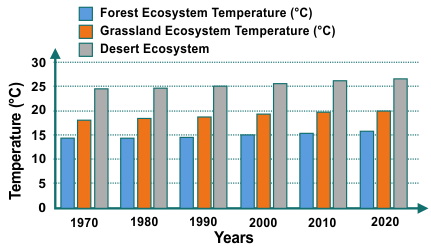
Read the passage carefully and answer the questions accordingly: Understanding Ecosystems: A Complex Web of Life Ecosystems are dynamic communities of living organisms interacting with each other and their physical environment. Some of the most well-known ecosystems include forests, grasslands, deserts, and aquatic ecosystems. Forests are rich in biodiversity, providing habitat for a wide range of animals and plants. Forest ecosystems can be temperate or tropical, depending on the climate and location. Grasslands are open landscapes dominated by grasses and other herbaceous plants. They typically have fewer trees and are home to large herbivores and their predators. Grasslands are often found in regions with moderate rainfall and can be found in both tropical and temperate climates. Deserts are characterised by very little rainfall and extreme temperature fluctuations. Despite harsh conditions, deserts are home to uniquely adapted plants and animals that can conserve water and survive extreme heat. Aquatic ecosystems, which include both freshwater and marine environments, make up the largest portion of Earth's surface. Freshwater ecosystems include rivers, lakes, and wetlands, while marine ecosystems encompass oceans and coral reefs. Understanding how ecosystems work is vital for conserving biodiversity and maintaining the balance of life on Earth. Refer to the given graph. If the trend of rising temperatures continues, which of the following changes is most likely to occur in the desert ecosystem by 2030?
Answer: (b) The temperature increase will result in more extreme weather events like sandstorms.
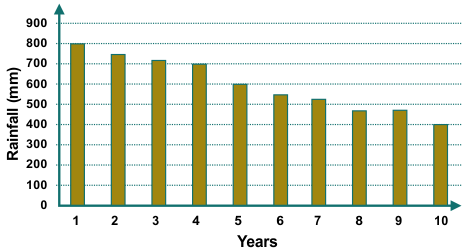
Read the passage carefully and answer the questions accordingly: Understanding Ecosystems: A Complex Web of Life Ecosystems are dynamic communities of living organisms interacting with each other and their physical environment. Some of the most well-known ecosystems include forests, grasslands, deserts, and aquatic ecosystems. Forests are rich in biodiversity, providing habitat for a wide range of animals and plants. Forest ecosystems can be temperate or tropical, depending on the climate and location. Grasslands are open landscapes dominated by grasses and other herbaceous plants. They typically have fewer trees and are home to large herbivores and their predators. Grasslands are often found in regions with moderate rainfall and can be found in both tropical and temperate climates. Deserts are characterised by very little rainfall and extreme temperature fluctuations. Despite harsh conditions, deserts are home to uniquely adapted plants and animals that can conserve water and survive extreme heat. Aquatic ecosystems, which include both freshwater and marine environments, make up the largest portion of Earth's surface. Freshwater ecosystems include rivers, lakes, and wetlands, while marine ecosystems encompass oceans and coral reefs. Understanding how ecosystems work is vital for conserving biodiversity and maintaining the balance of life on Earth. A grassland ecosystem receives moderate rainfall and is home to large herbivores. Below is a graph showing the gradual decrease in rainfall over several years. Based on the data, what is the most likely effect on the ecosystem in the short term?
Answer: (d) The number of herbivores would decrease because there would be less food available.
| Topic | Quiz |
|---|---|
| Introduction to Cell | Quiz on Introduction to Cell |
| Electrical Circuits and Phenomena | Quiz on Electrical Circuits and Phenomena |
| Elements, Compounds and Mixtures | Quiz on Elements, Compounds and Mixtures |
| Environmental Studies | Quiz on Environmental Studies |
| Human Body, Health and Hygiene | Quiz on Human Body, Health and Hygiene |
| Kinematics and Distance Measurement | Quiz on Kinematics and Distance Measurement |
| Life Sciences | Quiz on Life Sciences |
| Magnetic Interactions and Applications | Quiz on Magnetic Interactions and Applications |
| Optics and Light Phenomena | Quiz on Optics and Light Phenomena |
| Transformation of Matter | Quiz on Transformation of Matter |