An electrical circuit is a closed path through which electric current flows. It consists of a power source, wires, and devices like bulbs or motors. When the circuit is complete, electricity flows and the device works. Electrical phenomena include concepts like conductors, insulators, and the effects of electric current. Learning about electrical circuits and phenomena helps us understand how electrical appliances work. Solving this Electrical Circuit Quiz Grade 6 is all about safety measures when handling electricity and the importance of saving electrical energy. Take this quiz with 10 questions to test your understanding of electrical circuits and related phenomena.
In a closed circuit, a light bulb glows when a metal wire is connected to both terminals of a battery. If the metal wire is replaced with a wooden stick of the same length, what will happen to the light bulb?
Answer: (c) The light bulb will stop glowing.
In a home electrical system, multiple devices are connected to the same outlet. What is the potential risk if too many high-power devices are plugged in simultaneously?
Answer: (b) The circuit breaker will trip to prevent overheating and potential fire hazards.
A teacher sets up a demonstration where a circuit is created using a battery, a light bulb, and various materials to complete the circuit. If a student uses an insulator such as plastic instead of a conductor like copper, what will happen to the circuit?
Answer: (b) The bulb will not light up at all.
When considering the use of wires in an electrical circuit, which statement is most accurate?
Answer: (d) Wires conduct electricity from one component to another.
In a dimly lit room, a student finds that touching a metallic doorknob while walking on a carpet sometimes gives them a mild electric shock. Which of the following best explains why this occurs, and how could they prevent it?
Answer: (a) Friction between their feet and the carpet builds up static electricity; they could wear rubber-soled shoes to prevent this
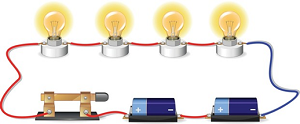
In a science project, a student connects a series of batteries in a circuit with multiple light bulbs. If one battery is removed from the series connection, what will happen to the remaining bulbs?
Answer: (c) All bulbs will go out, as series circuits rely on all components being connected
In a home circuit, if a child wants to add a third light bulb in parallel with two existing bulbs, which of the following statements is true about the effect on the total current drawn from the battery?
Answer: (c) The total current will increase because each bulb draws its own current from the battery.
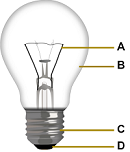
A picture of a light bulb is given below. Which part(s) of the bulb can conduct electricity?
Answer: (d) A, C and D only
Anna connects a battery, a bulb, a fuse, and a switch in a circuit. When the switch is closed, the bulb lights up but only for a few seconds before going out. If she replaces the fuse, the same thing happens again. What could be causing this?
Answer: (d) The circuit has a short circuit that overloads the fuse
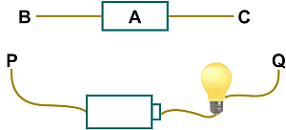
Box A contains an unknown object. B and C are wires joined to the object. Richard joins wire B to P and wire C to Q as shown below. The bulb lights up. However, when he joins wire B to Q and wisre C to P, the bulb does not light up. Which one of the following could be in a Box A?
Answer: (a) An ice cream stick
| Topic | Quiz |
|---|---|
| Introduction to Cell | Quiz on Introduction to Cell |
| Electrical Circuits and Phenomena | Quiz on Electrical Circuits and Phenomena |
| Elements, Compounds and Mixtures | Quiz on Elements, Compounds and Mixtures |
| Environmental Studies | Quiz on Environmental Studies |
| Human Body, Health and Hygiene | Quiz on Human Body, Health and Hygiene |
| Kinematics and Distance Measurement | Quiz on Kinematics and Distance Measurement |
| Life Sciences | Quiz on Life Sciences |
| Magnetic Interactions and Applications | Quiz on Magnetic Interactions and Applications |
| Optics and Light Phenomena | Quiz on Optics and Light Phenomena |
| Transformation of Matter | Quiz on Transformation of Matter |