Kinematics is the study of motion without considering the forces that cause it. It involves concepts like distance, displacement, speed, velocity, and acceleration. Distance is the total path covered by an object, while displacement is the shortest distance between two points. Learning about kinematics and distance measurement helps us describe and analyse motion accurately. This well-designed Kinematic Quiz for Grade 6 also teaches us how to calculate speed and interpret graphs of motion. Answer these 10 questions to check how much you know about kinematics and distance measurement.
Which of the following scenarios describes a case where distance and displacement are the same? A. Walking 50 m east and then 50 m west. B. Running 100 m in a straight line without turning. C. Driving 60 km north and then turning back 30 km south. D. Cycling 25 km around a square track and returning to the start.
Answer: (b) Only B
Which of the following situations describes an object with zero acceleration?
Answer: (b) A bicycle moving at a steady speed on a flat road.
Two runners start from the same point. Runner A runs 100 m north, and Runner B runs 100 m east. What is true about their distances and displacements
Answer: (c) Both have the same distance but different displacements.
Imagine you are observing a ball being dropped from the top of a tall building. As the ball falls, it gains speed due to gravity. However, there is a strong wind blowing sideways, causing the ball to drift slightly to the left while falling. Considering the effects of both gravity and wind, what combination of motions best describes the ball's movement before it touches the ground?
Answer: (b) Translational and accelerated motion
A cyclist rides in a circular path at a constant speed. Which statement best describes the motion of the cyclist?
Answer: (b) The cyclist is accelerating because the direction of motion is changing.
In which situation can you observe non-uniform motion that is not periodic? A. A runner sprinting at varying speeds on a track. B. A metronome ticking at a consistent tempo. C. A bicycle moving downhill with increasing speed. D. A pendulum swinging with the same timing for each swing.
Answer: (a) Only A
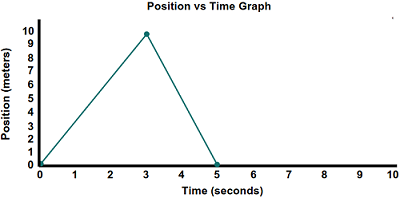
A graph depicts an object’s position over time. Initially, it rises sharply for 3 s, then drops rapidly for 2 s before moving horizontally for 5 s. What can be inferred about the object's motion?
Answer: (a) The object is launched upwards, falls back down, and stays at a constant height.
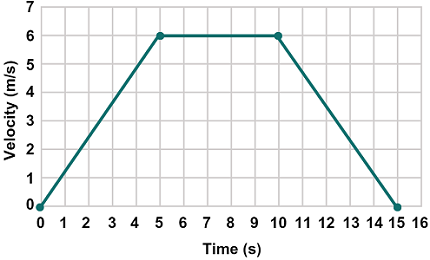
Consider a velocity-time graph of a roller coaster that starts from rest, what can be inferred about the total distance travelled during the first 10 seconds?
Answer: (d) The distance is 45 m.
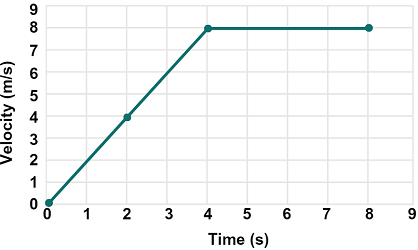
In a velocity-time graph, what can be inferred about the object’s motion after 4 seconds?
Answer: (c) The object is moving at a constant velocity.
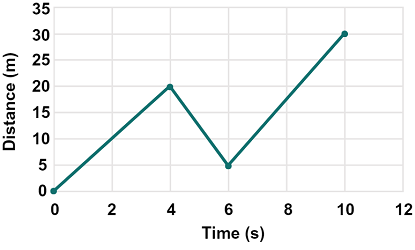
A position-time graph depicts an object’s movement. What can be concluded about the object's motion between 4 seconds and 6 seconds?
Answer: (d) The object is moving backwards.
| Topic | Quiz |
|---|---|
| Introduction to Cell | Quiz on Introduction to Cell |
| Electrical Circuits and Phenomena | Quiz on Electrical Circuits and Phenomena |
| Elements, Compounds and Mixtures | Quiz on Elements, Compounds and Mixtures |
| Environmental Studies | Quiz on Environmental Studies |
| Human Body, Health and Hygiene | Quiz on Human Body, Health and Hygiene |
| Kinematics and Distance Measurement | Quiz on Kinematics and Distance Measurement |
| Life Sciences | Quiz on Life Sciences |
| Magnetic Interactions and Applications | Quiz on Magnetic Interactions and Applications |
| Optics and Light Phenomena | Quiz on Optics and Light Phenomena |
| Transformation of Matter | Quiz on Transformation of Matter |