
An element is a pure substance made of only one type of atom, like oxygen or gold. A compound is formed when two or more elements combine chemically, like water or salt. A mixture contains two or more substances that are physically combined but not chemically bonded, like air or salad. Learning about elements, compounds, and mixtures helps us understand the composition of matter. Elements, Compounds, and Mixtures Quiz Grade 6 tests your knowledge about classifying substances and separating mixtures using different methods. Answer these 10 questions to check your knowledge about elements, compounds, and mixtures.
Noble gases, such as helium, neon, and argon, have several important characteristics, such as being colourless, odourless, and non-toxic. These gases are used in light bulbs, signs, and balloons. Considering these characteristics, what is their behaviour in terms of reactivity?
Answer: (b) They do not easily form compounds and are generally unreactive.
In a laboratory, sodium reacts with chlorine to form sodium chloride (NaCl). Which of the following statements best explains the properties of sodium chloride?
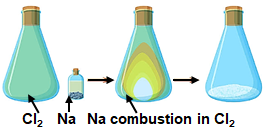
Answer: (d) Sodium chloride is a compound with new properties different from sodium and chlorine.
The table below shows different elements and their atomic characteristics. Which of the following options matches each element to its classification? Element Atomic Number State at Room Temperature P 1 Gas Q 2 Gas R 18 Gas S 3 Solid
Answer: (c) P: Non-metal, Q: Noble gas, R: Noble gas, S: Metal
A group of students heats a balloon filled with air. As the balloon is heated, it expands and becomes larger. Which of the following is the best explanation for this observation?

Answer: (d) The heat causes the air molecules in the balloon to move faster and spread out.
Which of the following best explains why compounds have properties that are different from the elements that make them up?
Answer: (b) The atoms of the elements in a compound interact and form new substances with different properties.
You have a mixture of iron filings, sand, and salt. The magnetic properties of iron are known, and salt and sand do not have magnetic properties. If you use a magnet to separate the iron filings, what can you do next to fully separate the remaining substances?
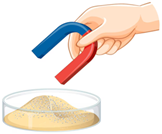
Answer: (a) Add water to dissolve the salt, then filter out the sand.
Below is a table showing four substances and their properties. Which substance has the highest melting point? Substance Properties Sodium chloride (NaCl) Strong connections between atoms, dissolves in water Water (H2O) Atoms are held together, liquid at room temperature Methane (CH4) Atoms are loosely connected, gas at room temperature Diamond (C) Atoms are very tightly connected, hard solid
Answer: (d) Diamond (C)
Consider the passage given below and answer the following question: Exploring Solubility: The Science of Solutions In the fascinating world of chemistry, solubility helps us understand how substances dissolve and interact. Solubility refers to the ability of a substance (called a solute) to dissolve in a liquid (called a solvent) to form a solution. Solutions can be classified based on their concentration and the extent to which the solute dissolves. This concept has practical applications in cooking, medicine, and even the environment. Saturated and Unsaturated Solutions: A solution is called saturated when it contains the maximum amount of solute that can dissolve in the solvent at a given temperature. On the other hand, an unsaturated solution can dissolve more solute until it becomes saturated. Movement of Molecules: Two important processes that describe the movement of molecules in solutions are diffusion and osmosis. Diffusion is the movement of molecules from an area of higher concentration to an area of lower concentration, like the spreading of a drop of food colouring in water. Osmosis, on the other hand, is the movement of water molecules through a semi-permeable membrane from a region of lower solute concentration to a region of higher solute concentration, such as the way water moves into a raisin when soaked. Understanding these concepts enables us to explore the properties of solutions and the movement of molecules in depth. The table given below lists salt dissolving in water as an example of solubility. Imagine adding too much salt to water so that some remains undissolved at the bottom of the container. Does this contradict the concept of solubility described in the passage? Example Types of Process Explanation Salt dissolving in water Solubility Salt breaks into tiny particles that mix uniformly with water. Tea diffusing in hot water Diffusion Molecules of tea spread evenly throughout the water. Water entering plant roots Osmosis Water moves from the soil into roots through a semi-permeable membrane.
Answer: (a) No, because the solution has reached its saturation point.
Consider the passage given below and answer the following question: Exploring Solubility: The Science of Solutions In the fascinating world of chemistry, solubility helps us understand how substances dissolve and interact. Solubility refers to the ability of a substance (called a solute) to dissolve in a liquid (called a solvent) to form a solution. Solutions can be classified based on their concentration and the extent to which the solute dissolves. This concept has practical applications in cooking, medicine, and even the environment. Saturated and Unsaturated Solutions: A solution is called saturated when it contains the maximum amount of solute that can dissolve in the solvent at a given temperature. On the other hand, an unsaturated solution can dissolve more solute until it becomes saturated. Movement of Molecules: Two important processes that describe the movement of molecules in solutions are diffusion and osmosis. Diffusion is the movement of molecules from an area of higher concentration to an area of lower concentration, like the spreading of a drop of food colouring in water. Osmosis, on the other hand, is the movement of water molecules through a semi-permeable membrane from a region of lower solute concentration to a region of higher solute concentration, such as the way water moves into a raisin when soaked. Understanding these concepts enables us to explore the properties of solutions and the movement of molecules in depth. A student places potato slices in three different solutions and observes their changes in size and texture after 2 hours. The data is below. Which of the following best explains the observations? Solution Observation Plain water Potato slices swelled and softened. Saltwater Potato slices shrank and hardened. Sugarwater Potato slices slightly shrank.
Answer: (b) Saltwater has a higher solute concentration, drawing water out of the potato.
Consider the passage given below and answer the following question: Exploring Methods of Separation In chemistry, separating mixtures is crucial for isolating individual substances based on their unique properties. Mixtures are combinations of two or more substances, and each substance in a mixture maintains its own properties. The separation technique chosen depends on the characteristics of the mixture’s components. Here are some advanced methods of separation Filtration is used to separate solid particles from liquids or gases: 1. Decantation separates liquids from solids or two immiscible liquids with different densities. 2. Evaporation separates a dissolved solid from a liquid. This method is often used in the production of salt from seawater. 3. Distillation is used to separate two or more liquids with different boiling points. This process helps in purifying liquids and is used in both laboratories and industries. 4. Magnetic Separation is used when one component of the mixture is magnetic. 5. Chromatography is used to separate substances in a mixture based on their movement through a medium. It’s commonly used in laboratories to separate pigments in ink or in pharmaceuticals to separate different chemical compounds. 6. Centrifugation uses rapid spinning to separate components based on density. Each separation method is chosen based on the properties of the mixture’s components. The table given below lists some of the examples. A lab technician separates a mixture of sand, iron filings, and salt. Which of the following techniques were used in the correct sequence to complete the separation process? Mixture Method of Separation Tea with leaves Filtration Oil and water Decantation Salt dissolved in water Evaporation Alcohol and water Distillation Iron fillings and sand Magnetic Separation
Answer: (c) Magnetic separation, filtration, evaporation