
A cell is the smallest unit of life and the basic building block of all living organisms. Some organisms are made of a single cell, while others are made of billions of cells. A cell has different parts, like the cell membrane, nucleus, and cytoplasm, each with a specific function. Learning about cells helps us understand how living things grow, reproduce, and function. This is a well-designed Cell Quiz for Grade 6 that enlightens and tests your knowledge regarding the difference between plant and animal cells. Take this quiz with 10 questions to evaluate your understanding of cells and their structure.
If a cell's nucleus does not divide properly, which of the following is likely to happen? A. Unequal distribution of genetic material. B. The daughter cells may not survive. C. Growth and repair in the organism could be slowed.
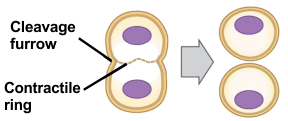
Answer: (d) A, B, and C
A scientist genetically modifies an organism, removing its vacuoles. Which of the following outcomes would most likely occur?
Answer: (a) The plant cell would collapse due to the loss of water storage.
If a cell membrane becomes damaged and unable to perform its function, what might happen to the cell?
Answer: (b) The cell will not be able to regulate materials entering or exiting.
Read the following statements about plant and animal cells and choose the correct statements: 1. Plant cells can survive without mitochondria because they have chloroplasts. 2. Animal cells do not need vacuoles because they store food directly in the cytoplasm. 3. Both plant and animal cells have cell membranes and ribosomes. 4. The cell wall is responsible for controlling what enters and leaves a cell.
Answer: (b) Only 3 is correct.
You place two types of cells—plant cells (from an onion) and animal cells (from a cheek swab)—in a solution. After some time, you add a staining solution to highlight certain cell organelles. After staining, you observe that the plant cells have green-colored structures, but the animal cells do not. Which organelle is being stained?
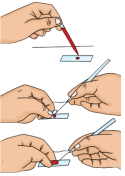
Answer: (d) Plastids
Which statement best describes a significant difference in how the cells depicted in the image labelled 'A' and those in the image labelled 'B' interact with their environment?
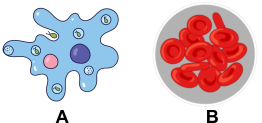
Answer: (c) A can form pseudopodia for movement and feeding, while B cells have a fixed shape.
Refer to the flowchart and respond to the following question. What might organisms X and Y be?
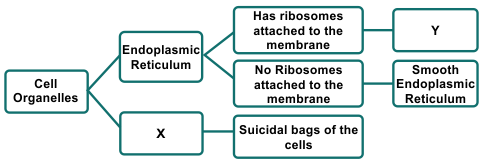
Answer: (a) X- Lysosomes Y-Rough Endoplasmic Reticulum
Choose the correct option regarding the two statements written below. Statement 1: The large vacuole in plant cells plays a key role in maintaining turgor pressure and storing water and nutrients. Statement 2: If the vacuole of a plant cell were to shrink significantly, the plant cell would likely become rigid and lose its ability to function properly.
Answer: (c) Statement 1 is correct but Statement 2 is incorrect.
A small cut occurs on the skin, and cells around the injury site start to divide and repair the tissue. Which organelle in the animal cell is most responsible for controlling the cell division and repair process in this scenario?

Answer: (a) Nucleus – It holds the genetic information and controls cell activities, including division.
Consider the passage given below and answer the following question: Exploring Cells: A Dive into the World of Life Cells are the building blocks of all living organisms, and they come in two main types: animal cells and plant cells. Both types of cells have unique features that help them carry out specific functions, but they also share many similarities. Animal Cells: Animal cells are the basic units of life in animals. They have several key structures that perform essential tasks. The most important parts of an animal cell include the cell membrane, which controls what enters and exits the cell, and the nucleus, which contains the cell's genetic material and controls its activities. Animal cells also contain mitochondria, which provide energy, and cytoplasm, a jelly-like substance where chemical reactions happen. Plant Cells: Plant cells share many structures with animal cells but also have some distinct features. Like animal cells, plant cells have a nucleus, cytoplasm, and mitochondria. However, plant cells also have a rigid cell wall made of cellulose that provides structure and support. Additionally, plant cells contain chloroplasts, which contain chlorophyll and allow the plant to perform photosynthesis, turning sunlight into energy. Plant cells also have large central vacuoles, which store water and nutrients, helping to maintain the plant's shape. Consider a scenario where a plant cell is placed in a solution that causes it to lose water. Based on your understanding of plant cells, what would you predict about the structure of the cell after water loss? A. The cell wall will shrink, making the plant wilt. B. The vacuole will shrink, and the cell membrane may pull away from the cell wall. C. The mitochondria will become larger to produce more energy. D. The chloroplasts will disappear due to lack of water.
Answer: (c) B only