The human body is a complex system made of organs and tissues that work together to keep us alive. Health is the state of physical, mental, and social well-being. Hygiene refers to practices that prevent diseases and maintain cleanliness. Washing hands, bathing regularly, and eating nutritious food are important hygiene habits. Learning about the human body, health, and hygiene helps us understand how to stay fit and disease-free. Moreover, solving this well-designed Human Body Quiz for Grade 6 tests your knowledge about exercise, rest, and a balanced diet. Answer these 10 questions to check your knowledge about the human body, health, and hygiene.
A scientist observes that whenever garbage is left uncovered in a neighbourhood, there’s an increase in certain diseases. Based on this, which diseases might increase due to the presence of uncovered garbage?
Answer: (a) Cholera and Dysentery
A village experiences an outbreak of waterborne illnesses. The health department advises villagers to use chlorine tablets in their drinking water. Why would chlorine tablets be helpful in this situation? A. They kill pathogens present in the water that cause illness. B. They remove large particles, making the water clear and safe to drink. C. They increase the nutrient content of water, making it healthier.
Answer: (a) A only
Which of the following structures are classified as organs in the human body? 1. Muscle 2. Skin 3. Liver 4. Ligament
Answer: (b) 2 and 3
When Tina’s body gets too hot from playing outside, she starts to sweat to cool down. Which two systems work together in this situation?
Answer: (a) Circulatory and excretory systems
Infectious diseases can be transmitted through various means, including direct contact, contaminated surfaces, and vectors like mosquitoes. Which of the following modes of transmission are accurately associated with infectious diseases? A. Inhalation of respiratory droplets B. Transmission through insect bites C. Indirect contact with infected surfaces
Answer: (d) A, B and C
Sara finds that her friend regularly has skin infections after swimming in a public pool. Which reason best explains why?
Answer: (c) Public pools can contain germs, especially if not properly sanitised.
During a science experiment, students were asked to investigate the function of different organ systems in the body. They placed their hand close to a hot object and quickly moved it away upon feeling the heat. What does this experiment demonstrate? 1. The nervous system only works with the muscular system in emergencies. 2. The muscular system senses danger and responds quickly to protect the body. 3. Nerves in the hand detect heat and send a message to the brain. 4. The nervous system helps control involuntary actions to prevent injury.
Answer: (d) 2 and 4
In an experiment, a student places three petri dishes containing agar gel in different environments to observe bacterial growth: - Petri dish A is left open to the air indoors. - Petri dish B is placed outside in a garden. - Petri dish C is covered and kept inside. After a week, bacterial colonies grow in Petri dishes A and B, but not in C. What conclusion can be drawn from this experiment?
Answer: (b) Bacterial growth is dependent on exposure to the environment.
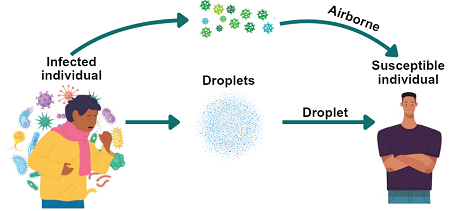
The following diagram shows a flowchart tracing the infection path of a specific disease within a population. The disease spreads through airborne particles and typically causes symptoms like a high fever and respiratory distress. Which of the following diseases does this diagram most likely represent?
Answer: (d) Tuberculosis
Consider the passage given below and answer the following question. Understanding How Diseases Spread Diseases can spread from one person to another through various modes of transmission, each involving different factors. One common method is direct contact, which includes physical interactions such as touching or hugging someone who is infected. Diseases like chickenpox and the flu spread easily this way. Another method is airborne transmission, where diseases spread through droplets when an infected person coughs, sneezes, or even talks. Measles and tuberculosis are examples of diseases that can spread through the air. Diseases can also spread through indirect contact, which involves touching contaminated surfaces or objects. For example, if someone with a cold sneezes on a doorknob, the virus can remain on that surface, infecting others who touch it and then touch their face. Another important mode is vector-borne transmission, where insects like mosquitoes carry diseases from one person to another. Malaria and dengue fever spread this way, as mosquitoes become infected when they bite an infected person and then carry the disease to others. Understanding these transmission modes helps us take specific precautions, like washing hands, covering coughs, and avoiding mosquito bites, to reduce the spread of diseases. Why might airborne transmission be more likely to infect multiple people in a crowded indoor setting compared to an outdoor setting?
Answer: (c) In an indoor setting, droplets from an infected person remain suspended in the air for longer, increasing the chance of exposure
| Topic | Quiz |
|---|---|
| Introduction to Cell | Quiz on Introduction to Cell |
| Electrical Circuits and Phenomena | Quiz on Electrical Circuits and Phenomena |
| Elements, Compounds and Mixtures | Quiz on Elements, Compounds and Mixtures |
| Environmental Studies | Quiz on Environmental Studies |
| Human Body, Health and Hygiene | Quiz on Human Body, Health and Hygiene |
| Kinematics and Distance Measurement | Quiz on Kinematics and Distance Measurement |
| Life Sciences | Quiz on Life Sciences |
| Magnetic Interactions and Applications | Quiz on Magnetic Interactions and Applications |
| Optics and Light Phenomena | Quiz on Optics and Light Phenomena |
| Transformation of Matter | Quiz on Transformation of Matter |