Magnetism is a force that attracts or repels certain materials like iron, nickel, and cobalt. A magnet has two poles-north and south-and like poles repel while opposite poles attract. Magnets are used in many devices like compasses, motors, and speakers. Learning about magnetic interactions and applications helps us understand the properties of magnets and how they are used in daily life. This well-designed Magnetic Interaction Quiz for Grade 6 tests your knowledge about magnetic fields and the Earth's magnetism. Take this quiz with 10 questions to evaluate your understanding of magnetism and its applications.
When a magnet is cut into two pieces, what is likely to happen to the magnetic properties of each piece?
Answer: (c) Both pieces will have their own north and south poles.
A student places a magnet near a compass, and the compass needle aligns itself to point toward the north pole of the magnet. If the student rotates the compass 180 degrees, what will happen to the compass needle?
Answer: (c) It will stay pointing to the magnet's north pole.
A circular disk magnet is divided into equal halves by cutting it straight across the middle. Which statement best describes the magnetic properties of each half?
Answer: (b) Each half will have its own north and south poles
A student has two identical magnets, but one is a permanent magnet and the other is a piece of magnetised steel. She wants to find out which one is the permanent magnet. What could she do to identify the permanent magnet?
Answer: (d) Try to demagnetize both magnets by heating them and see which one loses its magnetism
A student hangs a bar magnet from a string and observes that it always comes to rest in the north-south direction. The student then brings another strong magnet near it, and the bar magnet no longer aligns north-south. Why did this happen?
Answer: (b) The stronger magnet creates a new field that affects the bar magnet.
Two identical-looking magnets are placed near each other. Without touching or moving them, a student wants to figure out if their poles are facing each other. She places a small compass between them and notices the needle aligns perpendicular to the line connecting the two magnets. What can she conclude?
Answer: (d) The poles facing each other are like poles.
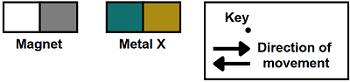
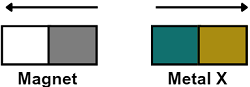
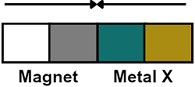
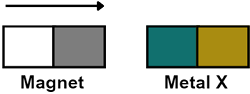
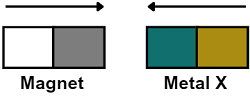
A magnet is used in an experiment to test whether Metal X is a magnet. The magnet was brought near Metal X. Which result shows that Metal X is definitely a magnet?
Answer: (a)
A student arranges three bar magnets in a row with poles facing as follows: north-south, south-north, north-south. When a compass is placed near the middle magnet, it aligns towards the south end of the first magnet. Which reasoning best explains this behavior?
Answer: (c) The arrangement creates a stronger field around the first magnet, affecting the compass.
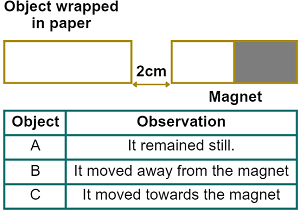
Jerry was given three objects, A, B, C, wrapped in paper. The objects were of similar size. He held a magnet about two centimetres away from each one of them as shown in the diagram below. He recorded his observations in the table. Which of the objects could be made of copper?
Answer: (a) Only A
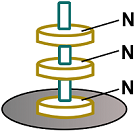
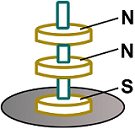
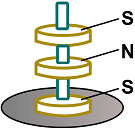
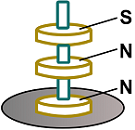
The diagram below shows three ring mangnets. Which of the following shows the possible poles of the ring magnets?
Answer: (c)
| Topic | Quiz |
|---|---|
| Introduction to Cell | Quiz on Introduction to Cell |
| Electrical Circuits and Phenomena | Quiz on Electrical Circuits and Phenomena |
| Elements, Compounds and Mixtures | Quiz on Elements, Compounds and Mixtures |
| Environmental Studies | Quiz on Environmental Studies |
| Human Body, Health and Hygiene | Quiz on Human Body, Health and Hygiene |
| Kinematics and Distance Measurement | Quiz on Kinematics and Distance Measurement |
| Life Sciences | Quiz on Life Sciences |
| Magnetic Interactions and Applications | Quiz on Magnetic Interactions and Applications |
| Optics and Light Phenomena | Quiz on Optics and Light Phenomena |
| Transformation of Matter | Quiz on Transformation of Matter |