Optics is the study of light and its behaviour. Light travels in straight lines and can be reflected, refracted, or absorbed. Reflection is the bouncing back of light from a surface, and refraction is the bending of light when it passes through different materials. Learning about optics and light phenomena helps us understand how mirrors, lenses, and optical instruments work. This is a well-curated Optics and Light Quiz for Grade 6 that tests your knowledge about natural phenomena like rainbows and mirages. Answer these 10 questions to check your knowledge about optics and light phenomena.
During a school science project, a student places a cardboard cutout of a tree in front of a bright lamp. If the student moves the lamp closer to the cutout, which observation would most likely be true regarding the shadow formed?
Answer: (a) The shadow becomes shorter and sharper.
What role does the pinhole play in maintaining the laws of reflection inside a pinhole camera?
Answer: (d) It allows only straight light paths, creating an inverted image.
A flat mirror is used in a funhouse. If a person stands 5 metres from the mirror, how far away will their image appear to be from them?
Answer: (c) 10 m
Sofia uses a plane mirror to practice her dance moves. Which property of the mirror allows her to see her full reflection?
Answer: (d) The mirror produces an image that is the same size as the object.
A student wants to create a makeshift periscope using two flat mirrors. If one mirror is placed at the bottom of a box and the other is at the top, what should the angle of each mirror be to allow the student to see outside from the bottom of the box?
Answer: (b) 45°
A plane mirror is installed at a 45° angle on the ground. A light ray shines directly onto it from above. In which direction will the reflected ray travel?
Answer: (a) Horizontally across the ground.
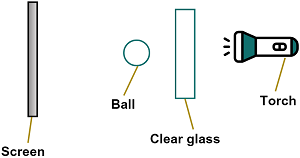
The diagram below shows a torch shining on a square piece of clear glass and a ball. A shadow is cast on the screen. What could be done to enlarge the shadow?
Answer: (c) Move the ball nearer to the clear glass
Peter made some observations when three objects X, Y and Z were placed in between the light source and a screen one at a time. The observations were recorded in the table as shown below: Object Observation X Dark shadow was formed. Y Light shadow was formed. Z No shadow was formed. Which of the following explains why the above observations were made? A. Object X is opaque while Object Z is transparent. B. Object Y is placed furthest away from the light source. C. The path of light was blocked by at least one of the objects.
Answer: (c) A and C only
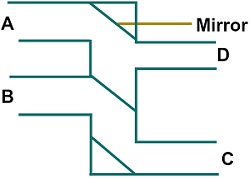
The diagram below shows a connection of pipes. 3 mirrors are placed inside the pipes. In order to see an object through the pipes, where should the eye and the object be placed respectively?
Answer: (b) Position of object - B Position of eye - C
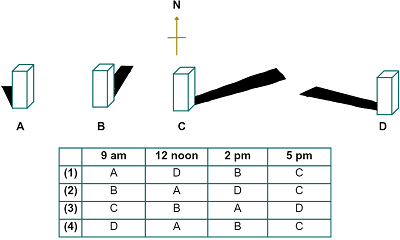
The diagram below shows the positions of the shadow cast by a stick at four different times of a day. Match each shadow to the correct time.
Answer: (d) 4
| Topic | Quiz |
|---|---|
| Introduction to Cell | Quiz on Introduction to Cell |
| Electrical Circuits and Phenomena | Quiz on Electrical Circuits and Phenomena |
| Elements, Compounds and Mixtures | Quiz on Elements, Compounds and Mixtures |
| Environmental Studies | Quiz on Environmental Studies |
| Human Body, Health and Hygiene | Quiz on Human Body, Health and Hygiene |
| Kinematics and Distance Measurement | Quiz on Kinematics and Distance Measurement |
| Life Sciences | Quiz on Life Sciences |
| Magnetic Interactions and Applications | Quiz on Magnetic Interactions and Applications |
| Optics and Light Phenomena | Quiz on Optics and Light Phenomena |
| Transformation of Matter | Quiz on Transformation of Matter |