Simple machines are basic tools that make work easier by reducing the effort needed. The six types of simple machines are the lever, pulley, wheel and axle, inclined plane, wedge, and screw. Each machine helps us lift, move, cut, or hold objects with less force. Learning about simple machines helps us understand how everyday tools work. Test your knowledge by solving this well-curated Simple Machine Quiz for Grade 5. It will test yourself and also teach about mechanical advantage and the principle of work and energy. Try these 10 questions to check how well you understand simple machines and their applications.
A compound machine consists of two or more simple machines working together to accomplish a specific function. Which of the following examples is NOT considered a compound machine?
Answer: (d)
Which simple machine involves an inclined plane wrapped around a central core, making it easier to fasten or lift objects?
Answer: (b) Screw
A stapler is used to press down on staples and secure pages together. Which of the following tools functions as a lever with a similar principle, where the effort is applied on one side and the load is at the other?
Answer: (d) Nail Clipper
A bicycle ramp is designed to help riders go from the ground to a higher platform. The park authority wants to build a new ramp that has a gentler incline (20°) compared to the existing ramp (30°). How will the effort required for a rider to get up the new ramp compare to the effort required for the existing ramp?
Answer: (b) The effort required on the new ramp will be less than on the existing ramp.
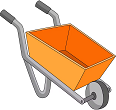
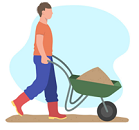
A gardener uses a wheelbarrow to transport soil to her garden. He notices that placing the soil closer to the wheel makes it easier to lift and push the wheelbarrow. What principle of simple machines is the gardener using to make his work easier?
Answer: (c) Reducing the distance from the load to the wheel decreases the effort needed.
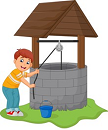
Leo is using a pulley system to lift a bucket of water from a well. He notices that the bucket moves more easily than when he tried to lift it directly without the pulley. Based on the information provided in the table, why is it easier for Leo to lift the bucket using the pulley compared to lifting it directly?
Answer: (b) The pulley changes the direction of the force, allowing Leo to pull down instead of lifting up.
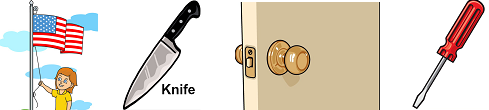
Fill in the blanks with the correct simple machine used in the following everyday applications: 1. Moving a flag up a flagpole using a rope: ______________ 2. Cutting vegetables with a knife: ______________ 3. Opening a door with a doorknob: ______________ 4. Using a screwdriver to tighten screws: ______________
Answer: (a) 1. Pulley, 2.Wedge, 3. Wheel and Axle, and 4. Screw
A skateboard ramp is designed for performing tricks, with the existing ramp having a steep angle of 60°. The skatepark plans to build a new ramp with the same length and material but a gentler slope of 30°. How will the speed of a skateboarder compare when using the new ramp versus the old ramp?
Answer: (d) The skateboarder will go faster on the old ramp because the steeper angle allows for a greater gravitational pull, resulting in higher speeds.
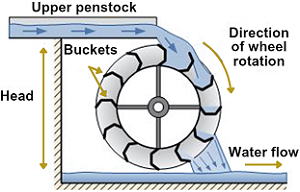
Carefully read through the passage and answer the following questions. The Mechanics of a Water Wheel A water wheel is a simple machine that uses the principles of a wheel and axle to harness the energy from flowing water. As water flows over the paddles or levers of the wheel, it exerts a force that causes the wheel to rotate. This rotation is used to perform tasks such as grinding grain or generating electricity. In a water wheel, the axle serves as the fulcrum, while the paddles act as levers. The energy of the moving water is transferred to the wheel, turning kinetic energy into mechanical energy. The diagram below shows how water flows over the wheel and the energy transformations that take place during the process. In the passage, it is stated that water flows over the paddles, causing the wheel to rotate. If the flow of water suddenly decreases, what impact would this have on the movement of the water wheel?
Answer: (c) The wheel will slow down gradually.
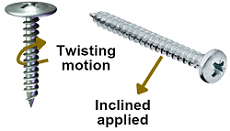
Carefully read through the passage and answer the following questions. The Mechanics of a Screw A screw is a simple machine used in everyday tools and construction. It consists of an inclined plane wrapped around a central shaft, which allows the screw to hold objects together or lift heavy materials. The threads of the screw help it move through materials by converting rotational force (torque) into linear force (downward pressure). This makes the screw an efficient tool for fastening wood, metal, and other materials. The diagram below shows how a screw works by applying a twisting motion, and how the inclined plane on the threads helps drive the screw deeper with less effort compared to driving a nail straight into the material. Sarah is putting together a model car. She sees two types of fasteners: bolts and screws. She knows screws are typically used for creating tight holds, while bolts often need nuts to stay secure. Which scenario would best describe when she should use a screw rather than a bolt?
Answer: (a) Joining small pieces that need a secure and permanent hold.
| Topic | Quiz |
|---|---|
| Animal Diversity | Quiz on Animal Diversity |
| Ecosystems and Interdependence | Quiz on Ecosystems and Interdependence |
| Food and Health | Quiz on Food and Health |
| Force, Work and Energy | Quiz on Force, Work and Energy |
| Circulatory and Skeletal system | Quiz on Circulatory and Skeletal system |
| Light and Shadows | Quiz on Light and Shadows |
| Simple Machines | Quiz on Simple Machines |
| Matter | Quiz on Matter |
| Plant Growth and Reproduction | Quiz on Plant Growth and Reproduction |
| Natural Calamities and Resources | Quiz on Natural Calamities and Resources |
| Sound and Noise | Quiz on Sound and Noise |