Matter is anything that has mass and occupies space. It exists in three states-solid, liquid, and gas. Solids have a fixed shape and volume, liquids have a fixed volume but take the shape of their container, and gases have neither fixed shape nor volume. Learning about matter helps us understand the physical properties of substances around us. Through this Matter Quiz for Grade 5, you can test your knowledge about how matter can change from one state to another through processes like melting, freezing, and evaporation. Take this quiz with 10 questions to check your knowledge about matter and its states.
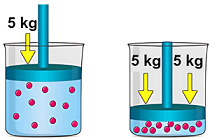
Based on the diagram, what happens to the speed of gas particles and the space between them when pressure is applied?
Answer: (c) When pressure increases, the gas particles move slower and are packed closer together.
Imagine you are in your room, and your mother starts cooking a spicy dish in the kitchen. Soon, you can smell the delicious aroma even though the kitchen is far away. Which of the following properties of gases explains why the smell reaches your room? A. Gases can flow easily in all directions because their particles are in constant random motion B. Gases can be compressed, which allows the smell to pass through small spaces in the walls. C. Gases have a fixed shape and volume, which helps them move through the house. D. Gases can only spread in one direction from the source of the smell.
Answer: (a) Only A
Refer to the table below and identify which of the following are examples of matter. Item Example A Shadow B Water C Sound D Smoke E Carbon Dioxide F Electricity
Answer: (d) B, D, and E
Sarah is helping her mom decide which appliance to use for cooking a meal in the evening. She plans to experiment by cooking the same dish in two different cooking vessels: a saucepan and a pressure cooker. Based on the different cooking methods, which of the following option is correct?
Answer: (b) The pressure cooker cooks food quickly because it raises the boiling point of water using steam and high pressure.
A student has three liquids: Liquid A has a density of 0.8 g/cm³, Liquid B has a density of 1.2 g/cm³, and Liquid C has a density of 1.0 g/cm³. The student pours all three liquids into a container. Which statement best describes the arrangement of the liquids in the container? a. Liquid A will sink to the bottom because it is denser than both Liquid B and Liquid C. b. Liquid C will settle between Liquid A and Liquid B because it has a density in between the two. c. Liquid B will float on top of both Liquid A and Liquid C because it has the lowest density. d. All three liquids will mix uniformly due to differences in density
Answer: (b) Only B
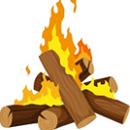
Observe the diagram of a piece of wood burning in a fireplace below. As the wood burns, it transforms into ash, smoke, and gases, releasing heat and light. Based on this observation, which of the following conclusions can you draw about the changes occurring in the wood?
Answer: (a) The wood is undergoing a chemical change as it transforms into ash and produces gases.
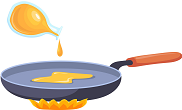
A chef is preparing a dish that requires the use of liquid oil. After heating the oil in a pan, the chef notices it starts to smoke, as shown in the diagram. Which of the following best describes what is happening to the oil?
Answer: (a) The oil is undergoing a chemical change where the particles are breaking down due to high heat, producing smoke.
A student uses a balance to measure the mass of two objects, Object X and Object Y. Both objects are made of the same material, but Object X has twice the volume of Object Y. Which statement correctly predicts the outcome if both objects are placed in water?
Answer: (d) Both objects will float or sink depending on their density, which is the same.
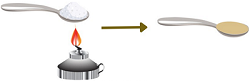
A student conducts an experiment by heating some sugar over a burner. The sugar melts and then turns brown. After some time, it releases a black substance and smoke. What can the student infer from this observation?
Answer: (d) This is both a physical and chemical change because the sugar melts first and then breaks down chemically.
Carefully read the passage and answer the following question. Physical and Chemical Changes Have you ever noticed how some things around you can change without losing their identity? This is what happens during physical changes. For instance, when ice melts into water, it undergoes a physical change. The molecules in the ice move faster as they absorb heat, but they remain water molecules. Even though the shape and state of the ice change, the chemical identity of the water stays the same. On the other hand, there are chemical changes, which transform one substance into another. A great example of this is when you bake a cake. The ingredients, such as flour, sugar, and eggs, combine and react with heat to form a new substance—cake! In this case, the original ingredients lose their identities, and new substances are created. Understanding the difference between physical and chemical changes is essential in our everyday lives. From cooking and baking to recycling and conserving resources, these transformations are everywhere! A table is given showing the properties of three substances (X, Y, and Z) before and after heating. Based on the data in the table, which of the following correctly identifies the type of change for each substance? Substance State before heating State after heating Colour change Other observation X Solid Liquid None None Y Solid Solid From white to black Gas released Z Liquid Gas None Bubbles seen
Answer: (c) X underwent a physical change; Y and Z underwent chemical changes.
| Topic | Quiz |
|---|---|
| Animal Diversity | Quiz on Animal Diversity |
| Ecosystems and Interdependence | Quiz on Ecosystems and Interdependence |
| Food and Health | Quiz on Food and Health |
| Force, Work and Energy | Quiz on Force, Work and Energy |
| Circulatory and Skeletal system | Quiz on Circulatory and Skeletal system |
| Light and Shadows | Quiz on Light and Shadows |
| Simple Machines | Quiz on Simple Machines |
| Matter | Quiz on Matter |
| Plant Growth and Reproduction | Quiz on Plant Growth and Reproduction |
| Natural Calamities and Resources | Quiz on Natural Calamities and Resources |
| Sound and Noise | Quiz on Sound and Noise |