Animal diversity refers to the wide variety of animal species found on Earth. Animals differ in size, shape, habitat, and behaviour. They are classified into groups like mammals, birds, reptiles, amphibians, fish, and insects based on their characteristics. Each group has adapted to survive in its environment. Learning about animal diversity helps us appreciate the richness of life on our planet. Through this well-curated Animal Diversity Quiz for Grade 5, you can check your knowledge regarding biodiversity and the need to protect endangered species. Take this quiz with 10 questions to evaluate your understanding of animal diversity and classification.
Read the statements below and determine which option is correct: Statement 1: Dolphins are the only mammals that live exclusively in water. Statement 2: Ostriches are flightless birds that can run at high speeds on land. Which of the following options is correct?
Answer: (b) Only statement 2 is correct.
Organism Z lives in a dense forest, and its characteristics are noted as follows: - Requires a variety of food sources for energy - Has strong limbs for climbing and moving through trees - Can be found on the ground as well as in trees - Reproduces through live birth Which one of the following could Organism Z be?
Answer: (a) Squirrel
James studied various animals in a local ecosystem and noted their physical characteristics. Based on James's observations, which reasoning can be made regarding the classification of these animals? A. Animals can be categorised as vertebrates or invertebrates based on the presence or absence of a backbone. B. All vertebrates are warm-blooded, while all invertebrates are cold-blooded. C. Vertebrates typically have more complex body systems compared to invertebrates, which may help them adapt to their environment. Which of the following statements are accurate based on the observations?
Answer: (c) Only A and C
Below are some statements deduced by studying various animals based on their hibernation habits and adaptations. A. Bears enter a deep sleep during winter, significantly slowing their metabolism to conserve energy until food becomes available in spring. B. Crabs hibernate by lowering their body temperature, allowing them to survive for long periods. C. Bats use hibernation primarily to avoid heat in the summer, allowing them to find cooler environments until conditions improve. Which of the following statements is true regarding these animals and their hibernation strategies?
Answer: (a) A only
The chart below displays various animals categorised based on their characteristics. Based on the chart, which of the following statements is incorrect? Animal Has backbones Lay eggs Live in water Has fur A Yes Yes Yes No B Yes Yes No No C Yes No Yes No D Yes No No Yes E No Yes Yes No
Answer: (d) B can be a reptile and E can be an amphibian
In a forest ecosystem, various animals have specific feeding habitats based on their dietary preferences. Below is a table showing some animals and their feeding habits: During a nature walk, a student observed the following: 1. Fresh green leaves with bite marks. 2. A muddy area with insects buzzing around. 3. A tortoise munching on some fallen fruits and leaves. Based on these observations, which of the following statements is true about the feeding habitats of the animals mentioned?
Answer: (c) The deer is a primary herbivore as it prefers to graze on fresh vegetation in forested areas.
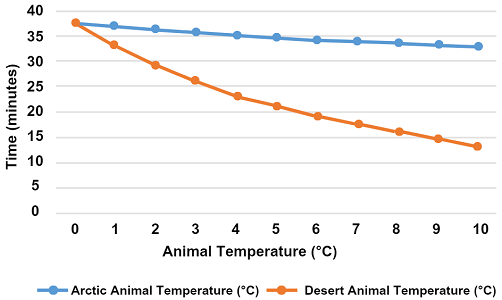
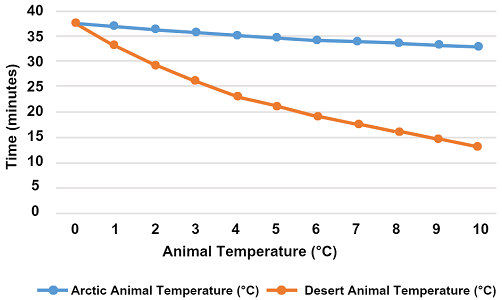
Carefully read through the passage and answer the following questions: Arctic and Desert Animals to Temperature Changes In a recent experiment, two animals from different environments—one living in the Arctic and the other in the desert—were subjected to a sudden cold environment. Researchers recorded the time it took for each animal's body temperature to decrease, revealing significant differences in their physiological responses to temperature change. The graph illustrates that the Arctic animal's temperature dropped slowly compared to the desert animal, which showed a rapid decline in body temperature. These observations suggest that the Arctic animal has developed specialised adaptations to survive its cold habitat. In contrast, the desert animal is accustomed to extreme heat. Based on this information, we can draw several conclusions about the adaptations of these two animals. What concept from animal biology is primarily being demonstrated in this experiment?
Answer: (c) Adaptations in different habitats
Carefully read through the passage and answer the following questions: Adaptations of Arctic and Desert Animals to Temperature Changes In a recent experiment, two animals from different environments—one adapted to the Arctic and the other to the desert—were subjected to a sudden cold environment. Researchers recorded the time it took for each animal's body temperature to decrease, revealing significant differences in their physiological responses to temperature change. The graph illustrates that the Arctic animal's temperature dropped slowly compared to the desert animal, which showed a rapid decline in body temperature. These observations suggest that the Arctic animal has developed specialised adaptations to survive its cold habitat. In contrast, the desert animal is accustomed to extreme heat. Based on this information, we can draw several conclusions about the adaptations of these two animals. Based on the graph, what can you infer about the animal that lives in the Arctic?
Answer: (b) It has thick fur that helps it retain heat.
Carefully read through the passage and answer the following questions: The Fascinating Breathing Habits of Animals Have you ever noticed how different animals breathe? Breathing is essential for life, and each animal has adapted its breathing methods to suit its environment. Mammals, like us, have lungs that help them take in oxygen from the air. Fish, however, breathe underwater using gills that extract oxygen from water. Birds possess a unique respiratory system that includes air sacs, allowing them to take in more oxygen while flying at high altitudes. Insects have yet another fascinating way of breathing. They rely on a network of tiny tubes called tracheae that transport oxygen directly to their tissues. These tubes open to the outside through small holes in their exoskeleton, known as spiracles. This method allows insects to efficiently take in oxygen and release carbon dioxide, enabling them to thrive in diverse environments, from forests to deserts. Similarly, amphibians like frogs can breathe both through their skin and lungs, depending on their life stage and habitat, showcasing their unique adaptations to life both in water and on land. Based on the passage, which of the following conclusions can be most accurately drawn about the importance of specialised breathing methods in animals?
Answer: (c) Specialised breathing methods help animals efficiently obtain oxygen in their specific environments.
Carefully read through the passage and answer the following questions: The Fascinating Breathing Habits of Animals Have you ever noticed how different animals breathe? Breathing is essential for life, and each animal has adapted its breathing methods to suit its environment. Mammals, like us, have lungs that help them take in oxygen from the air. Fish, however, breathe underwater using gills that extract oxygen from water. Birds possess a unique respiratory system that includes air sacs, allowing them to take in more oxygen while flying at high altitudes. Insects have yet another fascinating way of breathing. They rely on a network of tiny tubes called tracheae that transport oxygen directly to their tissues. These tubes open to the outside through small holes in their exoskeleton, known as spiracles. This method allows insects to efficiently take in oxygen and release carbon dioxide, enabling them to thrive in diverse environments, from forests to deserts. Similarly, amphibians like frogs can breathe both through their skin and lungs, depending on their life stage and habitat, showcasing their unique adaptations to life both in water and on land. If a dolphin, a mammal that breathes through lungs, swims to a depth where there is less oxygen, what might this indicate about its breathing habits?
Answer: (d) Dolphins might need to surface more frequently for air as they swim deeper to maintain oxygen levels.
| Topic | Quiz |
|---|---|
| Animal Diversity | Quiz on Animal Diversity |
| Ecosystems and Interdependence | Quiz on Ecosystems and Interdependence |
| Food and Health | Quiz on Food and Health |
| Force, Work and Energy | Quiz on Force, Work and Energy |
| Circulatory and Skeletal system | Quiz on Circulatory and Skeletal system |
| Light and Shadows | Quiz on Light and Shadows |
| Simple Machines | Quiz on Simple Machines |
| Matter | Quiz on Matter |
| Plant Growth and Reproduction | Quiz on Plant Growth and Reproduction |
| Natural Calamities and Resources | Quiz on Natural Calamities and Resources |
| Sound and Noise | Quiz on Sound and Noise |