
Natural calamities are disasters caused by natural forces like earthquakes, floods, cyclones, and droughts. They can cause loss of life and property. Natural resources like water, air, soil, minerals, and forests are gifts of nature that we use daily. Learning about natural calamities and resources helps us prepare for emergencies and stay safe. Calamities & Resources Quiz Grade 5 is going to test your knowledge regarding conserving resources and protecting the environment for future generations. Answer these 10 questions to check your knowledge about natural calamities and the wise use of natural resources.
Consider the following statements and state whether they are true or false: 1. Sedimentary rocks are formed from the process of weathering and the accumulation of broken-down particles called sediments. 2. Sediments are only carried by wind and cannot be moved by water. 3. Different types of sedimentary rocks are formed based on the composition of sediments and the environment in which they settle.
Answer: (b) 1-True 2- False 3- True
Study the statements made by four pupils below about forest fires. Which pupils are correct? Pupil A: Forest fires are small, controlled fires that are easy to manage. Pupil B: Forest fires can start from sparks and spread quickly through trees and plants. Pupil C: Lightning and improperly put-out campfires can cause forest fires, and they can be dangerous to homes and wildlife. Pupil D: Forest fires improve air quality and help the environment.

Answer: (d) Pupil B and Pupil C
You find hard rocks containing shiny minerals often used for making jewellery by a river. These minerals form deep within the Earth under intense heat and pressure. What type of rock might this be, and what valuable natural resource could it contain?
Answer: (c) May be metamorphic rock; could contain gems like diamonds.
Imagine a geologist finds a rock formation that contains different types of minerals and shows signs of being worn down by wind and water. What type of rock might this be, and what can this tell us about the environmental conditions that existed in that area in the past?
Answer: (c) Sedimentary Rock: This rock is made from particles that have been eroded by wind and water, indicating that the area was once covered by water or had moving air.
A climate scientist studied various environmental factors related to floods. The table below summarises the characteristics of different flood events. Based on the table, which flood event is most likely caused by heavy rainfall? Flood event Location Impact on Earth's systems A Mountain valley Erosion of riverbanks B Coastal region Waterlogging of agricultural land C Urban area Contamination of drinking water sources D Coastal area Destruction of coastal ecosystems
Answer: (b) Flood Event B
Maria learned about tsunamis in her science class and wanted to understand their causes and effects better. She studied the following scenarios: 1. An earthquake occurs under the ocean, causing a sudden movement of the seafloor. 2. A volcanic eruption triggers a large wave as the lava enters the sea. 3. A landslide on a coastal cliff sends rocks crashing into the water, creating a wave. 4. A strong storm causes heavy rain and high winds that does not affect the ocean floor. Based on Maria's observations, which of the following statements accurately describes what can lead to a tsunami?
Answer: (d) Tsunamis are caused by sudden movements in or near the ocean, so scenarios 1, 2, and 3 are correct.
In the following question, you will find an assertion and a reason. Select the appropriate option that applies. Assertion (A): The Earth's crust is made up of different types of rocks, including igneous, sedimentary, and metamorphic rocks. Reason (R): Each type of rock has unique characteristics and can contain valuable minerals and fossils. Which of the following is true?
Answer: (a) Both A and R are true, and R is the correct explanation of A.
Two students, Mia and Ethan, researched minerals and their uses. They presented their findings in a table. Based on the table, which of the following statements is most accurate? Mineral Uses Bauxite Used to make cans and parts of vehicles Diamond Used in jewellery and cutting tools Graphite Used in pencils and lubricants Magnetite Used to make iron and steel
Answer: (c) Metallic minerals, such as bauxite, is crucial for manufacturing a variety of industrial products.
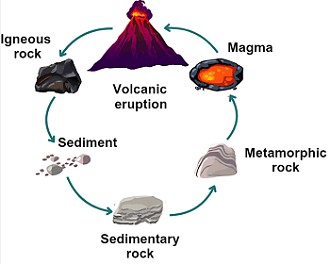
Carefully read through the passage and answer the following questions. Rock cycle The rock cycle is a continuous process that describes how rocks change from one type to another over time. This cycle involves several geological processes, including erosion, weathering, melting, and crystallisation. For example, sedimentary rocks form from the accumulation of sediments that have been compacted over time. These sediments can come from various sources, including weathered pieces of other rocks, minerals, and organic materials. When these rocks undergo changes due to natural forces, they can break down and eventually become sediments again, continuing the cycle. Metamorphic rocks form when existing rocks, either igneous or sedimentary, are subjected to intense heat and pressure. This transformation alters their structure and composition, leading to the creation of new rocks with different properties. For instance, limestone can change into marble, and shale can become slate. These changes not only affect the rocks' appearance but also influence their durability and the environments in which they can be found. Understanding the processes that lead to the formation of metamorphic rocks helps us appreciate the dynamic nature of the Earth’s crust. Igneous rocks are formed when magma cools and solidifies. This can happen either beneath the Earth's surface, leading to the formation of intrusive igneous rocks, or on the surface after a volcanic eruption, resulting in extrusive igneous rocks. The rock cycle illustrates how these three types of rocks—sedimentary, metamorphic, and igneous—are interconnected. By examining the rock cycle, we can better understand how Earth’s surface is shaped and reshaped over millions of years, influencing landscapes, ecosystems, and even human activities. Which of the following best describes the role of metamorphism in the rock cycle?
Answer: (a) It transforms existing rocks into new types of rocks by applying intense heat and pressure, changing their mineral structure and appearance.
Carefully read through the passage and answer the following questions. Rock cycle The rock cycle is a continuous process that describes how rocks change from one type to another over time. This cycle involves several geological processes, including erosion, weathering, melting, and crystallisation. For example, sedimentary rocks form from the accumulation of sediments that have been compacted over time. These sediments can come from various sources, including weathered pieces of other rocks, minerals, and organic materials. When these rocks undergo changes due to natural forces, they can break down and eventually become sediments again, continuing the cycle. Metamorphic rocks form when existing rocks, either igneous or sedimentary, are subjected to intense heat and pressure. This transformation alters their structure and composition, leading to the creation of new rocks with different properties. For instance, limestone can change into marble, and shale can become slate. These changes not only affect the rocks' appearance but also influence their durability and the environments in which they can be found. Understanding the processes that lead to the formation of metamorphic rocks helps us appreciate the dynamic nature of the Earth’s crust. Igneous rocks are formed when magma cools and solidifies. This can happen either beneath the Earth's surface, leading to the formation of intrusive igneous rocks, or on the surface after a volcanic eruption, resulting in extrusive igneous rocks. The rock cycle illustrates how these three types of rocks—sedimentary, metamorphic, and igneous—are interconnected. By examining the rock cycle, we can better understand how Earth’s surface is shaped and reshaped over millions of years, influencing landscapes, ecosystems, and even human activities. If you discover a rock that is smooth, layered and contains fossils, what can you conclude about its formation?
Answer: (d) It is a sedimentary rock that formed from the accumulation of sediments, including organic materials.