Reproduction is the organic method by which new organisms are developed. It is a manner of asexual mode, defining how a single parent and a sexual mode in which two gametes are involved. The purpose of reproduction is to contribute to the continuation of the species. As a result, by solving this Quiz on Reproduction for Grade 10, test the knowledge of students regarding the types of reproduction and the reproductive system of plants and animals, and the process of fertilisation and development. Moreover, on the basis of this topic, we received important information about adolescence and puberty, and reproductive health. Use this 10-question test to check your knowledge about reproduction in organisms.
Which of the following statements best explains why external fertilisation in animals requires a moist environment?
Answer: (b) It prevents the gametes from drying out and dying.
Match the reproductive adaptations in Column I with their advantages in Column II. Column I Column II P. Dioecious plants 1. Promotes cross-pollination Q. Self-incompatibility 2. Prevents self-fertilisation R. Monoecious plants 3. Allows self-pollination when necessary S. Cleistogamous flowers 4. Ensures seed production without pollinators
Answer: (d) P-1, Q-2, R-3, S-4
Which of the following statements regarding human reproduction are correct? 1. Fertilisation generally occurs in the fallopian tube (oviduct). 2. The blastocyst implants in the endometrium of the uterus. 3. The menstrual cycle is controlled by hormones like FSH and LH. 4. Spermatogenesis begins at puberty and continues throughout life.
Answer: (a) All statements are correct
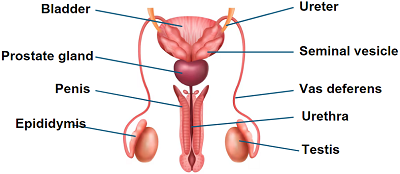
A diagram of the male human reproductive system is shown below. If the vas deferens is blocked, which process will most likely be affected?
Answer: (c) Transportation of sperm
Match the following reproductive strategies in Column I with their adaptive significance in Column II and environmental examples in Column III. Column I Column II Column III P. Parthenogenesis 1 High survival rate of zygotes A. Aphids Q. Internal fertilisation 2 Rapid population growth B. Amphibians R. External fertilisation 3 Requires water medium C. Humans
Answer: (c) P-2-A, Q-1-C, R-3-B
Which of the following statements correctly explains the role of pollinators in plant reproduction? 1. Pollinators facilitate cross-pollination. 2. Pollinators are essential only for self-pollinating plants. 3. Pollinators increase the chances of genetic variation. 4. Pollinators transfer nutrients from one flower to another.
Answer: (a) 1 and 3 only
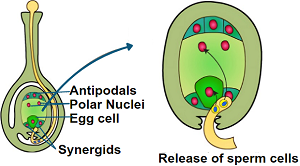
A student injects a chemical inhibitor that prevents the fusion of sperm cells with female gametes in the ovule. Which of the following outcomes is most likely to be observed?
Answer: (d) Neither the embryo nor the endosperm develops.
Fertilisation in flowering plants occurs inside the ovule, where one sperm cell fuses with the egg cell and another sperm cell fuses with two polar nuclei. This unique process is known as double fertilisation, and it ensures the development of both the embryo and the nutrient-rich tissue that supports it. What is the primary significance of double fertilisation in flowering plants?
Answer: (b) Simultaneous formation of zygote and endosperm.
A plant species is observed to produce fruits without fertilisation. Which of the following processes could explain this phenomenon?
Answer: (c) Parthenocarpy
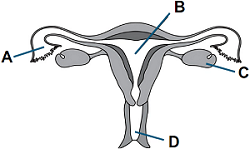
During in vitro fertilization (IVF), a fertilized egg is incubated until at least eight cells are formed. Once the embryo reaches this stage, it is transferred to a specific location in the reproductive system to continue development. Which letter in the diagram indicates the correct location where the ball of cells would be transferred?
Answer: (b) B
| Topic | Quiz |
|---|---|
| Acids, Bases and Salts | Quiz on Acids, Bases and Salts |
| Calorimetry | Quiz on Calorimetry |
| Chemical Reactions, Mole Concept and Stoichiometry | Quiz on Chemical Reactions, Mole Concept and Stoichiometry |
| Current Electricity and Electromagnetism | Quiz on Current Electricity and Electromagnetism |
| Energy Sources and Ecosystem | Quiz on Energy Sources and Ecosystem |
| Cell and Fundamentals of Genetics and Heredity | Quiz on Cell and Fundamentals of Genetics and Heredity |
| Life Processes, Control and Coordination | Quiz on Life Processes, Control and Coordination |
| Machines | Quiz on Machines |
| Optics and Spectrum | Quiz on Optics and Spectrum |
| Organic Chemistry | Quiz on Organic Chemistry |
| Periodicity in Properties of Elements and Metallurgy | Quiz on Periodicity in Properties of Elements and Metallurgy |
| Reproduction in Organisms | Quiz on Reproduction in Organisms |