Organic chemistry is the part of chemistry that deals with carbon-containing compounds. Carbon can create not only long chains but also rings; therefore, it is able to generate millions of different organic compounds. Hydrocarbons, alcohols, acids, and esters are the most basic organic compounds. When addressing organic chemistry, you will get to know the structure and characteristics of carbon compounds, plus the manner of their interaction and reactions. This organic Chemistry Quiz for Grade 10 will also test your knowledge of the significance of organic compounds through organic chemistry, these examples being fuel, medicines, plastics, and food. Take a 10-question quiz to check your knowledge about organic chemistry and carbon compounds.
Match each organic process with its correct description: Column I (Hydrogenation) Column II (Description) A. Esterification 1 Formation of alcohol from alkene B. Hydration 2 Addition of water across a C=C C. Hydrogenation 3 Conversion of carboxylic acid + alcohol → ester D. Combustion 4 Complete oxidation by burning in O2
Answer: (a) A-3, B-2, C-1, D-4
Hexane has several structural isomers. Which of the following isomers has the highest boiling point?
Answer: (b) n-Hexane
A student adds bromine water to an unknown organic compound, and the solution decolourises immediately. What can be inferred about the compound?
Answer: (d) It is an alkene or alkyne.
Which of the following factors increases the boiling point of an organic compound? 1. Presence of hydrogen bonding 2. Longer carbon chains 3. Higher molecular mass 4. Non-polarity of the molecule
Answer: (d) 1, 2, and 3
Carboxylic acids react with alcohols in the presence of concentrated sulphuric acid to produce esters. Esters are used in perfumes and flavourings due to their pleasant smell. What is the role of sulphuric acid in this reaction?
Answer: (c) It acts as a catalyst by lowering the activation energy.
Two organic compounds, shown below, exhibit significant differences in their physical and chemical properties. Which of the following factors is primarily responsible for these differences?
Answer: (a) The difference in their functional groups
Two alkanes are compared: one is a straight-chain alkane, and the other is a branched alkane with a symmetrical structure. Branching affects the physical properties of alkanes due to changes in molecular interactions. Which of the following correctly describes the effect of branching on their boiling and melting points?
Answer: (b) Lowers the boiling point; raises the melting point.
Which of the following statements about nucleophiles is/are correct? 1. A nucleophile is an electron pair donor. 2. Hydroxide ion (OH⁻) acts as a nucleophile in the hydrolysis of haloalkanes. 3. Ammonia (NH₃) is not a nucleophile because it does not have a negative charge. 4. A nucleophile must always contain a lone pair of electrons.
Answer: (c) 1, 2, and 4 only
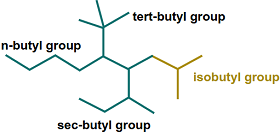
During a practical experiment, a student isolates an isobutyl group from a larger molecule. Based on the structure of this group (shown in the diagram below), how would you classify it?
Answer: (d) Primary
The reaction mechanism for saponification involves several steps. Identify the correct sequence: 1. Neutralisation of fatty acids to form soap 2. Hydrolysis of triglycerides into fatty acids and glycerol 3. Combination of glycerol with water Choose the correct order.
Answer: (a) 2 → 1 → 3
| Topic | Quiz |
|---|---|
| Acids, Bases and Salts | Quiz on Acids, Bases and Salts |
| Calorimetry | Quiz on Calorimetry |
| Chemical Reactions, Mole Concept and Stoichiometry | Quiz on Chemical Reactions, Mole Concept and Stoichiometry |
| Current Electricity and Electromagnetism | Quiz on Current Electricity and Electromagnetism |
| Energy Sources and Ecosystem | Quiz on Energy Sources and Ecosystem |
| Cell and Fundamentals of Genetics and Heredity | Quiz on Cell and Fundamentals of Genetics and Heredity |
| Life Processes, Control and Coordination | Quiz on Life Processes, Control and Coordination |
| Machines | Quiz on Machines |
| Optics and Spectrum | Quiz on Optics and Spectrum |
| Organic Chemistry | Quiz on Organic Chemistry |
| Periodicity in Properties of Elements and Metallurgy | Quiz on Periodicity in Properties of Elements and Metallurgy |
| Reproduction in Organisms | Quiz on Reproduction in Organisms |