
The periodic table organizes elements in order of their atomic number and properties. Chemical properties are similar within the same group of elements. Periodicity is the repeating trend of elements' properties in periods. Metallurgy is the extraction of metals from ores and their purification. Through this Quiz on Periodicity & Metallurgy for Grade 10, students can test their knowledge on periodicity and metallurgy and the extraction of metals. It also makes them aware of the properties of metals, alloys, and their industrial applications. Test your understanding of periodicity and metallurgy with these 10 questions.
In the context of periodic trends, atomic radius is closely related to ionisation energy. Fill in the blanks to describe the relationship: Atoms with a very small radius generally have __________, whereas atoms with a very large radius generally have __________.
Answer: (c) high ionisation energies / low ionisation energies
Match each element in Column I with its most likely ionic charge or behaviour from Column II. Column I (Elements) Column II (Possible Charges) 1 B (Boron) A. Does not form ions readily 2 Sr (Strontium) B. -2 3 S (Sulphur) C. +3 4 Xe (Xenon) D. +2 5 Rb (Rubidium) E. +1
Answer: (b) 1: C, 2: D, 3: B, 4: A, 5: E
Two elements, A (Group 1) and B (Group 17), are placed in a sealed container to react. A loses one electron, and B gains an electron. What type of compound will form, and what are its properties?
Answer: (a) Ionic compound with high boiling point
A chemistry student is studying atomic structure and ion formation. She is asked to identify the diagram that correctly represents the relationship between the diameter of a sodium atom and the diameter of its positive sodium ion. Which of the following is the correct answer according to you?
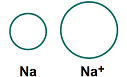
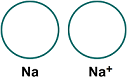
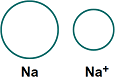
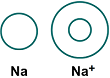
Answer: (c)
A scientist is investigating the reactivity of elements and notices that their electronegativity affects how they bond with other atoms. Based on this, which of the following represents the correct increasing order of electronegativity for the given elements?
Answer: (a) Al < B < O < F
A chemistry student is tasked with identifying an element that exhibits properties of both metals and non-metals. These elements, known as metalloids, are often used in semiconductors due to their unique characteristics. Given the following elements, the student must determine which one is a metalloid.
Answer: (d) Germanium (Ge)
A student is performing an experiment to observe the reactions of metals with dilute acids. She notices that some metals react vigorously, releasing hydrogen gas, while others do not react at all. Which of the following metals does not react with dilute acid?
Answer: (d) Copper
A chemist is working with precious metals and needs to dissolve gold for a specific application. Gold is known for its high resistance to corrosion and reactivity. Which solution is capable of dissolving gold?
Answer: (c) A mixture of concentrated HCl and HNO₃
A student is conducting an experiment to compare the reactivity of metals using displacement reactions and observations such as gas evolution and changes in solutions. The metals being tested are sodium (Na), magnesium (Mg), aluminium (Al), and copper (Cu). Based on the reactivity series, the student is asked to determine the correct order of reactivity. Which of the following represents the correct order of reactivity for the metals sodium (Na), magnesium (Mg), aluminium (Al), and copper (Cu)?
Answer: (b) Na > Mg > Al > Cu
In the following question, you will find an assertion and a reason. Select the appropriate option that applies. Assertion (A): When a strip of zinc is placed into a solution of copper(II) sulphate, a reddish layer of copper forms on the zinc surface. Reason (R): Zinc is more reactive than copper and displaces it from its compound.
Answer: (a) Both A and R are true, and R is the correct explanation of A