Calorimetry is the measurement of the heat of chemical reactions or physical changes. Heat can flow between two objects of different temperatures. The specific heat capacity is the heat per unit mass required to raise the temperature by one degree. Let's learn about calorimetry more and test your knowledge through this Quiz on Calorimetry for Grade 10, and how it helps us know the heat of exchange of different processes. We also learn how to calculate heat gained and lost, thermal equilibrium, and the uses of calorimetry in experiments and real life. Attempt this quiz with 10 questions on calorimetry and the measurement of heat to evaluate your understanding of calorimetry and heat measurement.
Which of the following best explains why steam at 100°C causes more severe burns than boiling water at 100°C?
Answer: (b) Steam has more latent heat than boiling water
If water is used to cool a metal piece and the metal has a much lower specific heat capacity than water, which of the following is the most likely consequence?
Answer: (d) The metal will cool quickly, but the water will heat up slowly.
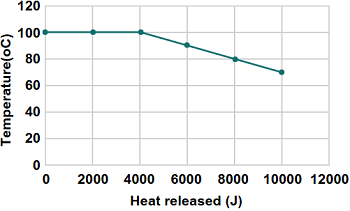
A student condenses steam at 100°C and measures the temperature change as heat is released. The graph shows a flat region at 100°C. What does this indicate?
Answer: (a) Steam releases latent heat before its temperature decreases
If a substance has a high latent heat of vaporization, what can be inferred about its phase change from liquid to gas?
Answer: (d) It requires a significant amount of heat energy to vaporize.
A student performs an experiment to determine the latent heat of fusion of ice by mixing ice at 0°C with water at 80°C in an insulated calorimeter. However, the student notices the final water temperature is lower than expected. What could be a valid explanation?
Answer: (c) Some of the ice was at -10°C instead of 0°C
Two liquids, A and B, of the same mass, are placed in a room for cooling. Their cooling curves are shown in a graph. Which of the following statements correctly describes A and B?
Answer: (a) Both A and B have the same freezing point
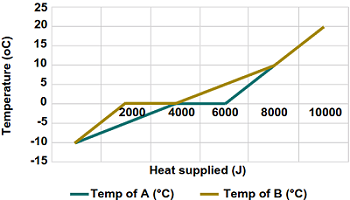
A student heats two different substances, A and B, and plots temperature vs. heat supplied. Substance A remains at 0°C longer than B. What does this indicate?
Answer: (b) Substance B has a higher latent heat of fusion than A.
A student mixes 100 g of water at 60°C with 100 g of ice at 0°C. The final equilibrium temperature is 10°C. Calculate the heat required to melt the ice and bring it to the final temperature, assuming the latent heat of fusion of ice is 300 J/g and the specific heat capacity of water is 4 J/g°C.
Answer: (d) 34,000 J
A calorimeter contains 200 g of water at 20°C. If a 100 g metal block at 80°C is dropped into the water, and the final temperature of the system becomes 25°C, what is the specific heat capacity of the metal? Specific heat capacity of water = 4.18 J/g°C
Answer: (c) 0.76 J/g°C
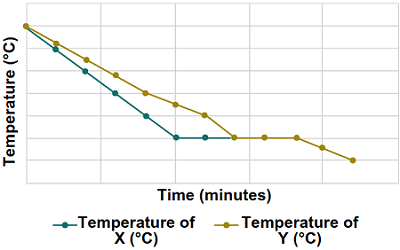
Which of the following statements correctly describes the two liquids?
Answer: (b) X has a higher specific latent heat of fusion than Y
| Topic | Quiz |
|---|---|
| Acids, Bases and Salts | Quiz on Acids, Bases and Salts |
| Calorimetry | Quiz on Calorimetry |
| Chemical Reactions, Mole Concept and Stoichiometry | Quiz on Chemical Reactions, Mole Concept and Stoichiometry |
| Current Electricity and Electromagnetism | Quiz on Current Electricity and Electromagnetism |
| Energy Sources and Ecosystem | Quiz on Energy Sources and Ecosystem |
| Cell and Fundamentals of Genetics and Heredity | Quiz on Cell and Fundamentals of Genetics and Heredity |
| Life Processes, Control and Coordination | Quiz on Life Processes, Control and Coordination |
| Machines | Quiz on Machines |
| Optics and Spectrum | Quiz on Optics and Spectrum |
| Organic Chemistry | Quiz on Organic Chemistry |
| Periodicity in Properties of Elements and Metallurgy | Quiz on Periodicity in Properties of Elements and Metallurgy |
| Reproduction in Organisms | Quiz on Reproduction in Organisms |