Optics is the branch of physics that deals with the study of light and its interactions with matter. Light can be reflected, refracted, and dispersed. A spectrum is a band of colors that is formed when white light is dispersed with a prism. The study of Optics and spectra helps us know how lenses and mirrors produce images. Through this well-curated Quiz on Optics and Spectrum for Grade 10, you will also test your knowledge regarding the properties of light, the formation of a rainbow, and how optical instruments like microscopes, telescopes, and cameras work. Test your understanding of optics and the spectrum of light with these 10 questions.
If a person with uncorrected myopia tries to watch a distant object, what changes occur in their eye to attempt to focus?
Answer: (c) The lens remains highly curved, causing excessive convergence of light.
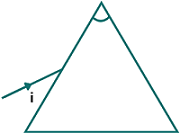
A ray of light is incident at an angle of 45° on one face of a prism angle of 30° (n = √2). If the light exits normally from the other face of the prism, what is the angle of deviation?
Answer: (b) 15°
A convex and a concave lens are kept in contact, forming a lens system with a focal length of 40 cm. If the magnitudes of their powers are in the ratio 3:2, what are the focal lengths of the individual lenses?
Answer: (d) 13.3 cm, -20 cm
A thin convex lens of focal length 15 cm is placed 5 cm away from a concave lens of focal length 30 cm. If a parallel beam of light is incident on the convex lens, where will the final image be formed?
Answer: (b) 15 cm behind the concave lens
A ray of light enters a 45°-90°-45° prism perpendicularly at one face and undergoes total internal reflection inside the prism. If the refractive index of the material is 2, what is the minimum angle of incidence for total internal reflection inside the prism?
Answer: (b) 45°
A convex lens forms an image three times the size of the object. If the focal length of the lens is 20 cm, what is the object distance?
Answer: (c) 13.34 cm
The absolute index of refraction for a substance is 2.0 for light having a wavelength of 5.9 × 10⁻⁷ metre. In this substance, what is the critical angle for light incident on a boundary with air?
Answer: (a) 30°
A mirror is tilted by 15° from its initial position while keeping the incident ray direction unchanged. If the angle of incidence before tilting was 25°, what is the total deviation of the reflected ray from its original direction?
Answer: (a) 30°
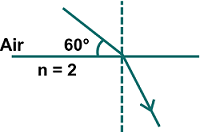
A ray of light travels from air into a glass block as shown. It makes an angle of 60o with the surface of the block. If the refractive index of the glass is 2, what is the angle of refraction?
Answer: (a) 14.5°
Assertion (A): A concave mirror can never form an image smaller than the object. Reason (R): The magnification of a concave mirror is always greater than or equal to 1. Choose the correct option:
Answer: (d) A is false, and R is false.
| Topic | Quiz |
|---|---|
| Acids, Bases and Salts | Quiz on Acids, Bases and Salts |
| Calorimetry | Quiz on Calorimetry |
| Chemical Reactions, Mole Concept and Stoichiometry | Quiz on Chemical Reactions, Mole Concept and Stoichiometry |
| Current Electricity and Electromagnetism | Quiz on Current Electricity and Electromagnetism |
| Energy Sources and Ecosystem | Quiz on Energy Sources and Ecosystem |
| Cell and Fundamentals of Genetics and Heredity | Quiz on Cell and Fundamentals of Genetics and Heredity |
| Life Processes, Control and Coordination | Quiz on Life Processes, Control and Coordination |
| Machines | Quiz on Machines |
| Optics and Spectrum | Quiz on Optics and Spectrum |
| Organic Chemistry | Quiz on Organic Chemistry |
| Periodicity in Properties of Elements and Metallurgy | Quiz on Periodicity in Properties of Elements and Metallurgy |
| Reproduction in Organisms | Quiz on Reproduction in Organisms |