Cells are the fundamental components of life and hold varying forms of genetic material. The focus of the field of genetics is on the study of heredity, which is how traits are passed from one generation to the next, specifically from parents to their children. DNA is organized into segments, and each segment is referred to as a gene that is associated with a particular trait. Through this heredity and genetics quiz for Grade 10, students learn that genetic variation, mutations, and inheritance patterns are all linked to the study of cells and genetics. This also covers Mendel's inheritance laws, the structure and function of chromosomes, and DNA's function in trait expression. To evaluate your comprehension of cells, genetics, and heredity, answer the next 10 questions.
Which of the following statements about chromosomes is incorrect? A. Their number is the same in all living organisms. B. They are composed of DNA and proteins. C. They carry hereditary information. D. They are visible only during cell division.
Answer: (a) A only
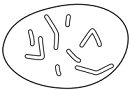
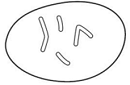
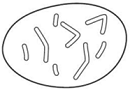
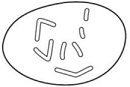
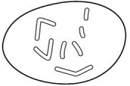
The diagram given below shows the chromosomes in the nucleus of a cell before it divides by mitosis. After mitosis, two daughter cells are formed. Which diagram represents the chromosomes in the nucleus of one of the daughter cells after mitosis?
Answer: (b)
Imagine that a species has 8 chromosomes in its somatic cells. A scientist observes a cell of this species undergoing meiosis. What will be the chromosome number in each gamete after meiosis?
Answer: (d) 4
Mutations always lead to harmful changes in an organism's traits. Which of the following best evaluates this statement?
Answer: (c) False, mutations can be neutral, beneficial, or harmful.
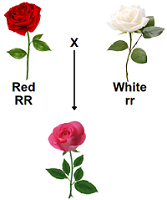
In an experiment, a student crossed a red flower plant (RR) with a white flower plant (rr). The offspring were all pink. What does this outcome suggest about the inheritance pattern?
Answer: (b) Incomplete dominance
In humans, blood type is determined by multiple alleles (A, B, O). A person with type AB blood inherits one allele from each parent. This inheritance pattern is an example of co-dominance, where both A and B alleles are equally expressed. Which of the following pairs of parents could produce a child with blood type AB? A. Type A and Type B B. Type AB and Type O C. Type O and Type O
Answer: (a) A only
Vitamin D-resistant rickets (hypophosphatemia) is inherited as an X-linked dominant trait. If a man with hypophosphatemia has children with a healthy woman, which of the following would be true about their children? A. All daughters will inherit the disease. B. None of the sons will inherit the disease. C. Both sons and daughters have a 50% chance of inheriting the disease. D. None of the children will inherit the disease.
Answer: (b) A and B only
Match the evolutionary evidence with its description: Evidence Description A. Fossil records 1 Similar structures in embryos. B. Comparative anatomy 2 Distribution of species across continents. C. Embryology 3 Study of ancient organisms. D. Biogeography 4 Homologous and analogous organs.
Answer: (c) A-3, B-4, C-1, D-2
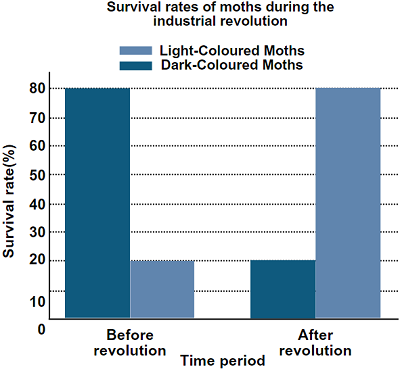
The graph below shows the survival rates of moths during the Industrial Revolution. Before the revolution, light-coloured moths were common due to their ability to blend with light tree bark. After pollution darkened the bark, dark-coloured moths became more common. Which mechanism is illustrated by this pattern?
Answer: (b) Directional selection
A scientist conducted an experiment where he introduced insects into a new environment with fewer predators. After 20 generations, the insects displayed brighter colours. What does this suggest?
Answer: (d) Brighter colours are an adaptation for attracting mates.
| Topic | Quiz |
|---|---|
| Acids, Bases and Salts | Quiz on Acids, Bases and Salts |
| Calorimetry | Quiz on Calorimetry |
| Chemical Reactions, Mole Concept and Stoichiometry | Quiz on Chemical Reactions, Mole Concept and Stoichiometry |
| Current Electricity and Electromagnetism | Quiz on Current Electricity and Electromagnetism |
| Energy Sources and Ecosystem | Quiz on Energy Sources and Ecosystem |
| Cell and Fundamentals of Genetics and Heredity | Quiz on Cell and Fundamentals of Genetics and Heredity |
| Life Processes, Control and Coordination | Quiz on Life Processes, Control and Coordination |
| Machines | Quiz on Machines |
| Optics and Spectrum | Quiz on Optics and Spectrum |
| Organic Chemistry | Quiz on Organic Chemistry |
| Periodicity in Properties of Elements and Metallurgy | Quiz on Periodicity in Properties of Elements and Metallurgy |
| Reproduction in Organisms | Quiz on Reproduction in Organisms |