All acids have a total hydrogen ion concentration of 1 or more and have a sour taste. The bitter taste is attributed to bases. Salts can be formed by and are generally used to neutralise acids and bases. The attributes of acids, bases, and salts and their neutralisation reactions allow for a greater understanding of their chemical properties and interactions. By solving this acid-base and salts Grade 10 quiz, students will get insight into pH, chemical properties of common indicators, and the overall use of these chemicals, including the salts, in a household, a lab, and an industry. To test your understanding, complete this acids, bases, and salts quiz and know how much you know about the depth and concept of these three.
Consider the following statements: I. A strong acid in aqueous solution dissociates completely into ions. II. A weak acid in aqueous solution has a higher pH than an equally concentrated strong acid. III. Both strong and weak acids, when diluted significantly, can have pH values closer to 7. Which combination of statements is correct?
Answer: (d) I, II, and III
Which of the following statements best describes the role of water in determining the strength of an acid?
Answer: (b) Water facilitates the dissociation of acids, releasing H⁺ ions.
Consider the following statements about the neutralisation process: 1. A strong acid neutralising a weak base always produces a neutral solution. 2. Heat is always released during neutralisation. 3. The pH of the resulting solution depends on the strength of the acid and base. 4. Salt formation occurs only when the base is in excess. Which of the above statements are correct?
Answer: (a) 2 and 3
A patient with indigestion consumes a tablet containing magnesium hydroxide, which neutralises stomach acid (HCl). If 0.5 moles of HCl are present in the stomach, how many moles of Mg(OH)₂ are required to neutralise it completely?
Answer: (d) 0.25 moles
A farmer notices that applying a particular fertiliser (containing ammonium chloride) makes the soil more acidic. In contrast, using a fertiliser containing calcium nitrate keeps the soil closer to neutral. Which reasoning best explains this difference?
Answer: (c) Ammonium ions from ammonium chloride are hydrolysed to release H⁺, lowering pH.
A student is given several compounds and asked to identify which one can act as both an acid and a base (amphiprotic). Which of the following compounds is amphiprotic?
Answer: (b) HCO3-
A student is analysing the acidity of three compounds whose structures are shown in the figure given below. The student is asked to arrange the compounds in order of decreasing acidity. Which of the following is correct?
Answer: (a) C > B > A
A student is testing an unknown solution using various indicators to determine whether it is acidic or basic. The following observations are recorded: Observation 1: The solution turns red when methyl red is added. Observation 2: The solution turns clear when phenolphthalein is added. Observation 3: The solution turns blue litmus paper red. Observation 4: The solution turns blue when bromothymol blue is added. Which of these observations is inconsistent with the rest of the observations?
Answer: (d) Observation 4
In a lab, a student adds 25.0 cm³ of 0.1 M HCl to a beaker. They slowly add 0.1 M NaOH from a burette until they reach neutral pH. They record the volume of NaOH used as 25.0 cm³. Next, they repeat the experiment with 25.0 cm³ of the same HCl but add 0.1 M Ca(OH)₂ instead. Assume complete dissociation and no side reactions. Approximately how much 0.1 M Ca(OH)₂ solution would be required to neutralise 25.0 cm³ of 0.1 M HCl to a neutral pH?
Answer: (c) 12.5 cm³
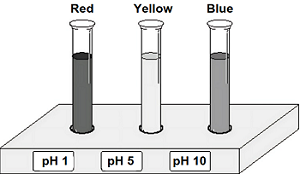
A student adds an indicator to three solutions with different pH values and records the observations shown in the diagram below. The student needs to identify the indicator based on its colour changes across pH. Which of the following indicators could it be?
Answer: (a) Thymol blue
| Topic | Quiz |
|---|---|
| Acids, Bases and Salts | Quiz on Acids, Bases and Salts |
| Calorimetry | Quiz on Calorimetry |
| Chemical Reactions, Mole Concept and Stoichiometry | Quiz on Chemical Reactions, Mole Concept and Stoichiometry |
| Current Electricity and Electromagnetism | Quiz on Current Electricity and Electromagnetism |
| Energy Sources and Ecosystem | Quiz on Energy Sources and Ecosystem |
| Cell and Fundamentals of Genetics and Heredity | Quiz on Cell and Fundamentals of Genetics and Heredity |
| Life Processes, Control and Coordination | Quiz on Life Processes, Control and Coordination |
| Machines | Quiz on Machines |
| Optics and Spectrum | Quiz on Optics and Spectrum |
| Organic Chemistry | Quiz on Organic Chemistry |
| Periodicity in Properties of Elements and Metallurgy | Quiz on Periodicity in Properties of Elements and Metallurgy |
| Reproduction in Organisms | Quiz on Reproduction in Organisms |