Energy sources consist of renewable, such as solar and wind, and non-renewable, for example, coal and petroleum. An ecosystem consists of a biotic community and the interacting physical, chemical, and biological components of its environment. Energy in an ecosystem is transferred through food chains and food webs. Learning about energy sources as well as ecosystems through this well-curated Quiz on Energy and Ecosystem for Grade 10, and the impact of energy utilization on the environment. The quiz also highlights the need to protect ecosystems. Assess your understanding of energy sources and ecosystems with this 10-question quiz.
In a pond environment, various interactions occur among living organisms (such as fish, plants, and microorganisms) and non-living factors (such as water, sunlight, and temperature). Which term best describes all these interactions combined, encompassing both biotic and abiotic components?
Answer: (a) Ecosystem
A city located near the coastline observed increased flooding during the monsoon season, which coincided with rapid urbanisation. Scientists identified reduced green cover, higher impervious surfaces, and sand mining in nearby rivers as major contributors. Which abiotic factor has been most affected by these activities?
Answer: (d) Water cycle regulation
Mangroves are known to stabilise coastal ecosystems. A coastal area with mangroves is cleared for urban development. Over time, the area experiences: - Increased coastal erosion - Higher flood vulnerability - Decline in marine species diversity Which combination of biological, geological, and chemical processes is disrupted by the loss of mangroves?
Answer: (b) Nutrient cycling, wave energy absorption, and carbon storage
A scientist introduces radioactive carbon into the producers of a food web. After a few weeks, radioactive material is detected in top predators. What conclusion can be drawn?
Answer: (d) Energy flow is unidirectional and traceable.
A freshwater lake is surrounded by agricultural fields and a growing urban area. Over time, residents notice the following changes: - Increase in algal blooms - Decline in fish populations - Emergence of invasive aquatic plants Which sequence of processes best explains these changes?
Answer: (c) Fertiliser runoff increases nitrates → algal blooms block sunlight → oxygen levels drop → fish die
Age structure diagrams provide insights into the distribution of a population's age groups, which helps determine growth patterns. Using this information, identify which diagram given below (A, B, C, D) represents the population experiencing the fastest growth.
Answer: (b)
Match the energy sources with their disadvantages: Energy Source Disadvantage A. Fossil Fuels 1 Produces greenhouse gases B. Wind Energy 2 Intermittent and location-dependent C. Geothermal Energy 3 Limited to tectonically active zones D. Solar Energy 4 Requires large land areas for farms
Answer: (a) A-1, B-2, C-3, D-4
A city is exploring bioenergy as a waste management solution. The waste available includes organic kitchen scraps, plastic, and paper. Which waste type would be most suitable for bioenergy production through anaerobic digestion, and why?
Answer: (d) Kitchen scraps
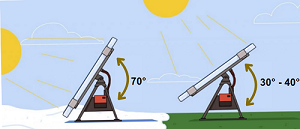
A student conducts an experiment comparing the energy output of solar panels placed at different angles to sunlight. What should they measure to determine the best angle?
Answer: (c) Voltage output of the panels
Rank the following locations in terms of their suitability for wind energy generation (best to worst): 1. Coastal areas 2. Urban areas 3. Open plains 4. Forested regions
Answer: (c) 1 → 3 → 2 → 4
| Topic | Quiz |
|---|---|
| Acids, Bases and Salts | Quiz on Acids, Bases and Salts |
| Calorimetry | Quiz on Calorimetry |
| Chemical Reactions, Mole Concept and Stoichiometry | Quiz on Chemical Reactions, Mole Concept and Stoichiometry |
| Current Electricity and Electromagnetism | Quiz on Current Electricity and Electromagnetism |
| Energy Sources and Ecosystem | Quiz on Energy Sources and Ecosystem |
| Cell and Fundamentals of Genetics and Heredity | Quiz on Cell and Fundamentals of Genetics and Heredity |
| Life Processes, Control and Coordination | Quiz on Life Processes, Control and Coordination |
| Machines | Quiz on Machines |
| Optics and Spectrum | Quiz on Optics and Spectrum |
| Organic Chemistry | Quiz on Organic Chemistry |
| Periodicity in Properties of Elements and Metallurgy | Quiz on Periodicity in Properties of Elements and Metallurgy |
| Reproduction in Organisms | Quiz on Reproduction in Organisms |