Work is said to be done if a force moves an object through a distance. Energy is the ability or strength to do work; it comes in numerous forms: kinetic energy, potential energy, sound energy, and so on. Sound is a type of energy that is produced by vibrations. The concept of work, energy, and sound gives an insight into the mechanics and wave motion. Test your knowledge by solving this Work, Energy, and Sound Quiz for Grade 9. It also elaborates the law of conservation of energy, the calculation of work and power, and the characteristics of sound waves, including frequency, amplitude, and wavelength. Here are 10 questions to test your knowledge about work, energy, and sound.
A ball is thrown vertically upward with a force of 50 N. What is the work done by the gravitational force during the upward motion of the ball?
Answer: (c) Negative
A rock is thrown straight up with an initial velocity. At the highest point, which of the following is true about the work done by gravity?
Answer: (c) Work done is negative
If a sound wave has a wavelength of 2 m and a frequency of 500 Hz, what is its speed?
Answer: (d) 1000 m/s
The intensity of a sound wave is inversely proportional to the square of the distance from the source. If the distance from the sound source is doubled, what happens to the intensity of the sound?
Answer: (d) It becomes one-quarter as strong.
A box is being dragged across a rough floor with a constant velocity by applying a force of 100 N forward. If the frictional force opposing the motion is also 100 N, what is the work done by friction after moving the box for 5 meters?
Answer: (b) -500 J
Assertion (A): A ball thrown upward has negative work done by gravity. Reason (R): The force due to gravity acts downward, opposite to the displacement of the ball. Choose the correct option:
Answer: (a) Both A and R are true, and R is the correct explanation of A
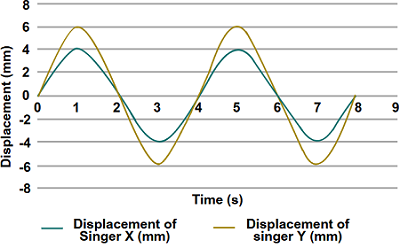
A sound analysis software records the voices of two singers, Singer X and Singer Y, while they sustain a single note. Their wave properties are recorded below: Which singer’s voice would sound louder, and why?
Answer: (a) Singer X, because the amplitude is larger, indicating higher loudness
A student plots two sound waves traveling through air and water on the same graph. The wave in water has a shorter wavelength but the same frequency as the wave in air. Which conclusion can be drawn from this graph?
Answer: (c) The speed of sound in water is greater than in air
A 30 kg object slides down a rough incline of 5 m length at an angle of 60°. If the coefficient of friction is 0.5, what is the work done by friction?
Answer: (b) -375 J
A tuning fork produces a sound of frequency 512 Hz. The sound travels through two rooms: Room 1 is at 0°C. Room 2 is at 30°C. What happens to the wavelength of the sound wave when it moves from Room 1 to Room 2?
Answer: (a) It increases because speed of sound increases
| Topic | Quiz |
|---|---|
| Atomic Structure and Models | Quiz on Atomic Structure and Models |
| Biodiversity in Nature | Quiz on Biodiversity in Nature |
| The Cell - Basic Building Block of Life | Quiz on The Cell - Basic Building Block of Life |
| Biogeochemical Cycles in Ecosystems | Quiz on Biogeochemical Cycles in Ecosystems |
| Gravitational Phenomena | Quiz on Gravitational Phenomena |
| Human Health | Quiz on Human Health |
| Kinematics | Quiz on Kinematics |
| Matter in Various States | Quiz on Matter in Various States |
| Reproductive Biology - Plants | Quiz on Reproductive Biology - Plants |
| Purity and Composition | Quiz on Purity and Composition |
| Tissue Dynamics | Quiz on Tissue Dynamics |
| Work, Energy and Sound | Quiz on Work, Energy and Sound |