Health is a term that means that no problems of a physical, mental, or social nature are experienced. Human life in a healthy way can be influenced negatively as well as positively by factors like food, sports, hygiene, and lifestyle. Some of the factors that can lead to diseases and health disorders such as microorganisms, heredity, or the environment. A health topic will be a means of knowing more about how to keep the body fit and the mind healthy. The Human Health Quiz for Grade 9 will check how much you know about the immune system, disease causation, prevention, hygiene, and the importance of diet, exercise, and rest. So, test your knowledge by taking the 10-question quiz on human health that is provided.
When a pathogen enters the body, the immune system responds by producing specific proteins to target and neutralise it. Which of the following are proteins or molecules directly involved in the immune response to pathogens?
Answer: (a) Antibody
A patient presents to the clinic with symptoms of a common cold caused by a viral infection. The physician explains that antibiotics will not be effective. Which of the following reasons best supports this explanation?
Answer: (a) Viruses lack a cell wall that can be targeted by antibiotics.
In a laboratory experiment, researchers isolate macrophages from a mouse model. They expose these macrophages to a bacterial pathogen. What is the primary role of macrophages in this scenario?
Answer: (d) Directly kill the bacteria through phagocytosis
In the following question, you will find an assertion and a reason. Select the appropriate option that applies. Assertion (A): Vector-borne diseases can be transmitted through organisms such as mosquitoes and ticks. Reasoning (R): Vectors serve as reservoirs for pathogens, providing an environment that facilitates their growth and multiplication before transmission to humans.
Answer: (a) Both A and R are true, and R is the correct explanation for A.
An outbreak of amoebic dysentery caused by Entamoeba histolytica has been reported in a densely populated urban area. Local health authorities are concerned about the rapid spread of the disease, particularly in areas with poor sanitation. Which of the following public health measures would be most effective in controlling the outbreak?
Answer: (a) Increasing access to clean water and improving sanitation facilities.
A 35-year-old man works a desk job and consumes a diet high in processed foods. He rarely exercises. After a health screening, his doctor informs him that he is at risk of metabolic syndrome. Which lifestyle change is most likely to have the greatest impact in reducing his risk?
Answer: (b) Limiting sugar and processed food intake while increasing physical activity
A study compared two groups of adolescents: Group A consumed a balanced diet including fruits, vegetables, and whole grains, while Group B consumed a diet high in processed foods and sugars. After six months, Group A showed lower levels of fatigue and higher concentration levels in school than Group B. What hypothesis can be best supported by this data?
Answer: (c) A balanced diet enhances energy levels and cognitive function in adolescents.
A study was conducted to analyse the effects of different types of immunity on patients exposed to a specific virus. The following data were collected regarding two groups of patients. Based on this data, which of the following statements accurately describes the differences between passive and active immunity? Groups Types of immunity Method of administration Time to effect Reduction in infection A Passive Antibodies Within hours 90% reduction within 24 hours B Active Vaccination Two weeks 70% reduction within one week
Answer: (b) Passive immunity provides immediate protection but is short-lived, while active immunity takes time to develop but offers long-lasting protection.
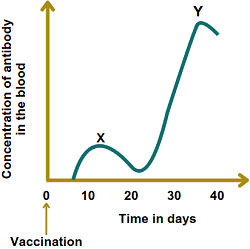
The graph shows the concentration of antibodies in the blood over time following a vaccination. After an initial increase in antibody concentration, marked as point X, there is a slight decline before a more substantial increase at point Y. This pattern illustrates the body’s immune response to vaccination over a period of days. Based on your understanding, answer the following question. Why does the antibody concentration drop slightly after reaching point X?
Answer: (d) The body recognises there’s no immediate threat and reduces antibody production.
Carefully read through the passage given below and answer the following questions. Principles of Disease Treatment and Prevention Disease treatment and prevention are crucial aspects of maintaining public health and individual well-being. Treatment aims to reduce or eliminate disease symptoms, often through medication, surgery, or therapy. Antibiotics, for example, are a common treatment for bacterial infections, while antivirals can target specific viruses. It's important to note that antibiotics cannot treat viral infections, highlighting the need for precise treatment approaches based on the disease type. Prevention, on the other hand, focuses on stopping disease before it occurs. Vaccination is a key preventive measure, as vaccines help the immune system recognize and fight specific pathogens before they can cause illness. Other preventive methods include hygiene practices, like regular handwashing and using clean water, which reduce exposure to harmful microbes. For some chronic diseases, like heart disease or diabetes, prevention includes lifestyle changes, such as a balanced diet and regular exercise. Together, effective treatment and preventive strategies play vital roles in controlling the spread of diseases and promoting health across populations. Despite the availability of vaccines, some communities still experience outbreaks of vaccine-preventable diseases. Which reasoning best explains this phenomenon?
Answer: (c) Incomplete vaccination coverage reduces herd immunity in the population.
| Topic | Quiz |
|---|---|
| Atomic Structure and Models | Quiz on Atomic Structure and Models |
| Biodiversity in Nature | Quiz on Biodiversity in Nature |
| The Cell - Basic Building Block of Life | Quiz on The Cell - Basic Building Block of Life |
| Biogeochemical Cycles in Ecosystems | Quiz on Biogeochemical Cycles in Ecosystems |
| Gravitational Phenomena | Quiz on Gravitational Phenomena |
| Human Health | Quiz on Human Health |
| Kinematics | Quiz on Kinematics |
| Matter in Various States | Quiz on Matter in Various States |
| Reproductive Biology - Plants | Quiz on Reproductive Biology - Plants |
| Purity and Composition | Quiz on Purity and Composition |
| Tissue Dynamics | Quiz on Tissue Dynamics |
| Work, Energy and Sound | Quiz on Work, Energy and Sound |