The study of the reproduction of plants is reproductive biology. Plants can reproduce sexually - needing the fusion of male and female gametes - or asexually - not needing gametes. Flowers are the most recognized reproductive organs of plants. In studying plant reproductive biology, we're studying pollination, fertilisation, seed formation, and fruit production. Solving this Plant Reproduction Quiz for Grade 9 tests about types of reproduction and the advantages associated with them. To assess your knowledge of plant reproductive biology, please answer the following 10 questions.
In terms of reproductive strategy, how does a plant benefit from having a large number of stamens in its flowers?
Answer: (c) It enhances the likelihood of pollen transfer to pollinators.
Which of the following is the gametophyte stage of a fern?
Answer: (b)
A student reading about floral anatomy learns that the androecium can vary significantly among plant species, from a single stamen to many. What could be a conceptual explanation for this variation?
Answer: (a) Evolutionary adaptation to different pollination strategies
A plant breeder uses a method to ensure all genetic material in a crop retains specific desirable traits. Which method focuses solely on preserving these traits without genetic variability?
Answer: (d) Cloning through tissue culture
In gymnosperms, what adaptation reduces the dependence on water for fertilisation during the transition from the gametophytic to the sporophytic phase? A. Development of seeds that protect and nourish the embryo. B. Development of pollen grains. C. Presence of flagellated male gamete
Answer: (b) A and B only
Consider the environmental conditions necessary for the successful germination of seeds. Which combination of the following chemicals is essential for a seed to germinate and begin its growth process? I. Water II. Carbon dioxide III. Oxygen
Answer: (b) I and III only
Column A lists various plant characteristics, and Column B lists potential abiotic factors influencing these characteristics in the context of reproductive success. Match the plant characteristics from Column A with the most influential abiotic factors from Column B that could affect their reproductive outcomes. Column A Column B 1 Flowering time A. Wind speed 2 Seed dispersal mechanism B. Temperature 3 Pollination efficiency C. Soil moisture 4 Germination rate D. Light intensity
Answer: (d) 1: B, 2: A, 3: D, 4: C
Why do some plants produce seeds that are enclosed in fruits, while others produce seeds without any protective covering?
Answer: (a) Enclosed seeds ensure better dispersal by animals, while uncovered seeds rely on wind or water.
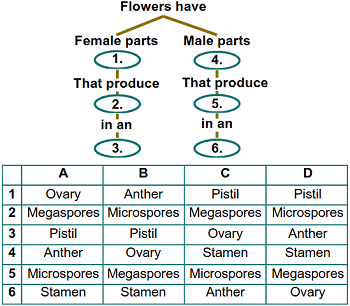
Review the incomplete concept map below. Study the provided table and choose the option that best completes the map.
Answer: (c) C
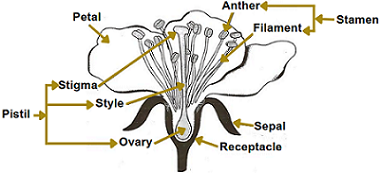
Carefully read through the passage given below and answer the following questions. Understanding Complete and Incomplete Flowers Flowers are the reproductive structures of angiosperms or flowering plants. A key distinction among them is whether they are complete or incomplete. A complete flower contains all four major floral organs: sepals, petals, stamens, and pistils. Sepals protect the developing bud, petals attract pollinators with their colour and scent, stamens produce pollen as the male reproductive parts, and pistils (or carpels) house the ovary as the female reproductive parts. An incomplete flower is missing one or more of these structures. For instance, many grasses have flowers that lack petals and sepals, relying on wind rather than insects for pollination. Additionally, flowers are classified as perfect or imperfect based on their reproductive organs. Perfect flowers contain both stamens and pistils, while imperfect flowers lack either the male or female parts. It's important to note that all complete flowers are perfect, but incomplete flowers can be either perfect or imperfect depending on which parts are absent. Understanding these distinctions is crucial in botany and agriculture, as they affect pollination methods and plant breeding strategies. Which of the following is an example of an imperfect flower?
Answer: (c) Corn
| Topic | Quiz |
|---|---|
| Atomic Structure and Models | Quiz on Atomic Structure and Models |
| Biodiversity in Nature | Quiz on Biodiversity in Nature |
| The Cell - Basic Building Block of Life | Quiz on The Cell - Basic Building Block of Life |
| Biogeochemical Cycles in Ecosystems | Quiz on Biogeochemical Cycles in Ecosystems |
| Gravitational Phenomena | Quiz on Gravitational Phenomena |
| Human Health | Quiz on Human Health |
| Kinematics | Quiz on Kinematics |
| Matter in Various States | Quiz on Matter in Various States |
| Reproductive Biology - Plants | Quiz on Reproductive Biology - Plants |
| Purity and Composition | Quiz on Purity and Composition |
| Tissue Dynamics | Quiz on Tissue Dynamics |
| Work, Energy and Sound | Quiz on Work, Energy and Sound |