Tissues consist of similar cells that have the same function and work together. The plant tissues are, for example, meristematic and permanent tissues. Animal tissues have four types: epithelial, connective, muscular, and nervous tissues. Knowledge of tissue dynamics clarifies the mechanisms of how cells are organized into tissues and how tissues are the building blocks of organs. This Tissue Dynamics Quiz for Grade 9 tests your knowledge regarding the heterogeneous nature of tissues regarding their structure, function, and their contribution to life processes. Attempt this quiz with 10 questions to assess your comprehension of tissue dynamics in plants as well as animals.
Based on the diagram of complex permanent tissues, which statement best explains the structural adaptations of xylem and phloem that facilitate their functions in plants?
Answer: (d) Vessel elements in xylem allow efficient water transport; companion cells in phloem aid nutrient transport.
Match column I with column II: Column I Column II 1 Simple squamous epithelium A Found in the kidney tubules and is responsible for the absorption and secretion 2 Stratified squamous epithelium B Provides a protective lining in areas of high friction, such as the skin 3 Simple cuboidal epithelium C Facilitates gas exchange in the lungs and lines blood vessels 4 Simple Columnar epithelium D Lines the digestive tract and is involved in absorption and secretion
Answer: (a) 1-C, 2-B, 3-A, 4-D
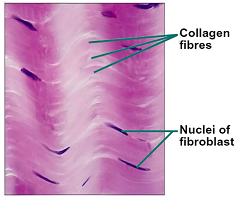
The image below shows a cross-section of a tissue, highlighting different structures within the tissue (fibres, cells, and extracellular matrix). Based on the image, identify the correct function of the connective tissue type depicted.
Answer: (a) Provides structural support and elasticity, allowing organs to withstand stretching.
In cancer research, tissue culture is extensively used to study tumour cells. Which of the following are benefits of using tissue culture in the development of cancer treatments?
Answer: (d) Allows testing drug effects on live tumour cells.
In the following question, you will find an assertion and a reason. Select the appropriate option that applies. Assertion (A): Stem cells have the potential to differentiate into various types of animal tissues and are used in regenerative medicine. Reason (R): Stem cells are undifferentiated cells that can divide and develop into specialised cell types, including muscle, nerve, and epithelial tissues.
Answer: (a) Both A and R are true, and R is the correct explanation of A.
A new drug is tested that enhances the healing properties of connective tissue. Which of the following roles of connective tissue might this drug most likely improve?
Answer: (b) Supporting and connecting other tissues and organs.
A plant leaf cross-section shows the following layers: Layer P: Waxy cuticle Layer Q: Palisade mesophyll Layer R: Spongy mesophyll Layer S: Lower epidermis with stomata Which layer primarily facilitates gas exchange?
Answer: (b) Layer R
A recent study explored various applications of tissue culture in medicine, including: 1. Regeneration of tissues for transplants. 2. Testing new drugs on living cells. 3. Culturing tumour cells for cancer research. 4. Growing viruses for vaccine production. Which application is most directly associated with advancing personalised medicine?
Answer: (c) Testing new drugs
In a recent experiment, researchers aimed to study the role of different meristematic tissues in plant growth by applying various treatments to three identical plants. Each treatment targeted a specific type of meristematic tissue, leading to distinct observations regarding growth patterns. The results provided in the table given below highlight the functions of apical, lateral, and intercalary meristems in plant development. Answer the following question based on the information provided. In the experiment, Plant B was girdled, removing the lateral meristem. Which of the following processes would be most affected by this treatment? Plant Treatment Affected Meristematic Tissue Observations After Several Weeks Plant A The tip of the shoot was cut off. Apical meristem No increase in height; developed more lateral branches. Plant B The stem was girdled (removing a strip of bark). Lateral meristem No significant increase in girth; continued growing in height. Plant C A section from the middle of the stem was removed. Intercalary meristem Continued growing in length; rapid regeneration in the cut section.
Answer: (c) Secondary growth (increase in girth)
Carefully read through the passage and answer the following questions. Understanding Animal Tissues and Their Functions Animal tissues work together to keep the body functioning smoothly. Each type plays a vital role in maintaining health and survival. Epithelial tissue forms tightly packed layers that act as a protective barrier for organs like the skin. Its ability to heal quickly helps repair injuries and maintain the body's defences against external harm. Muscle tissue is responsible for movement. It can contract and relax on its own, which is crucial for functions such as making the heartbeat and moving the body. Nervous tissue sends electrical messages throughout the body, enabling communication and quick responses to stimuli. However, unlike epithelial tissue, nervous tissue cannot repair itself after damage, making recovery from injuries like brain or spinal cord damage challenging. Together, these tissues protect the body, allow movement, and ensure internal communication for survival. If the nervous tissue in the experiment is unable to regenerate after being damaged, which part of the nervous system is most likely being studied?
Answer: (a) The brain and spinal cord
| Topic | Quiz |
|---|---|
| Atomic Structure and Models | Quiz on Atomic Structure and Models |
| Biodiversity in Nature | Quiz on Biodiversity in Nature |
| The Cell - Basic Building Block of Life | Quiz on The Cell - Basic Building Block of Life |
| Biogeochemical Cycles in Ecosystems | Quiz on Biogeochemical Cycles in Ecosystems |
| Gravitational Phenomena | Quiz on Gravitational Phenomena |
| Human Health | Quiz on Human Health |
| Kinematics | Quiz on Kinematics |
| Matter in Various States | Quiz on Matter in Various States |
| Reproductive Biology - Plants | Quiz on Reproductive Biology - Plants |
| Purity and Composition | Quiz on Purity and Composition |
| Tissue Dynamics | Quiz on Tissue Dynamics |
| Work, Energy and Sound | Quiz on Work, Energy and Sound |