Kinematics belongs to physics and is the area that considers the motion of objects exclusively without taking into account the forces responsible for the motion. The branch is concerned with displacement, velocity, acceleration, and the equations that govern motion. Pictures and graphs are used as tools to illustrate motion. Understanding kinematics makes it possible for us to analyze and depict the motion of objects with great precision. Kinematic Quiz for Grade 9 also gives us the skills to tackle numerical questions concerning motion, and also be able to interpret the graphic representations of distance, speed, and time. Answering these 10 questions will help you assess your knowledge of kinematics and motion analysis.
In the context of object motion and kinematics, which of the following statements best represents a contradiction in motion principles?
Answer: (d) An object accelerates uniformly while maintaining a constant velocity.
If a car travels 6.0 km at a constant speed of 50 km/h, and then travels another 6.0 km at a constant speed of 60 km/h, calculate the total time taken for the entire journey.
Answer: (d) 13.2 minutes
If two objects are dropped from the same height in a vacuum, one a second after the other, what will be the relation in their speed difference with time?
Answer: (b) The speed difference remains constant.
A train with an initial speed passes a station and decelerates at a constant rate to halt at the next station. Suppose the deceleration process is modified to occur over twice the distance while maintaining the same initial speed. How would the magnitude of constant acceleration change?
Answer: (c) The acceleration would halve
A driver embarks on an 864 km trip that must be completed in 10 hours to attend a scheduled meeting. The vehicle travels at a constant speed of 96 km/h. If the driver stops for a 1-hour meal break during the journey, will the meeting schedule be missed?
Answer: (d) The driver will arrive exactly on time.
A ball is thrown vertically downward from a height of 40 m above the ground with an initial velocity of 10 m/s. Assuming no air resistance and taking acceleration due to gravity as 10 m/s², calculate the exact time it takes for the ball to reach the ground.
Answer: (a) 2 s
If the acceleration-time graph of an object is below the time axis, which statement is true?
Answer: (b) The object is slowing down.
If the acceleration-time graph of a body is a straight line sloping downward and passing through the time axis, what happens to the body?
Answer: (d) The body comes to rest and reverses direction.
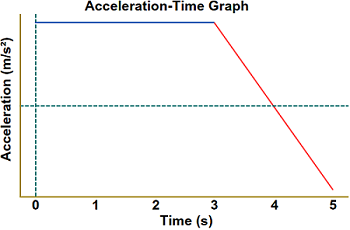
An object has a constant positive acceleration for 3s, followed by constant negative acceleration for 2 s, as shown in the acceleration-time graph. If the area under the positive portion is 15 m/s and under the negative portion is -10 m/s, what is the net change in velocity?
Answer: (a) 5 m/s
When a golf ball is hit off a tee, it will experience an acceleration of 1000 g’s while the club makes contact with the ball. Typically the club will make contact for 0.00080 seconds. 1. What is the acceleration of the ball ? 2. How fast is the ball traveling when it leaves the club?
Answer: (c) 1 - 10000 m/s2, 2 - 8 m/s
| Topic | Quiz |
|---|---|
| Atomic Structure and Models | Quiz on Atomic Structure and Models |
| Biodiversity in Nature | Quiz on Biodiversity in Nature |
| The Cell - Basic Building Block of Life | Quiz on The Cell - Basic Building Block of Life |
| Biogeochemical Cycles in Ecosystems | Quiz on Biogeochemical Cycles in Ecosystems |
| Gravitational Phenomena | Quiz on Gravitational Phenomena |
| Human Health | Quiz on Human Health |
| Kinematics | Quiz on Kinematics |
| Matter in Various States | Quiz on Matter in Various States |
| Reproductive Biology - Plants | Quiz on Reproductive Biology - Plants |
| Purity and Composition | Quiz on Purity and Composition |
| Tissue Dynamics | Quiz on Tissue Dynamics |
| Work, Energy and Sound | Quiz on Work, Energy and Sound |