Don't miss this free quiz on Physical States and Changes in Matter for UGSO Class 8. Practice now and secure your rank! Try the quiz today.
Imagine a situation where the surrounding air is completely still and stable, with no movement. How would this condition impact the rate of evaporation of a liquid placed in this environment?
Answer: (b) Decrease the rate of evaporation
Louis discovered five unmarked bottles in a science lab, each containing a pure, colourless liquid. To identify these liquids accurately, he measured the following properties: 1. Volume 2. Density 3. Boiling point 4. Mass Which combination of properties should Louis use to correctly identify the substances?
Answer: (c) 2 and 3
A student records the heat required to change the state of two substances (X and Y) under identical conditions. From the table, which inference can be made about the substances? Substance Melting Point (°C) Boiling Point (°C) Observed Heating Time from Solid to Liquid (min) Observed Heating Time from Liquid to Gas (min) X 50 120 10 15 Y 55 160 20 10
Answer: (b) Substance Y likely has a higher latent heat of fusion than X, indicated by its longer melting time.
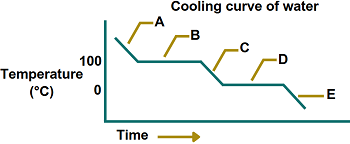
The graph represents the cooling curve of water. What does letter D represent?
Answer: (d) The boiling point/freezing point
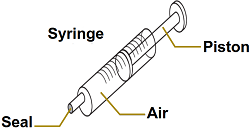
A sealed syringe containing air is compressed by pushing the piston slowly. The air's temperature remains constant during compression. What happens to the pressure of the air inside the syringe as the piston is pushed in? A. The pressure increases because the air particles hit the sides of the syringe more frequently. B. The pressure increases because the air particles have more kinetic energy. C. The pressure increases because the air particles hit the sides of the syringe less frequently.
Answer: (a) A only
A scientist heats 1 kg of a liquid until it fully turns into vapour without changing its temperature. During this process, the energy absorbed per kilogram is measured. Which unit best represents the specific latent heat of vaporisation?
Answer: (c) Joules per kilogram
Which factors affect the boiling point of a liquid? 1. Atmospheric pressure 2. Strength of intermolecular forces 3. The volume of the liquid 4. The purity of the liquid
Answer: (d) 1, 2 and 4
A chef heats 25 kg of milk from 10°C to 130°C using 120,000 J of thermal energy. Based on this, what is the specific heat capacity of the milk?
Answer: (a) 80 J/kg°C
When heated, particles in a solid vibrate more vigorously, causing a slight increase in volume. In liquids, thermal expansion is more noticeable as particles are less tightly bound. In gases, the increase in particle kinetic energy leads to significant expansion due to the minimal forces between particles. Why does thermal expansion in gases occur more prominently than in solids or liquids?
Answer: (a) Gases are highly compressible and have negligible intermolecular forces.
You are designing a cooling system for a spacecraft. Which property of matter would be most critical to consider for selecting the coolant?
Answer: (c) The specific heat capacity of the coolant.
| Topic | Quiz |
|---|---|
| Cell, Life Cycles, Reproduction and Development | Quiz on Cell, Life Cycles, Reproduction and Development |
| Chemical Changes, Combustion and Reactions | Quiz on Chemical Changes, Combustion and Reactions |
| Ecosystem and Environmental Contamination | Quiz on Ecosystem and Environmental Contamination |
| Chemical and Magnetic Effects of Electric Current | Quiz on Chemical and Magnetic Effects of Electric Current |
| Energy Transformation and Transfer | Quiz on Energy Transformation and Transfer |
| Force, Pressure and Friction | Quiz on Force, Pressure and Friction |
| Light and Sound | Quiz on Light and Sound |
| Physical States and Changes in Matter | Quiz on Physical States and Changes in Matter |
| Metals and Non-Metals | Quiz on Metals and Non-Metals |
| Micro-organisms | Quiz on Micro-organisms |
| Earth, Stars and the Solar System | Quiz on Earth, Stars and the Solar System |
| Endocrine System, Hormones and Circulatory Systems in Animals | Quiz on Endocrine System, Hormones and Circulatory Systems in Animals |