
Master Force, Pressure, and Friction with free quiz practice designed for Unicus Global Science Olympiad Class 8. Improve your understanding today! Start the quiz now.
Which of the following correctly explains why mountain climbers carry oxygen tanks?
Answer: (d) The pressure at higher altitudes is less, reducing the oxygen intake.
A brick is placed on a table in three different orientations: lying flat, on its edge, and standing on its end. If the force due to the brick’s weight remains the same, which orientation exerts the greatest pressure on the table?
Answer: (c) Standing on its end
When a basketball player jumps to make a shot, what forces act on the player while they are in the air?
Answer: (c) Both gravitational force downward and air resistance upward.
A heavy book is resting on a table. Which of the following best describes the force of pressure exerted by the book on the table?
Answer: (d) It depends on the weight of the book and the area of contact with the table.
A cyclist applies a 200 N force to a bicycle of mass 20 kg, moving it forward. Suddenly, a 50 N resistive force acts against motion. What is the acceleration of the bicycle?
Answer: (a) 7.5 m/s²
A balloon remains unaffected when pressed with a finger but pops when pricked with a needle. Why?
Answer: (a) The needle applies force over a small area, increasing pressure.
A wooden beam of weight 1500 N has dimensions 2.0 m × 0.5 m × 0.2 m. It is placed on the ground in two different ways: Case 1: The 2.0 m × 0.5 m surface touches the ground. Case 2: The 0.5 m × 0.2 m surface touches the ground. Which of the following is true about the pressure exerted on the ground?
Answer: (b) Pressure in Case 2 is greater than in Case 1
The diagram below shows a dam holding water. The depth of water at point A is 10 m, while at point B it is 30 m. At which point is the water pressure highest, and why?
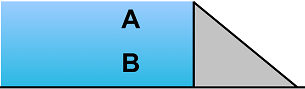
Answer: (b) Point B, because pressure increases with depth
A syringe works when pressed and releases fluid. Assertion (A): A syringe operates using the principles of pressure transmission in liquids. Reason (R): Liquids exert pressure equally in all directions when force is applied. Choose the correct option.
Answer: (a) Both A and R are true, and R explains A
A U-tube contains a liquid with different heights on each side. The left side has a denser liquid, while the right side has a lighter liquid. What happens if more of the lighter liquid is added to the right side?

Answer: (c) The level of the denser liquid on the left will rise
| Topic | Quiz |
|---|---|
| Cell, Life Cycles, Reproduction and Development | Quiz on Cell, Life Cycles, Reproduction and Development |
| Chemical Changes, Combustion and Reactions | Quiz on Chemical Changes, Combustion and Reactions |
| Ecosystem and Environmental Contamination | Quiz on Ecosystem and Environmental Contamination |
| Chemical and Magnetic Effects of Electric Current | Quiz on Chemical and Magnetic Effects of Electric Current |
| Energy Transformation and Transfer | Quiz on Energy Transformation and Transfer |
| Force, Pressure and Friction | Quiz on Force, Pressure and Friction |
| Light and Sound | Quiz on Light and Sound |
| Physical States and Changes in Matter | Quiz on Physical States and Changes in Matter |
| Metals and Non-Metals | Quiz on Metals and Non-Metals |
| Micro-organisms | Quiz on Micro-organisms |
| Earth, Stars and the Solar System | Quiz on Earth, Stars and the Solar System |
| Endocrine System, Hormones and Circulatory Systems in Animals | Quiz on Endocrine System, Hormones and Circulatory Systems in Animals |