Access free quiz practice on Endocrine and Circulatory Systems, vital for the UGSO Class 8. Practice and succeed! Try the quiz today.
Identify the hormone by the given hints: (i) Secreted from pancreas (ii) An antagonist to insulin (iii) Stimulates breakdown of glycogen
Answer: (d) Glucagon
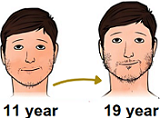
Ana visited her cousin after 8 years and was amazed by how much he had changed. His appearance had transformed significantly over the years, as shown in the picture. This change is the result of:
Answer: (d) adolescence
The circulatory system evolves from simple diffusion in sponges and rotifers for the exchange of nutrients and gases, to more complex systems. Arthropods and many molluscs have open circulatory systems, while active molluscs like squids have developed closed systems to support rapid movement and hunting. Which of the following can we infer from this information? (i) The evolution of the circulatory system is closely linked to the organism's complexity and activity levels. (ii) Adaptive progression towards efficiency in oxygen and nutrient delivery.
Answer: (c) Both (i) and (ii)
One of your friends called to inform you that her uncle was in a serious road accident, resulting in significant blood loss. The doctor recommended a blood transfusion. Since her uncle has blood group AB, he can receive blood from a donor with the blood group: (i) A (ii) B (iii) AB (iv) O
Answer: (d) (i), (ii), (iii) and (iv)
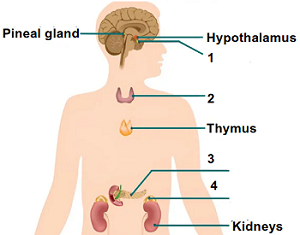
In the given image depicting major endocrine glands in humans, identify which gland (2, 3 and 4) is not directly regulated by gland 1.
Answer: (d) Only 3
Consider the given statements and select the correct option for them. Statement 1(S1): Insect blood does not function in oxygen transport. Statement 2 (S2): Insects have colourless blood.
Answer: (a) Both S1 and S2 are correct.
Read the given table describing the differences between open and closed circulatory system. Which of the following is NOT a main difference between open and closed circulatory systems? Open circulatory system Closed circulatory system (i) blood is pumped into a cavity called a hemocoel blood is kept within blood vessels while it circulates around the body (ii) uses more energy to circulate hemolymph Uses less energy to circulate blood (iii) circulate blood through the system along with interstitial fluid only circulate blood (iv) blood re-enters the heart via ostia Blood re-enters the heart through veins
Answer: (b) (ii)
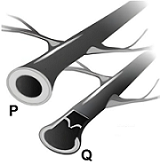
Carefully examine the given structures P and Q. They are blood vessels involved in transporting oxygen and carbon dioxide. Choose the option that correctly identifies them.
Answer: (b) P- artery, Q- vein
Carefully read the given passage and answer the question that follows. Reproductive hormones The gonads, which are the primary reproductive organs, consist of the testes in males and the ovaries in females. These organs produce sperm and ova while also secreting hormones, classifying them as endocrine glands. Male sex hormones, collectively known as androgens, include testosterone as the primary hormone. Testosterone is primarily secreted by the testes, with a small amount also produced by the adrenal cortex. Its production begins during foetal development, continues briefly after birth, decreases during childhood, and resumes at puberty. In females, the ovaries produce two main groups of sex hormones: oestrogens and progesterone. These steroid hormones play a crucial role in the development and function of the female reproductive system and secondary sex characteristics. Progesterone thickens the uterine lining to prepare for pregnancy, and together with oestrogens, regulates the changes in the uterus during the menstrual cycle. Choose the option that correctly fills the blanks in the given table. Gland Hormone Function Testis Testosterone ___i___ Ovary ___ii___ Development of mammary gland Ovary ___iii___ Maintains pregnancy
Answer: (a) i-Development of secondary sexual characters in males ii- Oestrogen iii- Progesterone
Carefully read the given passage and answer the question that follows. Reproductive hormones The gonads, which are the primary reproductive organs, consist of the testes in males and the ovaries in females. These organs produce sperm and ova while also secreting hormones, classifying them as endocrine glands. Male sex hormones, collectively known as androgens, include testosterone as the primary hormone. Testosterone is primarily secreted by the testes, with a small amount also produced by the adrenal cortex. Its production begins during foetal development, continues briefly after birth, decreases during childhood, and resumes at puberty. In females, the ovaries produce two main groups of sex hormones: oestrogens and progesterone. These steroid hormones play a crucial role in the development and function of the female reproductive system and secondary sex characteristics. Progesterone thickens the uterine lining to prepare for pregnancy, and together with oestrogens, regulates the changes in the uterus during the menstrual cycle. If a female is diagnosed with polycystic ovary syndrome (PCOS), leading to an increase in testosterone production, what potential changes in her appearance might be observed? (i) Irregular or absent menstrual periods (ii) Unwanted facial or bodily hair (iii) Thinning hair or male-pattern baldness (iv) Increased body fat in the hips and thighs (v) Darkening of the skin on the face
Answer: (c) (i), (ii), (iii)
| Topic | Quiz |
|---|---|
| Cell, Life Cycles, Reproduction and Development | Quiz on Cell, Life Cycles, Reproduction and Development |
| Chemical Changes, Combustion and Reactions | Quiz on Chemical Changes, Combustion and Reactions |
| Ecosystem and Environmental Contamination | Quiz on Ecosystem and Environmental Contamination |
| Chemical and Magnetic Effects of Electric Current | Quiz on Chemical and Magnetic Effects of Electric Current |
| Energy Transformation and Transfer | Quiz on Energy Transformation and Transfer |
| Force, Pressure and Friction | Quiz on Force, Pressure and Friction |
| Light and Sound | Quiz on Light and Sound |
| Physical States and Changes in Matter | Quiz on Physical States and Changes in Matter |
| Metals and Non-Metals | Quiz on Metals and Non-Metals |
| Micro-organisms | Quiz on Micro-organisms |
| Earth, Stars and the Solar System | Quiz on Earth, Stars and the Solar System |
| Endocrine System, Hormones and Circulatory Systems in Animals | Quiz on Endocrine System, Hormones and Circulatory Systems in Animals |